
The Allahabad High Court is in the news again, this time not over the ruckus caused by lawyers but for invoking the Manusmriti in a court order.
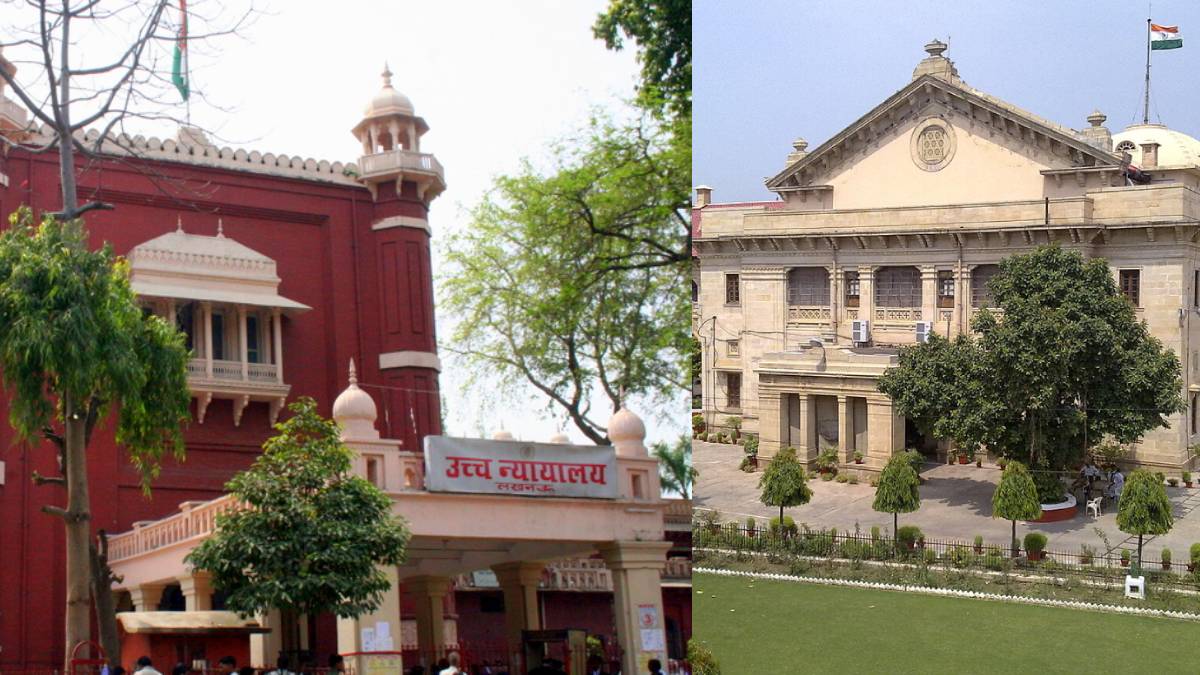
The development comes shortly after a Gujarat court sentenced three men to life imprisonment in a cow-slaughter case, citing the Manusmriti and other Hindu scriptures while discussing the religious significance of cows. The Gujarat court also observed that cows could eventually become extinct if those responsible for slaughtering them were not punished in accordance with the law.
Now, the Allahabad High Court has referred to the Manusmriti while discussing a husband's responsibility to financially support his wife, minor children and aged parents who are unable to support themselves.
In a country that is constitutionally secular, these repeated references to an ancient religious text by judicial authorities have prompted questions and criticism, particularly from people concerned about the relationship between religious traditions and constitutional values.
The Allahabad High Court, in an order dated Oct 22, referred to Chapter XI, Verse 10 of the Manusmriti while hearing a criminal revision petition filed by a woman, seeking enhancement of maintenance awarded by a family court in Kanpur Nagar.
The bench of Justice Praveen Kumar Giri observed that a husband has not only a legal responsibility but also a "pious obligation" to maintain his wife, minor children and aged parents if they are financially incapable of supporting themselves.
The court also referred to the Supreme Court's judgment in Anju Garg and Another vs. Deepak Kumar Garg (2022), in which the apex court held that it is the "sacrosanct duty" of a husband to provide financial support to his wife and minor children.
The Allahabad High Court emphasised that maintenance is a social welfare measure intended to prevent vagrancy and destitution. It subsequently directed the husband's employer, Indian Bank, to deduct 25 per cent of his gross salary, after excluding income tax, and transfer it to the wife's verified bank account. Which was in accordance to what
What Is Manusmriti?
Manusmriti, also known as the Laws of Manu or Manavadharmashastra, is an ancient Sanskrit text belonging to the Dharmashastra tradition. Generally dated to around the second century CE, it contains verses dealing with duties, social conduct, religious practices, marriage, inheritance, punishments, and the social hierarchy.
Although it is an important historical text in the study of ancient Hindu social and legal traditions, it is not a universally accepted religious code followed by all Hindus. Most contemporary Hindus do not necessarily read or follow its prescriptions.
The book has faced extensive criticism for its caste-based hierarchy, discriminatory treatment of certain communities, and patriarchal views on women.
Almost a century ago, Dr. B. R. Ambedkar, the principal architect of the Indian Constitution, publicly rejected the Manusmriti by organising its burning along with his followers.
The burning took place on Dec 25, 1927, during the Mahad Satyagraha movement in Maharashtra. Ambedkar and his followers viewed the text as a symbol of the social discrimination and injustice imposed on oppressed communities.
Even today, Dec 25 is observed by Ambedkarite groups as Manusmriti Dahan Diwas, marking their rejection of caste discrimination and the social hierarchy associated with the text.
The irony of a text that Ambedkar publicly rejected being invoked in contemporary court proceedings is not lost on those who see constitutional equality as the foundation of India's legal system.
It Is Not the First Time
This is not the first time the Manusmriti has entered discussions involving India's judiciary.
In Jun 2023, Gujarat High Court judge Justice Samir J Dave referred to the Manusmriti while hearing a petition seeking permission to terminate the pregnancy of a minor rape survivor who was approximately seven months pregnant.
During the hearing, Justice Dave made oral observations that girls in earlier generations were married at the age of 14 or 15 and would give birth to their first child before turning 17. He also remarked that girls matured earlier than boys and referred to the Manusmriti, advising the lawyer representing the victim's father to read it.
The remarks triggered criticism, particularly because the proceedings concerned a minor rape survivor seeking medical termination of pregnancy.
The controversy continued when Justice Dave, responding to criticism during a subsequent hearing on June 15, invoked the Bhagavad Gita and said judges should remain like a 'Stithaprajna', meaning they should remain unaffected by both praise and criticism.
In another instance, Delhi High Court judge Justice Prathiba M. Singh, speaking at a Federation of Indian Chambers of Commerce and Industry (FICCI) event on August 10, 2022, said Indian women were a "blessed lot" because scriptures such as the Manusmriti gave them a respectable position.
She said "Our scriptures have always given a very respectable position for women and as Manusmriti itself says that if you don't respect and honour women, all the pooja path that you may do has no meaning."
In November 2020, the Madras High Court also discussed the Manusmriti while hearing a public interest litigation concerning VCK leader and MP Thol Thirumavalavan.
The petition sought disqualification proceedings against Thirumavalavan over his remarks about the text and his interpretation of its treatment of women. The court observed that the Manusmriti was not a statute book that had to be interpreted in only one particular way and that people had freedom of expression. The petition was subsequently withdrawn.
Why Is It Causing Sudden Panic Online?
With the right-wing Hindutva ideology increasingly becoming part of discussions surrounding different aspects of social and political life, people are already concerned about the direction in which the country is heading.
From reports of police personnel allegedly describing protesting Muslim women as anti-national to growing public dissatisfaction with sections of the traditional media and its handling of important developments, trust in several institutions has become a subject of debate.
The current government, the Election Commission of India and concerns surrounding the functioning of various public institutions have added to the unease among sections of the population.
For many people, the judiciary remains one of the last institutions through which they expect constitutional protections and democratic rights to be upheld.
BUT when reports emerge of judges invoking ancient religious texts in judicial proceedings, or of judicial observations that appear to rely on historical social practices while dealing with sensitive cases involving women and minors, questions about the separation between personal beliefs, religious traditions and constitutional responsibilities naturally arise.
The issue is not whether an ancient religious text can be discussed or studied. It is whether such texts should be given a place in judicial reasoning in a constitutional democracy where equality, liberty, dignity and justice are guaranteed by the Constitution.
The Allahabad High Court's reference to the Manusmriti was made while discussing a husband's obligation to maintain his family, an obligation independently recognised by Indian law and reinforced by the Supreme Court.
People may disagree over religion, tradition and ideology, but the Constitution is supposed to remain the common ground that protects everyone, regardless of their caste, religion, gender or social background.
When people begin losing faith in the institutions that are meant to protect their rights and uphold the democratic system, the consequences can be far more serious than any individual controversy.
And if people lose hope in all the institutions of a democratic system, where are they supposed to go?
While these are all internet talking points it is important to remember that the law is above all and is unbiased. We cannot guarantee the beliefs and how an individual acts with power, but we must remember that in such situtions, we need to keep everyone in power accountable for their actions and words through collective and sustained pressure







Comments