
A story claiming Christian persecution in Chhattisgarh is gaining traction on social media, alleging that a woman and her daughter were thrown out of their village because of their religious conversion. However, the claims contain several inconsistencies and, so far, lack a verifiable source.
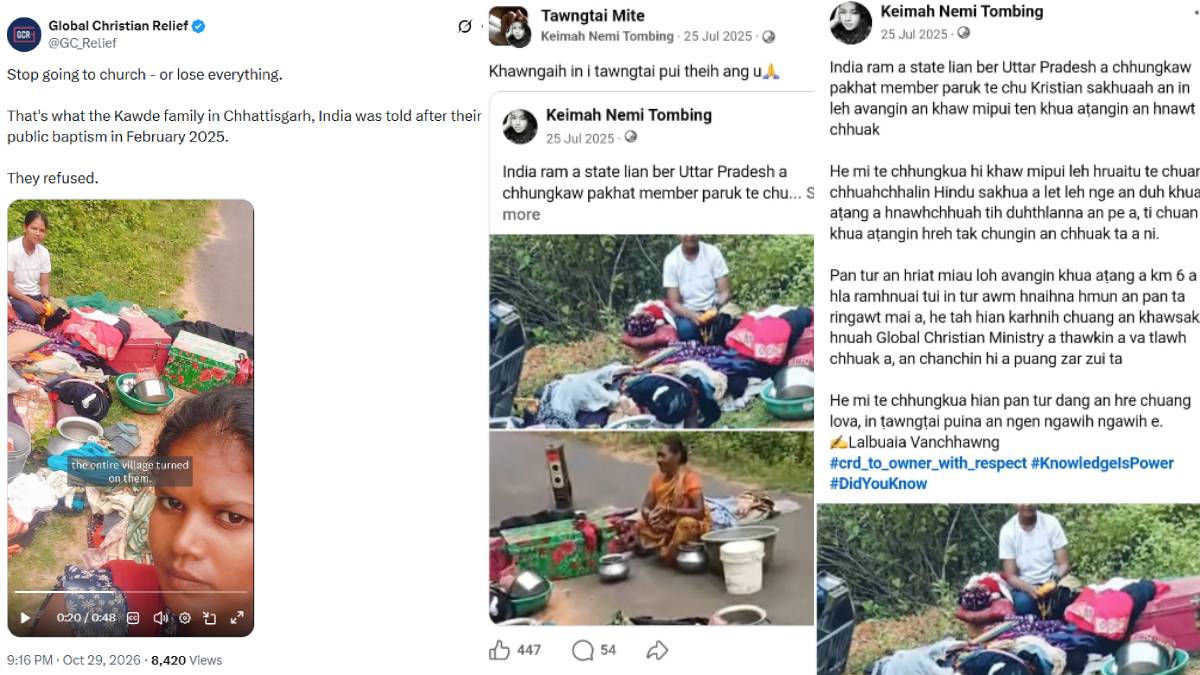
The viral posts have appeared across multiple platforms, including twitter (X), Instagram and YouTube, with identical captions and voice-over videos from the same account.
The posts claim that a family named Kawde was expelled from their village for converting to Christianity, allegedly following a public baptism. However, we could not locate an identifiable original report, police complaint or official statement corroborating this particular incident.
Stop going to church - or lose everything. That's what the Kawde family in Chhattisgarh, India was told after their public baptism in February 2025. They refused. https://t.co/KLynAlgPBI
— Global Christian Relief (@GC_Relief) October 29, 2026
Kawde or Kawardha: Is There a Confusion?
One possible source of confusion is the similarity between the name Kawde and Kawardha, a district in Chhattisgarh's Kabirdham region. Kawde is also a community or surname associated with Maharashtra, Kawardha witnessed a separate incident in May 2025, when a Kerala-based pastor, Jose Thomas, and his family faced alleged harassment and assault by members of Hindutva organisations over accusations of religious conversion.
The family had reportedly been living in the area for around 35 years.
However, that incident is not the same as the one being claimed in the viral video.
There have also been other independently reported cases of Christian families being forced out of villages in Chhattisgarh, including reports from Sukma in April 2025. These incidents must not be confused with the unverified video currently circulating.
Suspicious Video and Recycled Claims
Another suspicious aspect of the viral video is that the original voices appear to have been muted and replaced with a voice-over. While this does not establish that the video is fake, it makes independent verification more difficult.
If the claims are genuine, why are the original voices of the alleged victims not available? Why are the accounts circulating the video not identifying the people involved, the village or the source of their information?
A reverse image search also led us to another Facebook post, reportedly uploaded in February last year, making a similar claim but attributing the incident to Uttar Pradesh and using a different account.
why is the same story being circulated with different geographical details, while the accounts sharing it fail to provide an original source?
We could not trace the original people involved or establish the origin of the video.
Based on the inconsistencies, recycled claims and absence of independently verifiable evidence, the video remains unverified. There is currently insufficient evidence to establish that the particular incident depicted or described in the posts actually happened.
Why Verification Matters
We should be extremely careful before believing everything circulated on social media, especially when a claim is designed to confirm or escalate our existing biases.
Whether it concerns religious persecution, communal violence or discrimination, identifiable sources, original footage and verifiable evidence matter.
Sharing genuine incidents is important, but circulating unverified allegations as established facts can undermine the credibility of genuine victims and documented cases of persecution.
A source is always better than a vague and unprovable claim.




Comments