System, an acclaimed litigation drama by film director Ashwiny Iyer Tiwari, carries an understated tone of tension and emotion to highlight the harsh reality of the legal world that defines our world.
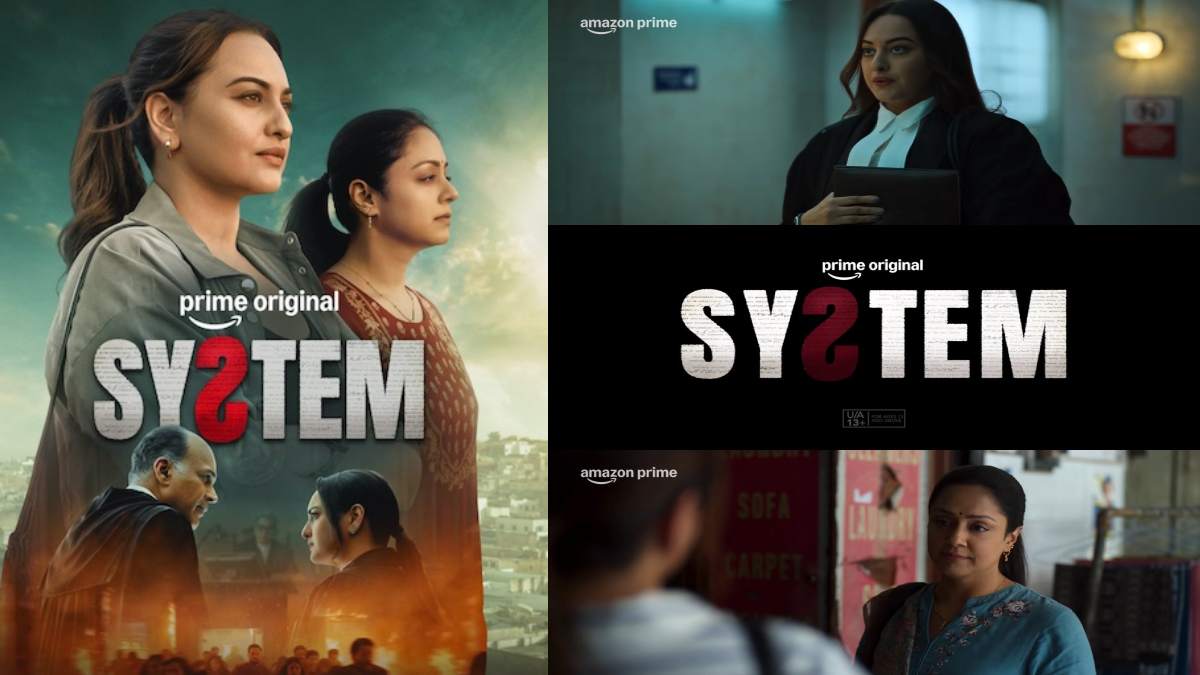
Today it’s on Amazon Prime Video, the Hindi film offers a combination of mystery, family feuds and socio-political commentary, made exciting with some great female performances played by Sonakshi Sinha and Jyotika.
The film is about Neha Rajvansh (Sonakshi Sinha), the tenacious public prosecutor who struggles to find her way in a world where her influential father, Ravi Rajvansh (Ashutosh Gowariker), has become a shadow. Ravi challenges Neha to complete ten cases by herself before stepping into his famed law firm.
Keen to prove herself, Neha embarks on the labyrinthine, complex and morally questionable road which is the courtroom. Neha hires Sarika to increase her own understanding of courtroom cases and people, a very good court stenographer indeed (a role that Jyotika did excellently).
Their emotional anchor in a film as a co-partner. Where Neha solves cases, though, through logic, through ambitions, Sarika brings the down-to-earth insight and emotional intelligence. From beneath the crust and beyond the confines of a courtroom, they start to lay bare truths hidden in the legal system and the police story.

The stakes pick up when Neha takes on a high-profile murder case, but later learns that her father is acting on behalf of the accused. And then that conflict moves the film away from one of pure, savage legal spectacle and into a bigger exploration of morality, privileges, fairness, justice and family relationships.
The underlying truths of the play begin to surface as it progresses, and people sit there on a cliffhanger, staring into the light of day until the end. The screenplay, by Harman Baweja and Arun Sukumar, neatly hides major themes in plain view. Under Ashwiny Iyer Tiwari’s supervision, the reason for each courtroom moment, and every tear-streaked, tear-filled voiceover line, is found in its meaning.
Rather than excessive dramatisation of dramatic climaxes, the movie makes the audience aware of a tension in how these characters interact with or reveal each other. The appearance of the film is visually understated yet effective in tone. But the camera work done by the cinematographer Rangarajan Ramabadran gives a quiet, restrained and controlled appearance to the law world, to a film’s style and to edited films like Tiwari, with Charu Shree Roy at the helm as editor.
The film wraps up the layers of emotional and narrative threads in the end, although for a few viewers, we might feel as if it's relying further on word-based and explanatory dialogues through the climax. One of the movie’s most effective performances is from Jyotika in performance. Sarika’s character also becomes enigmatic, weighty with meaning, her quiet presence a potent one for much of the movie, and with her restrained acting.
Sonakshi Sinha is similarly impressive, and especially impressive in the second half as Neha becomes an adrift lawyer and reluctant, to someone who becomes an agent, confident enough to bring the uncomfortable truth to the surface. In some ways, the supporting actors such as Ashutosh Gowariker, Adinath Kothare and Nishant Singh do an excellent job in this film in multiple aspects of emotional and legal conflicts in the film.
The performances of such characters bring texture to the world of System without drowning in the waters or distracting from its narrative. System is the plot at its heart; system is more than the typical courtroom thriller, isn't it? It also highlights the shortcomings of our legal system itself, which often necessitate the most difficult compromises to attain fairness. It reflects on how class, privilege and personal relationships determine what gets carried out often for those who are least able to see for themselves in court or from behind closed doors, by the end of a process.
At times, even the movie's pace feels relatively slow, but when you realise what it means to be a final act protagonist of the most emotional section of the movie, they will be content. That’s not something we’re quite exposed to watching or taking in any kind of other aspect of film justice.
Ashwiny Iyer Tiwari does this kind of reflective and contemplative legal drama right at the end, so people do remember every time they see the final credits. When it comes to character-driven courtroom dramas that cover courtroom dramas and courtroom drama that have characters with more emotional layers and multiple emotional levels of depth than ever before, System can definitely be worth seeing for them.