
The proposed Delhi-Panipat-Karnal Namo Bharat corridor would improve connectivity between the national capital and several important cities in Haryana. Apart from cutting travel time, regional rapid transit project could also make locations like Sonipat, Panipat and Karnal more attractive to homebuyers, working professionals and real estate developers.
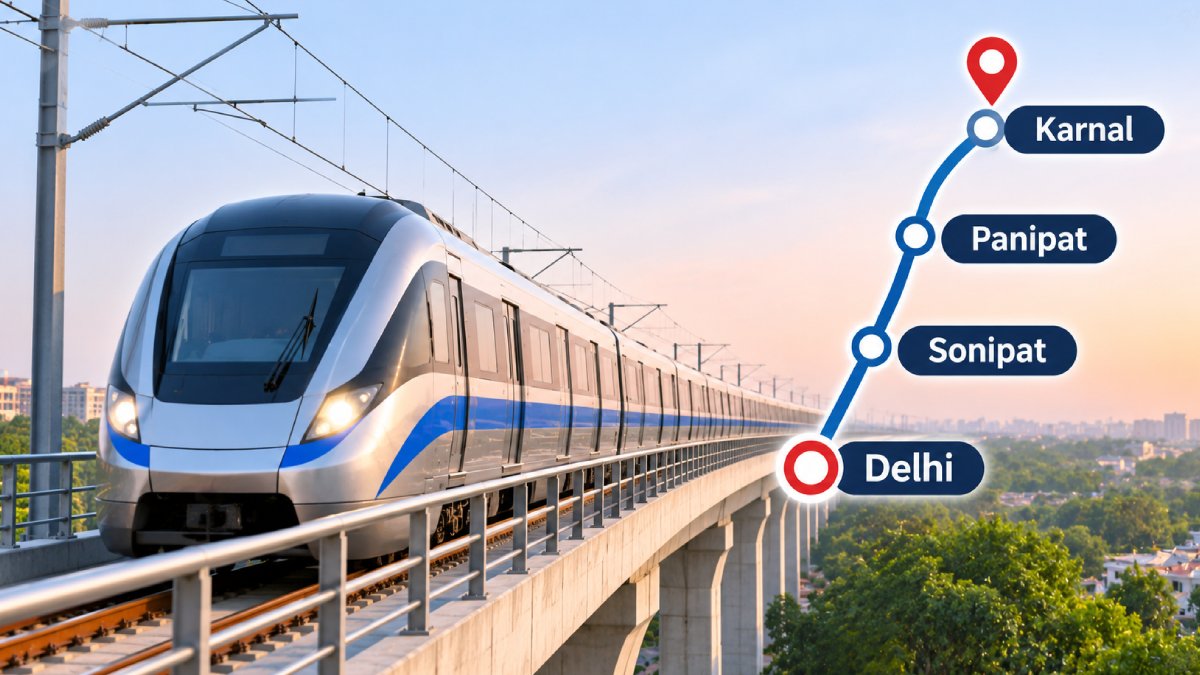
The 136.3 km corridor is being developed by National Capital Region Transport Corporation (NCRTC) as part of RRTS network. The project cost is around ₹33,051 crore and the corridor is expected to be completed by 2030.
The project has received important government clearances (NHAI approval for land use along the alignment), preliminary work on a stretch between Narela and Murthal has also started.
Which Cities Will Benefit From the Namo Bharat Corridor?
The corridor will link Delhi with major urban and industrial centres in Haryana broadly following the Delhi-Ambala highway (NH-44).
The route will pass through several important locations including:
- Narela and Kundli
- Sonipat and Bahalgarh
- Rajiv Gandhi Education City
- Murthal and Ganaur
- Samalkha and Panipat
- Gharaunda and Karnal
The corridor will have 22 proposed stations. It will link residential areas with educational institutions, industrial zones and commercial centres in the region.
Once operational the journey from Delhi to Panipat is expected to take one hour and from Delhi to Karnal could take around 90 minutes.
The Namo Bharat trains are designed to run at a speed of 180 kmph (maximum) and up to 160 kmph (operating speed). Services will run at intervals of about five to ten minutes depending on the final operating schedule.
How Could the Corridor Influence Housing Demand?
Transport connectivity often changes how homebuyers look at locations. Places where you had to take long road journeys to get to Delhi may become more attractive once faster public transport is available.
The Delhi-Panipat-Karnal corridor may open up new possibilities for residential development in North Haryana.
Sonipat, Panipat and Karnal may benefit from increased interest among people working in Delhi and elsewhere in the NCR who are looking for alternative residential locations.
Better connectivity could encourage:
- Greater demand for apartments and residential projects
- Development of integrated townships near proposed stations
- Increased interest from working professionals and families
- Growth in retail, healthcare and educational facilities
- Expansion of commercial and mixed-use developments
However the actual impact will depend on station accessibility, local infrastructure (employment etc), housing available and so on.
Sonipat, Panipat and Karnal Could Gain Real Estate Attention
Sonipat
Sonipat is one of the places where regional connectivity will improve. Delhi, educational institutions and industrial areas are already nearby; so Sonipat is already part of NCR’s expanding urban fabric.
Places like Kundli, Bahalgarh and Murthal may gain interest if the proposed stations provide better access to employment centres and residential areas.
Panipat
Panipat has an industrial and commercial base. Better connectivity with Delhi and Sonipat could make it more accessible to professionals and businesses.
The improved transport link may also stimulate demand for housing, retail space and supporting urban infrastructure.
Karnal
Karnal could benefit from better connectivity to Delhi and other major Haryana cities. Faster travel may make it a more practical residential area for people who want access to NCR employment centres but live outside the capital.
The amount of new demand will depend on the development of transport facilities and supporting infrastructure around the proposed stations.
Haryana's Transit-Oriented Development Policy Adds Momentum
Another important development is Haryana’s decision to bring Delhi-Panipat-Karnal Namo Bharat corridor under its TOD (Transit Oriented Development) Policy.
The Haryana government notified the policy amendment on September 22, 2026. This allows planned development around the proposed transit corridor.
TOD policies generally promote development of residential, commercial and mixed-use spaces near public transport stations. The idea is to create neighbourhoods that are better connected people can get to transport, workplaces and services more easily.
For real estate developers this framework could open up projects near selected stations. It may also facilitate more organised expansion of urban areas along the corridor.
Could better connectivity make housing cheaper?
One of the attractions of North Haryana is that there are residential options outside some of the more expensive locations in Delhi and NCR markets.
Buyers who struggle with property prices in central Delhi or other developed NCR neighbourhoods could look at Sonipat, Panipat and Karnal instead.
However connectivity alone does not guarantee affordable housing prices may go up around areas where there is strong demand (e.g. transport stations).
Buyers will need to compare property prices, travel costs, local facilities and actual distance from their homes to proposed stations before making a decision.
What Could Limit the Real Estate Impact?
Although the corridor has considerable development potential, its impact on the property market will depend on many factors.
The project must happen on time and stations need to be supported by reliable last mile connectivity. Roads, public transport, schools, hospitals and commercial facilities will also be important in attracting residents.
Second, property appreciation isn’t guaranteed. How well individual locations do long-term will depend on actual housing demand; employment growth; and infrastructure development rates.
What’s in store for North Haryana’s property market?
The Delhi-Panipat-Karnal Namo Bharat corridor could be an infrastructure development for North Haryana. Better access between Delhi, Sonipat, Panipat and Karnal may increase residential choices as well as commercial development across the region.
Having the corridor included under Haryana TOD Policy provides another layer of planning support for development around proposed stations.
However the real estate impact will only become apparent as construction continues and the project moves towards operation. For now, the corridor is not a guarantee of property price appreciation it’s just a long-term growth opportunity.





Comments