In a historic discovery for earth science, scientists have detected the seafloor splitting apart and forming new ocean crust in the world’s richest picture yet of a geological process that’s been part of the history of this planet for hundreds of millions of years. It is evidence that scientists can live with in real time the movement of Earth's tectonic plates that separate and create new sections of the ocean floor, but never stop.
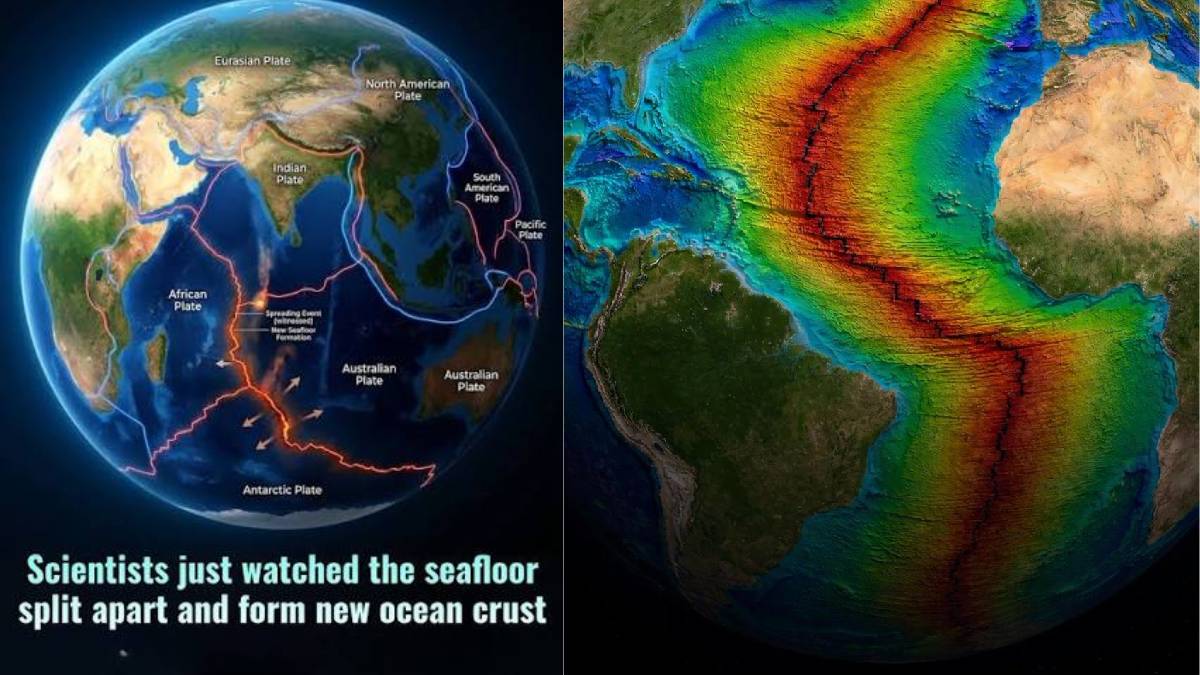
The process of seafloor spreading mostly at mid-ocean ridges, large underwater mountains where tectonic plates drift away from each other. As the plates separate, molten rock, or magma, rises from deep within Earth’s mantle through fractures in the crust. When the magma reaches the ocean floor, it quickly cools in seawater and solidifies into new basaltic rocks, forming fresh oceanic crust.
JUST IN🚨: Scientists just watched the seafloor split apart and form new ocean crust....... mind-blowing! pic.twitter.com/102psVbY5D
— All day Astronomy (@forallcurious) July 14, 2026

Although scientists have known about plate tectonics for decades, the formation of new ocean crust was still extremely difficult to observe because of the extremely deep, high-pressure, and remote ocean floor. Recently, deep-sea robotics, underwater imaging, seismic monitoring, and oceanography have enabled us to observe these dynamic geological events with a new level of detail.
Researchers recorded the movement of the seafloor during the tectonic activity and observed fractures in the crust as magma erupted upward. High-resolution mapping and seismic data revealed new volcanic rock filling the growing gap between the divergent tectonic plates. These observations are very rare and provide a very different verification of long-standing geological models that the Earth is constantly renewing.
The formation of new ocean crust is a fundamental aspect of Earth's geological cycle. While new crust is generated along spreading ridges, older oceanic crust slowly moves away from these areas over millions of years. Some of this older crust eventually gets recycled back to Earth's mantle at subduction zones, where one plate slips beneath another. This continuous recycling process drives plate tectonics and impacts earthquakes, volcanic eruptions, and the long-term evolution of continents and oceans.
And we also have some insight into underwater volcanoes. Hydrothermal vents usually occur near spreading seafloor centers and can feed off of chemical energy coming from the Earth’s interior. Knowledge of how new crust is formed might help scientists understand these strange environments and the organisms that inhabit them better.
The observations, in addition to improving geological knowledge, have practical applications. In particular, a better understanding of tectonic processes can lead to better earthquake and volcanic hazard models, better maps of the ocean floor, and studies on how the Earth's internal heat flow is maintained, as well as research on the distribution of minerals from submarine volcanic activity.
A very modern exploration technology was a key factor in this. Autonomous underwater vehicles, remotely operated robots, high-resolution sonar systems, and networks of seafloor sensors enabled scientists to track geological changes that would have been impossible to see just a few decades ago. These technologies are changing our understanding of Earth’s least explored environment—the deep ocean.
The study also shows how dynamic our planet is. While the movement of tectonic plates is as fast as the growth of human fingernails each year, large volcanic and tectonic events can abruptly change the seafloor. The study takes an opportunity to verify scientific theories with actual observations.
It will be years to come, and so much more interesting to understand what forces of the ocean are at work on Earth's surface. With every new observation, we can learn more about plate tectonics, volcanic activity, and how the planet has changed since its formation billions of years ago.
The discovery of new ocean crust forming beneath the sea is another step towards Earth science being able to observe the planet's most fundamental geological processes in real time with modern technology.