A new political development in Pakistan’s volatile Balochistan region has attracted attention after Baloch nationalist leaders declared independence from Pakistan and started referring to a proposed entity as the “Republic of Balochistan” or “Democratic Republic of Balochistan.”
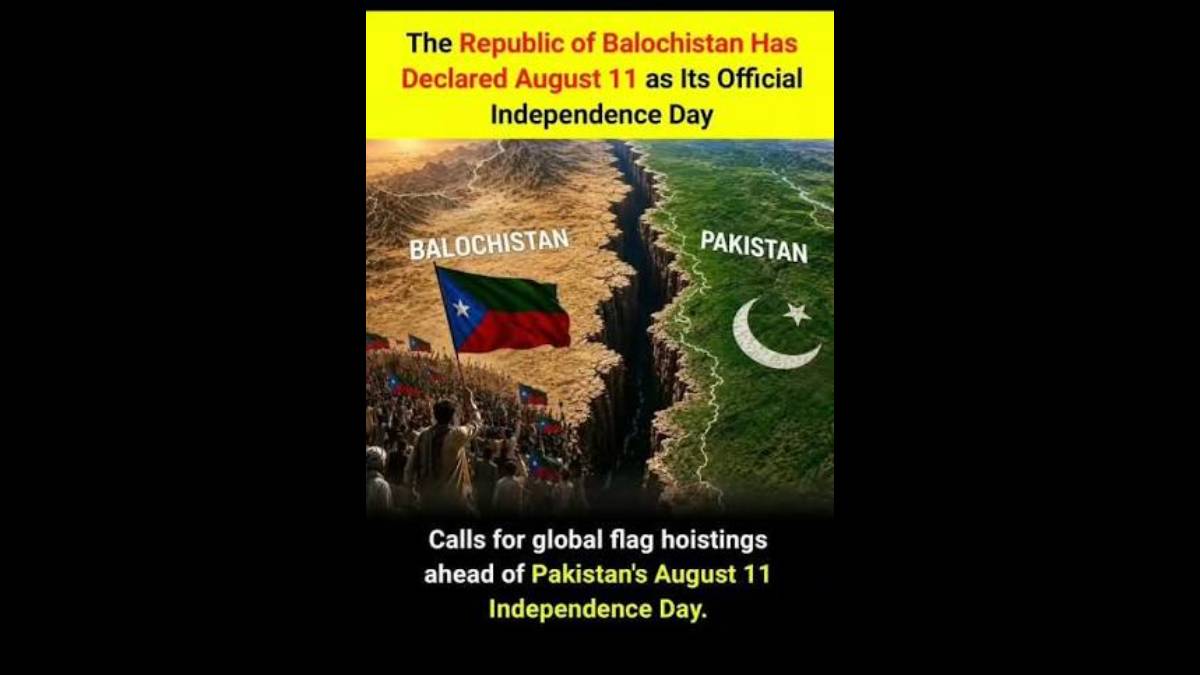
But the declaration was inextricably linked to Baloch writer and separatist activist Mir Yar Baloch, who declared independence in May 2025 and called for global recognition of Balochistan as a sovereign country. He also appealed to India and the United Nations for help, the Times reported at the time.
The development came at a time of increased tension between India and Pakistan after the Pahalgam terror attack and India’s subsequent military response, Operation Sindoor. In this context, Mir Yar Baloch expressed his support for India’s stance on PoK.
Baloch said in a social media post on May 14, 2025, that Balochistan supported India’s call for Pakistan to vacate PoK. The statement placed the Baloch independence campaign directly in the context of other political tensions between India and Pakistan.
The Baloch independence declaration, however, has to be viewed as a separatist political claim and not as an internationally recognised change in sovereignty. Pakistan still has control over Balochistan, and the proposed Republic of Balochistan is not recognized as a sovereign state by India, the United Nations, or any other international organization.
According to the reports, after the declaration, Mir Yar Baloch sought the United Nations to recognize Balochistan as an independent nation and called for international assistance. His requests were for UN involvement and financial assistance in setting up institutions for the proposed state to be governed by the proposed nation and so on, his letter said.
The issue has roots in a much longer Baloch nationalist movement. The Baloch separatist groups have accused Pakistan’s central government and security forces of political repression, enforced disappearances and human rights violations for decades. Pakistan, meanwhile, considers armed separatist groups operating in the province as threats to national security.
Balochistan is Pakistan’s largest province and is strategically significant due to its natural resources and location on the Arabian Sea. It includes Gwadar, a key port that is part of the China-Pakistan Economic Corridor (CPEC). The province’s importance as a strategic entity has made the Baloch conflict of Pakistan’s internal politics more than just a domestic political issue.
The independence declaration also attracted much attention on social media, with the phrase “Republic of Balochistan” trending and images of proposed flags and maps of an independent Baloch state spread widely.
At the same time, it is important to distinguish social media declarations and statements by individual activists from formal diplomatic recognition. The United Nations has not recognised a sovereign Republic of Balochistan. Reports on the issue also noted that the declaration was not made by an internationally recognised government.
The UN position after the declaration was that the organization is to defend the sovereignty and territorial integrity of its member states, including Pakistan. This means the declaration has not changed Balochistan’s status under international law.
For India, the Balochistan issue has long been part of its wider criticism of Pakistan’s record on human rights and its approach to separatist movements. But India has not formally recognised the so-called Republic of Balochistan.
But these recent statements highlight the growing international reach of Baloch independence movements. To seek UN recognition and publicly state India’s position on PoK, Baloch nationalist figures have aimed to attract global attention to their political demands.
The development is also important because of its timing. Relations between India and Pakistan have come under pressure for years on terrorism, Kashmir and cross-border security. Any political movement in Pakistan that openly challenges the country’s territorial integrity is therefore likely to draw more international attention.
So far, the "Republic of Balochistan" is still an unrecognised separatist project and not an established state. But the declaration has revived the political discussion regarding Balochistan’s political future, Pakistan’s internal security as well as its geopolitical rivalry with India, Pakistan and China.
The Baloch independence movement's next challenge will be to turn political declarations and international appeals into tangible diplomatic recognition and political legitimacy. Until that happens, Pakistan will continue to exercise sovereignty over Balochistan, and separatist leaders and activists will continue to campaign for independence.
The issue will continue to be closely watched as developments in Balochistan intersect with Pakistan’s internal security and, more broadly, South Asia’s political dynamics.