Bumble bees are not elegant, but they are far more sophisticated than their clumsy reputation suggests. A new study has revealed that these fuzzy pollinators recognize and respond to rhythmic patterns, and have a new dimension to insect intelligence, challenging long-held beliefs about the cognitive abilities of small-brained animals.
Bumble has long been referred to as an awkward movement, in light of their seemingly unsteady flight, but bumble bees are actually the most competent pollinators in nature. Their ability to navigate complex environments, find flowers, and return to their nests has fascinated researchers for decades. And yet, their newly discovered sense of rhythm adds yet another new talent to their growing repertoire.
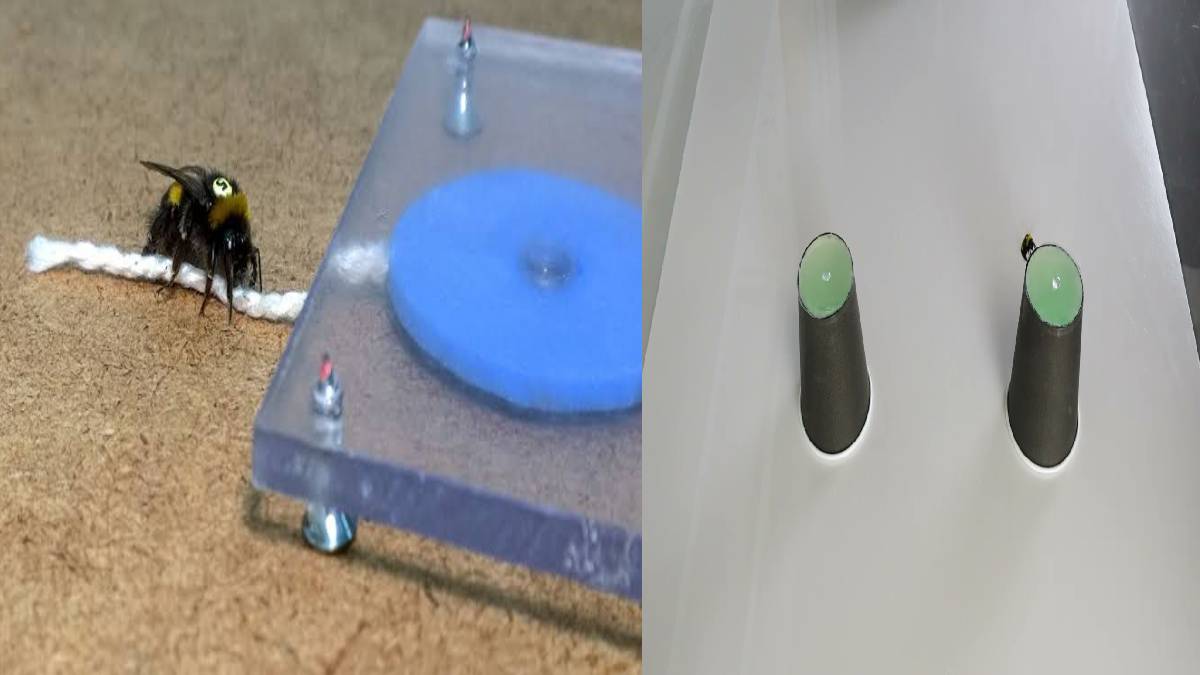
Researchers studying bumblebee behavior designed experiments to test if the insects could detect and respond to rhythmic sequences. Experiments on the bees showed that with repeated visual and sensory patterns of events, the insects were able to predict recurrent signals and not just respond randomly. This suggests that bumble bees are able to see patterns in time, a skill that more advanced learners are known to understand.
Rhythm perception is widely accepted to be a rare talent in the animal kingdom. Humans are used to moving with music, but some birds, marine mammals, and other species have found a similar ability. Finding that rhythmic sensitivity in insects is highly likely to be widespread in life has also broadened the understanding of how common this ability can be across life forms.
The findings are particularly interesting because bumble bees have very small brains with fewer than one million neurons. On the contrary, the human brain has 86 billion neurons. Yet bees are managing to do memory, learning, navigation, and decision-making with remarkable efficiency in this incredibly small brain.
Researchers believe rhythm recognition may be advantageous when foraging. Flowers often have visual, scent, and timing cues in common that repeat with each other. A bee that is able to recognize these could recognize and return rewards for flowers more efficiently, save energy, and collect more pollen during each tour. And that is good for bees and plants that depend on them for pollination.
The research raises other interesting questions about bees' communication. Honey bees, for example, dance a waggle dance in order to communicate with food suppliers. But bumble bees communicate in vibrations and body movements to communicate with their colonies. In this way, rhythm is now being investigated.
This finding is just one of the pieces of evidence to suggest that insects have quite advanced cognitive abilities. Animals have been shown to solve simple puzzles, distinguish between different shapes and colors, learn from observation, remember efficient routes between flowers, and even recognize human faces in controlled laboratory settings. And bees are also shown to behave in a way that resembles optimistic and emotional states after receiving rewards.
In addition to expanding our knowledge of insect biology, our findings could have applications in technology. Engineers designing autonomous robots and drones often study insects as they have very efficient navigation and little computational power. Learning how bumble bees process rhythmic information could inform new robot algorithms and drones for robotics, artificial intelligence, swarm coordination, and environmental sensing.
The study also adds to the urgency of conserving pollinator populations. Bumble bees are critical for maintaining landscapes by pollinating wild plants and crops. But habitat destruction, pesticide exposure, climate change, and new diseases continue to threaten many bee species worldwide. We need to protect them not only for biodiversity but also for global food security.
Researchers insist that many aspects of bee cognition are still not well understood. Every discovery has shown that intelligence is not dependent on brain size but on how efficiently nervous systems process information. Bumble bees, with their tiny brains and seemingly awkward flight, have shown that sophisticated behavior can evolve in unexpected ways.
This week, we discovered that bumble bees are more than just the clumsy flyers of nature. What is so great about one of the world’s most familiar and indispensable insects is how they have rhythm, something we are only starting to see with our eyes and understand about their rhythm.