China has completed the world’s biggest 582-tonne superconducting magnet, a landmark engineering accomplishment that should play a crucial role in China’s push to develop an “artificial Sun” through nuclear fusion. The massive magnet is destined for a new generation of fusion research facilities to make clean, virtually limitless energy possible by replicating the same process that powers the Sun.
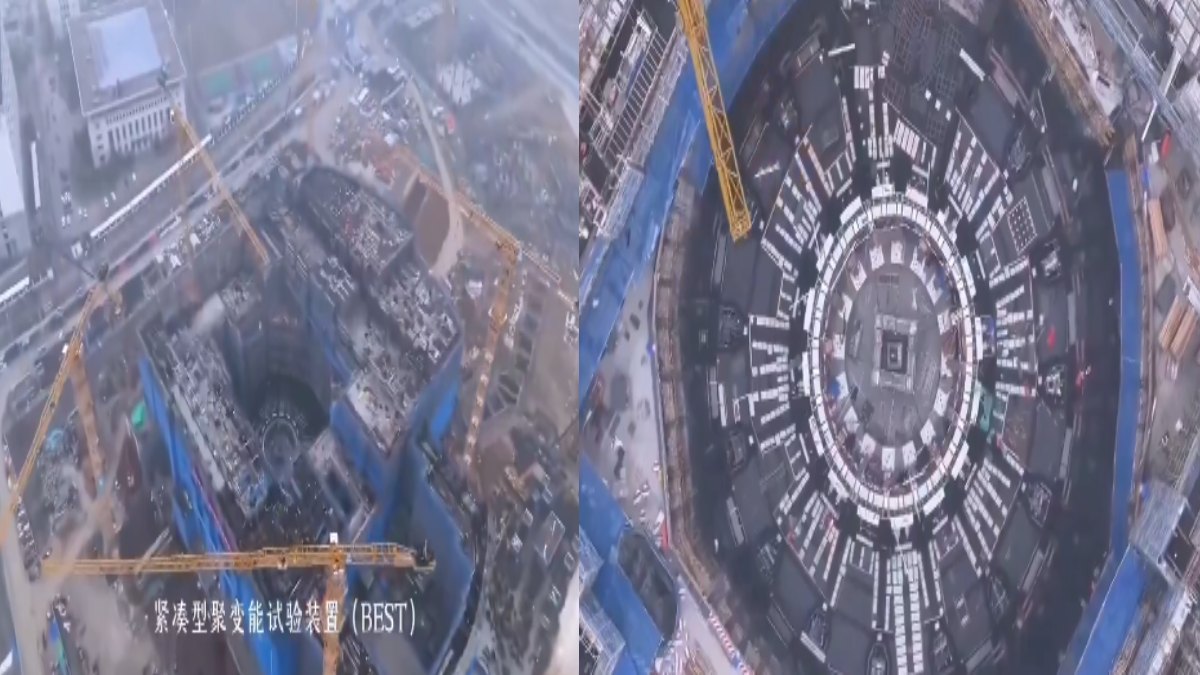
The newly constructed magnet is one of the most complex and powerful superconducting systems ever built. Superconducting magnets are an essential component of fusion reactors because they produce highly magnetic fields capable of containing plasma heated to temperatures hotter than 100 million degrees Celsius. There is no physical material to hold the plasma at such high temperatures, so magnetic confinement is the only practical solution for maintaining fusion reactions.
Unlike conventional nuclear power plants that produce electricity via nuclear fission (the splitting of heavy atoms), nuclear fusion is performed by combining light atomic nuclei (typically isotopes of hydrogen) to produce enormous amounts of energy. This is the same process that naturally occurs inside the Sun and other stars. Scientists say if fusion is maintained efficiently on Earth, it could provide a nearly unlimited supply of electricity with little greenhouse gas and significantly less long-lived radioactive waste than conventional nuclear power.
The 582-tonne magnet is developed to help one of China’s most advanced fusion research projects, and it is known as an ‘artificial Sun’ project since it aims to recreate the energy-production processes in stars. Such a huge magnet and engineered precision is a challenge to build a practical fusion reactor. All components must be capable of operating at high temperatures, strong magnetic fields, and mechanical demands.
Superconducting magnets differ from conventional magnets in that they are cooled to extremely low temperatures through cryogenic techniques. In such conditions, superconducting materials conduct electricity with almost zero resistance, resulting in an exceptionally powerful magnetic field with relatively little electrical energy. This is crucial to maintain stable plasma confinement during fusion experiments.
China has been investing in fusion research for the past decade, in line with other major powers trying to commercialize fusion power generation. The country has already achieved several milestones at its EAST (Experimental Advanced Superconducting Tokamak), where high-temperature plasma has been maintained for record periods of time. The giant magnet will be part of the next phase to improve plasma stability, reaction times, and finally to show sustained fusion power generation.
The race to develop commercial fusion energy is on the rise, with the United States, the United Kingdom, Japan, South Korea, France, and the European Union investing billions in research. International collaborations such as the ITER project in France are working to prove the feasibility of large-scale fusion reactors. Private companies are also investing in the field and designing new reactor designs for commercial use.
Nuclear fusion is one of the most promising long-term solutions to meet global energy demands while reducing dependence on fossil fuels. Fusion fuel is abundant, mostly from hydrogen isotopes such as deuterium, and the process itself does not produce carbon dioxide emissions during electricity generation. If it is commercialized, fusion electricity could help to provide renewable energy sources like solar and wind power to keep them going at night and in the sun.
Despite the progress of the scientific community, there are still big technical challenges to overcome before fusion becomes commercially viable. Maintaining stable plasma for long periods, improving energy efficiency, developing durable reactor materials, and ensuring economic competitiveness remain important challenges. Large-scale engineering projects such as China’s new superconducting magnet are the stepping stones to overcome these hurdles.
#China has completed a giant 582-ton magnet. The goal is an "artificial sun" for infinite energy. pic.twitter.com/du86Rwg1rU
— Mina (@Mina696645851) July 27, 2026
Scientists worldwide have welcomed continued investment in fusion technology because international progress is beneficial for clean energy research. In a research program, breakthroughs made by one research program will often result in valuable knowledge that is useful to the global scientific community as a whole through cooperation, collaboration, and technological innovation.
China’s successful construction of the 582-tonne superconducting magnet is not only a technical achievement but also an investment to build future energy technologies as countries look to find sustainable alternatives to conventional power generation. Although the commercialization of fusion is not a given, milestones like this bring scientists to the next level in the development of safe, abundant, and low-carbon energy that is fueled by the Sun’s power.