China has made another step in further developing its commercial space programme with the successful launch of the Gravity-1 (Y4) carrier rocket from the East China Sea.
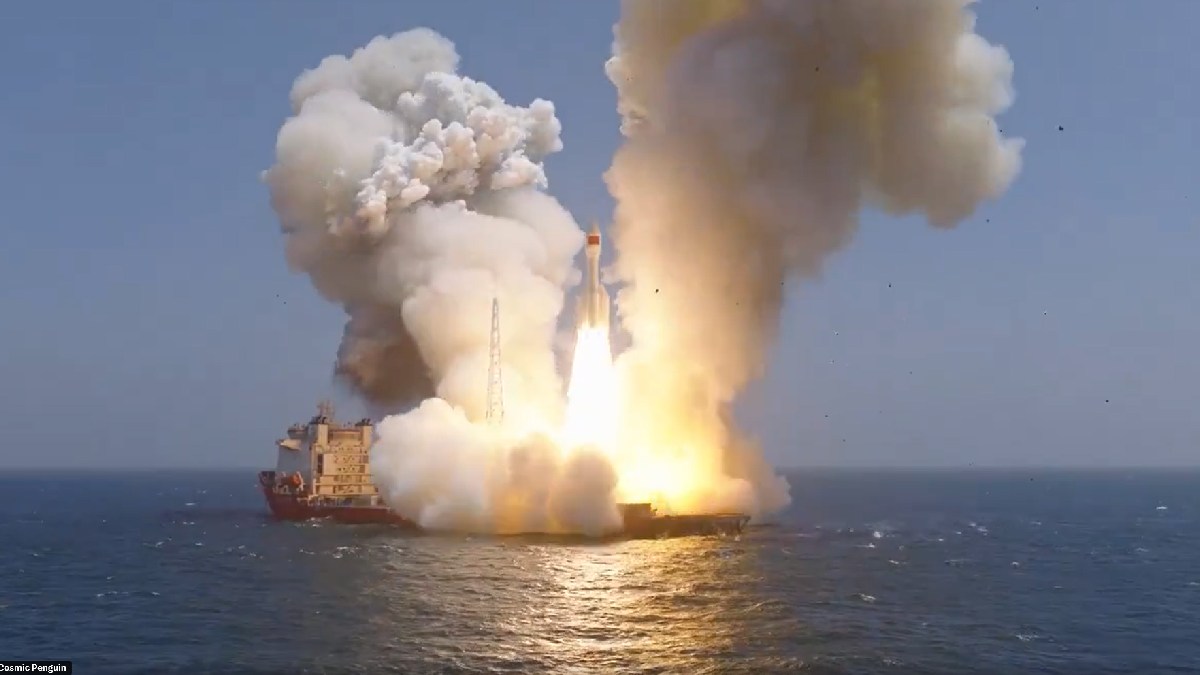
Orienspace, a private aerospace company, successfully launched nine satellites to their orbits and became the third successful Gravity-1 mission and its first to launch from the East China Sea.
The rocket lifted off at 10:54 a.m. Beijing Time from a specially designed offshore launch platform east of Shanghai. As per Taiyuan Satellite Launch Center, all nine satellites separated successfully and went on their orbits.
The rocket also carried an experimental payload, further demonstrating the versatility of the rocket for commercial and scientific purposes.
Orienspace was one of the country's first commercial launch companies to develop launch vehicles with the increasing global demand for satellite deployment.
Gravity-1 China's Powerful Commercial Launch Vehicle
Gravity-1 is one of the most powerful commercial solid-fuel rockets in the world. The launch vehicle is about 30 metres tall and has a three-stage solid-fuel platform with four powerful strap-on boosters. It can carry up to 6.5 tonnes into Low Earth Orbit (LEO) and 4.2 tonnes into Sun-Synchronous Orbit (SSO) for communications, Earth observation and scientific satellite missions.
The rocket first made waves as it became China’s most powerful privately developed commercial rocket in January 2024. Orienspace has since continued to enhance the rocket’s performance and reliability with a number of successful missions.
Orbital launch No. 170 of 2026 🇨🇳🚀9🛰️
— Space Intelligence (@SpaceIntel101) July 22, 2026
Gravity-1 | Orienspace | Jan 11 | 0530 UTC
Orienspace successfully launched the most powerful all-solid-motor Gravity-1🚀 from the swimming launch platform Dongfang Hangtiangang in the Yellow Sea, near Haiyang port, taking 9🛰️to LEO.…
Why is it important for East China Sea launch
This recent mission is especially important because it is the first Gravity-1 launch from the East China Sea and among the closest orbital launches ever conducted near Shanghai. Moving launch operations offshore offers several operational and safety advantages.
The sea-based launches allow engineers to choose more efficient flight paths while avoiding populated areas. Offshore launch sites also remove the restrictions of land-based spaceports and allow for greater flexibility on different orbital missions.
With satellite launches from commercial and domestic launch sites increasing around the world and a growing number of space-based launch platforms in development, mobile launch platforms will play an increasing role as they are expected to play a more and more important role.
China has been steadily expanding its sea-launch capability over the past few years and offshore missions are a good practice to boost launch frequency without putting additional strain on its inland launch facilities.
Strengthening China's Commercial Space Industry
The successful Gravity-1 mission demonstrates the increasing investment China is making in commercial aerospace. Orienspace and other private companies LandSpace, Galactic Energy, and Space Pioneer are developing more advanced launch systems to meet the country's growing space ambitions.
The Chinese government has encouraged private participation in the aerospace sector, with the goal of encouraging innovation in the aerospace industry, to boost domestic innovation and increase competitive advantage in the international launch market.
Commercial rockets will help to support the deployment of satellite constellations for broadband internet, remote sensing, navigation services and scientific research.
Looking Ahead
With another successful mission completed, Gravity-1 is still one of China’s most reliable commercial launch vehicles. The launch from East China Sea reflects not only the maturity of the rocket, but China’s growing expertise in offshore space missions.
With the increasing global demand for satellite launches around the world, successful missions like Gravity-1 will strengthen China’s standing in the commercial space industry, and open the way for more advanced sea-based launch operations to take place in the years to come.