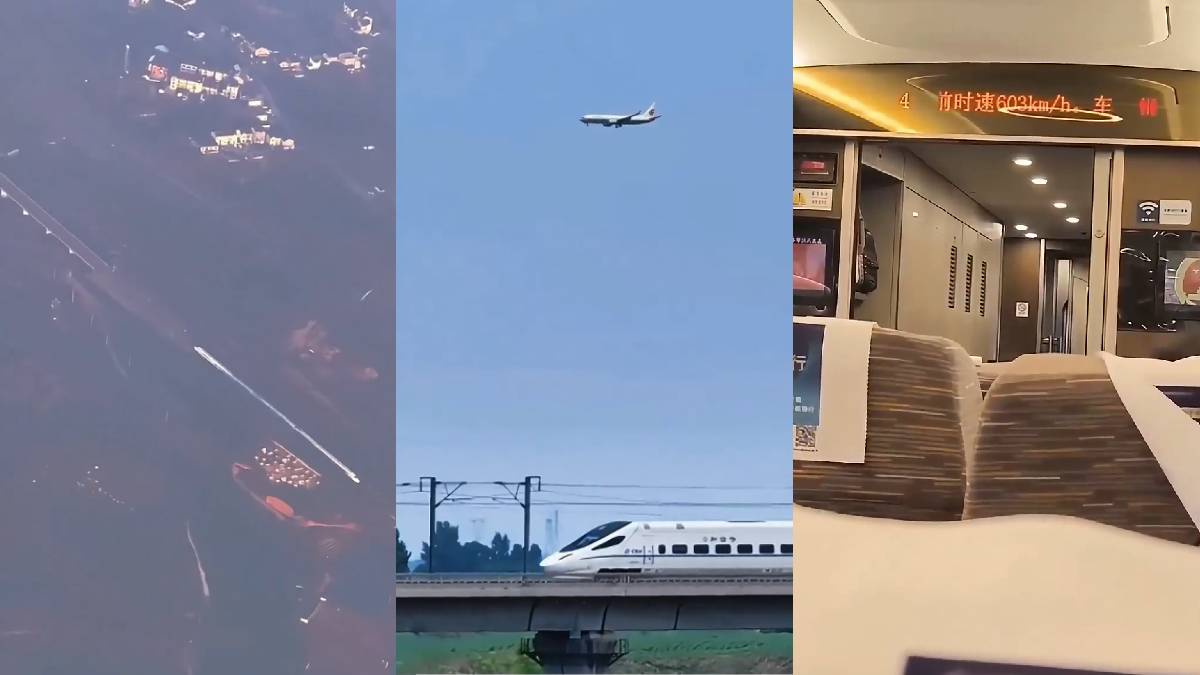
China’s high-speed rail network is among the greatest examples of how advanced transportation technology can be turned into an everyday service. Trains with speeds of around 350 km/h enable passengers to work, have coffee, read, use their devices, or just sleep while traveling between major cities.
The experience can seem so ordinary to passengers, but the engineering infrastructure that supports it is anything but that. The railway behind a high-speed train running smoothly at hundreds of kilometres per hour is a vast system of tracks, bridges, tunnels, signalling systems, electrical infrastructure, stations and periodic maintenance.
China’s high-speed rail network is now well over 50,000 km long, a massive transportation infrastructure constructed over years. The scale of the network is important because the high-speed operations must be maintained with a common framework for tracks, signalling, rolling stock, power systems and safety.
The trains are only one part of this technological ecosystem. At speeds exceeding 350 km/h, railway engineers have to deal with aerodynamic resistance, vibration, braking performance, energy consumption and passenger comfort. Even small improvements in these areas can be significant if multiplied over thousands of daily train services.
The next step in this development is the CR450, a new high-speed train technology being developed in China. The project is being built at commercial operating speeds of around 400 km/h. These are not so much the case of adding a more powerful propulsion system but rather the need for improvements in train design and railway infrastructure.
China’s high speed trains travel at around 350 km/h while passengers work, have coffee or sleep as if they were on a regular commute.
— Harsh Mariwala (@hcmariwala) September 16, 2026
The scale behind that experience is remarkable. China’s high speed rail network now extends beyond 50,000 km, supported by an immense system of… pic.twitter.com/KEQuNlTDiH
Aerodynamics becomes more critical as speed increases because air resistance increases substantially. Engineers must therefore optimise the shape of the train while balancing noise, pressure and energy consumption. Braking is another big engineering challenge; however, to slow a train at almost 400 km/h will take sophisticated systems and an integrated infrastructure.
The same is true of the energy efficiency issue. Higher speeds typically require more energy, and better train propulsion, aerodynamics and overall train efficiency is necessary if faster services will continue to be feasible. Passenger comfort must also be considered since the increase in speed can amplify vibration, pressure change and noise.
The development of the CR450 therefore reflects the wider principle of technological evolution. Innovation is not about achieving the most number of people. A 400 km/h train is only useful if it can be delivered safely, efficiently and comfortably.
This is also what makes China’s high-speed rail system remarkable from a broader infrastructure perspective. The visible part of the experience is the train moving rapidly between cities. The less visible part is that the whole system is reliable enough to make it a part of daily life so passengers can view it as part of their daily life routine.
For many travellers, the technology eventually disappears into the background. Passengers don’t need to think about signalling systems, power supply, track geometry, aerodynamic engineering or braking calculations while sitting in their seats. They simply board, travel and arrive at their destination.
The transformation—from complicated technology to everyday life—is one of the most important measures of technological maturity. The future might seem distant as a laboratory-like idea or engineering prototype. But when the technology is reliable enough for millions of people to use every day, it starts to become less like the future, and more like everyday life.
China’s high-speed rail expansion and the development of the CR450 highlight this evolution. The headline numbers—50,000-plus kilometres of network and a potential commercial speed of around 400 km/h—are impressive. But the bigger achievement is the infrastructure, engineering and operational discipline needed to convert those numbers into a reliable transportation experience.