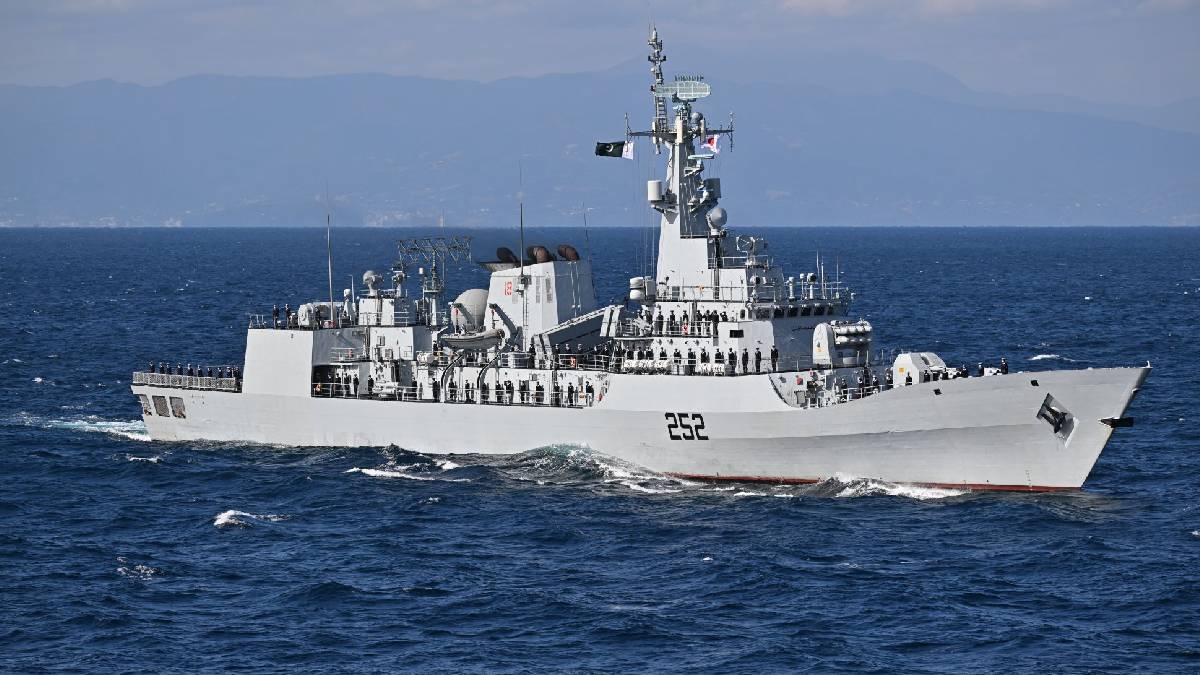
A Pakistan Navy ship collided with an Indian Navy warship in international waters in the North Arabian Sea on September 15, which has led India to call Pakistan’s Charge d’Affaires to a strong diplomatic protest. Pakistani navy sources said the Pakistani vessel sustained damage and had to return to its port.
According to Indian sources cited in various reports, the Pakistani ship approached the Indian Navy warship at high speed while the Indian vessel was carrying out a routine surveillance mission in the North Arabian Sea. The Pakistani ship reportedly manoeuvred in what Indian authorities described as an unsafe and unprofessional manner before the two vessels collided.
The Pakistani vessel was identified in the reports as the Yarmook-class vessel PNS Hunain. A source said it sustained damage and was seen to be heading towards a Pakistani harbour. The Indian Navy vessel did not suffer damage and continued its mission.
The exact extent of the damage to the Pakistani vessel has not been independently established in the available official statements. The damage was severe according to some reports and India’s Ministry of External Affairs says the incident did not lead to any major damage. This is important as the official report on both vessels is awaited.
The incident quickly moved from the maritime domain into the diplomatic sphere. On September 16, India called Pakistan’s Charge d’Affaires in New Delhi and sent “a strong protest” to the Ministry of External Affairs about the conduct of Pakistani naval forces at sea. The MEA said the behaviour was “unacceptable and unprofessional.”
The MEA said that the incident occurred in international waters. India also said that the Pakistani naval ship's conduct was in complete violation of Article 10 of the April 1991 Agreement between India and Pakistan on advance notice of military exercises, manoeuvres and troop movements.
The Pakistani Charge d’Affaires was directed to inform the relevant authorities in Pakistan of the need for military units to take care and follow the provisions of relevant agreements between the two countries to prevent such incidents in the future. India also instructed its Charge d’Affaires in Islamabad to lodge a similar protest with Pakistan’s Ministry of Foreign Affairs.
The collision occurred on September 15 when the Indian warship was on routine surveillance duty. The manner of the Pakistani ship's approach, its manoeuvres and the exact point of collision will still be examined.
The incident comes at the same time that India-Pakistan relations are already very sensitive. Any interaction between military vessels of the two countries in international waters is well-managed because of the potential impact on maritime safety and regional security.
There is currently no official indication that the collision resulted in casualties. The Indian ship continued to sail after the accident, the reports also say. The return of the Pakistani ship to the harbour is being monitored to see if there is any damage.
The diplomatic protest indicates that New Delhi is treating the incident as a matter that needs to be clarified. More specific information from Indian and Pakistani officials could shed light on the vessels involved, the damage done and the reasons for the collision.
Now the facts are that a Pakistani naval vessel and an Indian Navy vessel collided in international waters in the Arabian Sea; India summoned Pakistan’s Charge d’Affaires and New Delhi filed a strong protest. The extent of the damage to the Pakistani vessel is not yet known and is in stark contrast to the MEA’s initial view that the incident did not damage the Pakistani vessel that much.