China’s Xinjiang region is taking a major leap toward the future of agriculture by using robots with artificial intelligence in huge cotton fields—a sign that technology is changing one of the world’s largest cotton-producing regions. Cameras, sensors, autonomous navigation systems, and laser technology are helping farmers track crops, optimize chemical use, and do tasks that have never been done by humans.
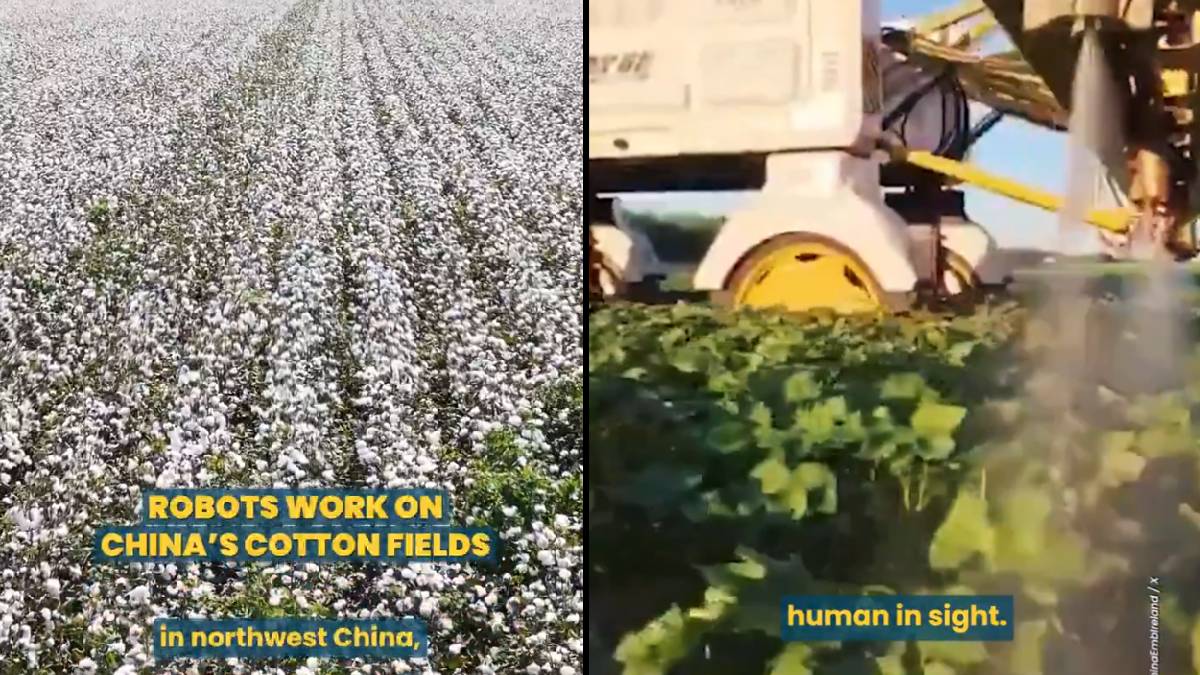
Over cotton farms in Shawan City, autonomous agricultural robots take over cotton farmers’ crops and manage more than 100,000 hectares of farmland each day. With cameras on board and sensors to track the fields and farmers’ environment to make quicker and more accurate decisions, the AI-driven machines collect real-time information about crop health, plant growth, soil conditions, and field environments.
Across cotton fields in Shawan City, in China's Xinjiang region, intelligent agricultural robots equipped with cameras, sensors, and autonomous driving technology are managing over 100,000 hectares of cotton — collecting real-time crop data, calculating precise pesticide and… pic.twitter.com/0dXeecXKDv
— Interesting Engineering (@IntEngineering) July 14, 2026
One of the robots’ most important duties is precision spraying. Instead of spraying pesticides or fertilizers in a uniform manner in each part of the whole field, the autonomous systems will measure the exact amount of pesticides in every part of the farmland to minimize chemical waste and production costs and promote healthy crop growth.
The robots are also incredibly efficient. A single autonomous machine will cover more than 6.7 hectares per hour, which is well above the productivity of conventional farming. Since the machines operate independently, a single technician can control up to five robots at the same time, reducing labor and improving efficiency.
Another breakthrough is a laser-topping robot developed by Xinjiang University in cooperation with agricultural technology company EAVision. Cotton topping (the removal of a plant's terminal bud) is a critical step in cotton cultivation because it encourages the plant to feed more nutrients to cotton boll production rather than to keep growing taller.
Usually, topping is done manually or by mechanical equipment, and both methods involve great labor and can damage plants. This laser robot is completely different.
The lidar, machine vision, and artificial intelligence will allow the robot to identify the terminal bud of each cotton plant and navigate the fields on its own. The bud is detected with a high-powered blue laser that vaporizes the bud without touching it. The system will be able to accurately identify buds with 98.9% accuracy and can work almost ten times faster than manual labor.
Computer vision and laser accuracy are key for the robot to do delicate agricultural tasks in a way that does not damage leaves or stems. This precision will help crop consistency, will not require seasonal labor to do some work, and will produce more.
Xinjiang has already become one of the world’s most mechanized cotton-producing regions. About 90 percent of the cotton harvest in the region is now machine-picked, and AI-driven field management technologies are moving cotton farming closer to complete automation—from planting and monitoring to crop management and harvesting.
The bigger picture for these technologies is creating a fully digital agricultural landscape. Artificial intelligence helps farmers monitor crop health throughout the entire process, and autonomous machines reduce human work and increase productivity. Coupled with satellite images, drones, Internet of Things (IoT) sensors, and cloud-based analytics, farmers can optimize irrigation, fertilization, pest control, and harvesting on a scale that has never before been achieved in agriculture.
They say precision agriculture can produce better food and fiber production at lower water consumption, fertilizer use, fuel costs, and greenhouse gas emissions, too, as well as fewer greenhouse gas emissions by using more efficient methods, such as precision agriculture. Automated systems also produce big datasets that allow scientists to study crop performance in different environmental conditions.
Agricultural automation has had a huge impact on the productivity of the workforce to begin with, but the rapid adoption of automation also raises broader questions. With robotics and AI more prevalent on farms, there would be fewer workers needed to maintain equipment and software and perform data analysis and data management. Agricultural policymakers and educators must prepare workers for new roles in this ever-changing agricultural environment.
And yet, Xinjiang's AI-driven cotton fields are a glimpse of the future of agriculture. Robotics, artificial intelligence, computer vision, and precision agriculture will be more and more dependent on autonomous systems to do complex tasks with exceptional speed and accuracy.
China’s investment in smart agriculture demonstrates how technology is changing one of humanity’s oldest industries. From laser-guided crop management to autonomous field monitoring, Xinjiang’s cotton farms show how AI and robotics could transform agricultural productivity, sustainability, and efficiency in the decades to come.