# Chinese Students Build and Test Drones at School: Could Indian Classrooms Be Next?
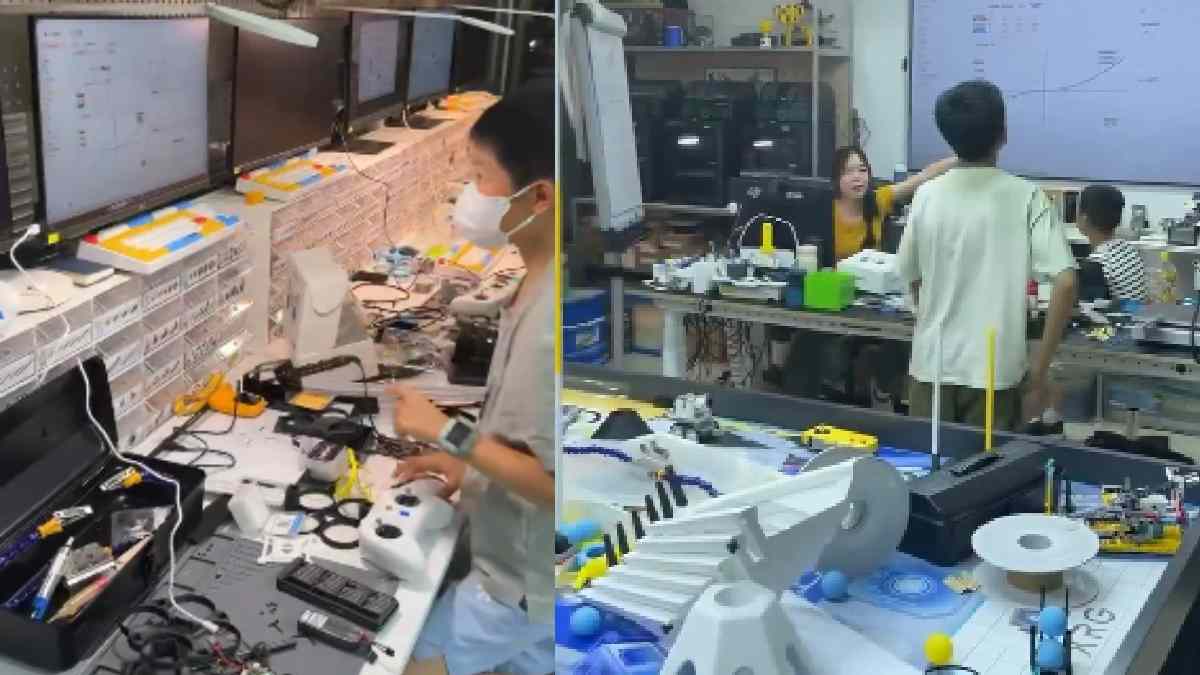
Students in China are getting an early introduction to drone technology, where schools are designing, building and testing unmanned aerial vehicles as part of their learning. The development has raised questions on the Internet about whether similar hands-on technology education might be more common in Indian schools.
A post in Chinese social media shows Chinese students working with drones at a school. We have seen them on social media and its message and images show that students can learn valuable engineering and technology skills long before they leave college.
Instead of just reading and writing about technology education in textbooks, there should be projects like drone building that are hands-on and can integrate science, mathematics, electronics and computer programming.
Students who build a drone will have to understand motors, batteries, flight controllers, sensors and communication systems.

Testing drones can also teach students how to program and problem-solve. Even a simple flight experiment must have errors identified, designs changed and how different components play a role in performance.
This type of project-based teaching can instill curiosity and give students experiences with technology used in the real world.
The discussion is important for India, where drones are becoming more prevalent in agriculture, logistics, infrastructure inspection, photography and defence.
And drone education and skills development is also being encouraged in the country as the technology becomes more critical.
If drone-building projects become more accessible in Indian schools, students could potentially develop technical skills at an earlier age.
School laboratories could provide controlled environments where students learn about aerodynamics, electronics, coding and robotics through supervised experiments.
Chinese students are designing and testing drones at school. 🇨🇳
— India Plus (@india_plus_) September 2, 2026
Imagine if this became normal in Indian schools too. 🇮🇳
The future is being built early. pic.twitter.com/V5g9TnPhkG
But putting drones in schools would require the proper infrastructure, trained teachers and safety regulations. Schools would need age-appropriate equipment and clear rules governing where and how drones can be operated. The objective would be education rather than just flying the devices.
The bigger question is how schools should prepare students for a technology-driven future. Many careers will look to emerging fields like artificial intelligence, robotics, drones and automation to be a factor in the future in the coming years.
Students are not only going to be able to test those technologies in the classroom, but can also use them in practice.
China’s school drone activities have thus prompted a wider conversation about technology education. For India, the idea could serve as inspiration for expanding hands-on STEM learning, particularly through school innovation labs, robotics clubs and supervised engineering projects.
The future of technology may not start at the workplace or university campus.
For students learning in the school laboratory and developing their own ideas, students may get their start in the classroom and can test, refine and improve them.