The race to create smarter, more capable humanoid robots has recently taken a major step forward. Figure AI has shown that its new humanoid robot, Figure 03, powered by the company’s advanced Helix AI system, can now jog at about 2 meters per second in a very smooth, human-like manner.
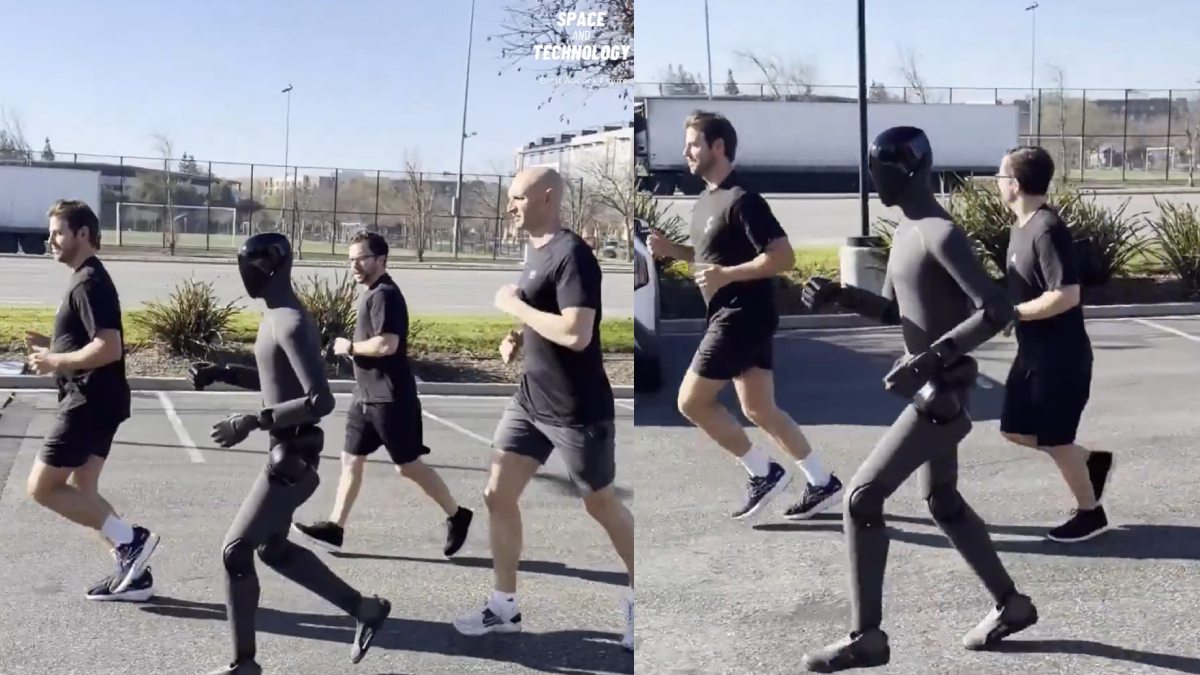
It is not just a speed mark. It exemplifies how robotic mobility is now a product of artificial intelligence; machines can move easily, maintain balance, and work in changing environments with human agility.
A Leap in Robotic Movement
Unlike traditional robots with rigid pre-programmed movements, Figure 03 uses Helix AI to coordinate complex body mechanics in real time. Every stride involves constant changes to posture, balance, joint angles, and foot placement.
Running is one of the most challenging tasks for humanoid robots because it requires the two feet to leave the ground for a moment while staying stable when landing. Helix AI can process sensor data fast enough for Figure 03 to make these split-second corrections and still maintain a fluid running motion.
At around 2 meters per second (about 7.2 km/h or 4.5 mph), Figure 03 shows a pace appropriate for fast walking and light jogging, bringing humanoid robots closer to humans.
How does Helix AI make it possible?
Helix AI is the robot's central intelligence system, combining machine learning, computer vision, motion planning, and reinforcement learning in a unified control framework.
Instead of following some set movement scripts, the AI continuously interprets the data from the sensors on board (camera and joint sensor) to predict the robot's next move. This allows Figure 03 to adapt to uneven surfaces naturally, stay balanced in acceleration, and also to recover from small disturbances without any human attention.
The AI also optimizes energy usage by optimizing movements to minimize unnecessary movement and maintain speed and stability.
Why Human-Like Jogging Matters
It is a game changer to have a robot that can jog smoothly.
Humanoid robots with agile mobility could work alongside humans in warehouses, manufacturing facilities, hospitals, and logistics centers. Robots move faster to transport items, respond to changing conditions quickly, and work in environments designed for people.
Emergency response is another interesting application. Robots that can run over rough terrain would help in disaster relief, search and rescue, or hazardous industrial environments where human safety is at risk.
The same technology would also be advantageous for home robotics: natural movement allows robots to navigate stairs, hallways, and cluttered living spaces better.
Figure 03, powered by Helix AI, can now jog with a smooth, human-like running style at speeds of about 2 meters per second.
— Space and Technology (@spaceandtech_) July 13, 2026
Shared by Figure AI CEO Brett Adcock earlier this year, the robot learned to run through reinforcement learning instead of relying on pre-programmed… pic.twitter.com/LPDipR0Tr7
The Increasing Competition in Humanoid Robotics
Figure AI is in an increasingly crowded robotics field that is producing advanced humanoid machines. Industry leaders are investing heavily in AI-powered locomotion, dexterous manipulation, and autonomous decision-making to develop robots that can actually perform jobs in the real world.
As AI models become more sophisticated, robots are expected to move from controlled demonstrations to reliable deployment in workplaces and eventually homes.
Figure 03’s jogging demonstration illustrates how artificial intelligence is accelerating this transformation. There are still hurdles to widespread commercial adoption related to safety, cost, and scalability, but the rapid pace of innovation suggests that humanoid robots are becoming more and more realistic.
Looking Ahead
Figure 03's ability to naturally jog at about 2 m/sec is another big milestone in humanoid robotics. Powered by Helix AI, the robot shows the growing capabilities of AI-driven motion control and autonomous mobility.
Researchers will continue to build on robotic intelligence and mechanical designs, with the goal of faster, more adaptable, better-designed robots that can work in harmony (and safety) with humans in the future. The latest demonstration is a glimpse of a future where robots are not just confined to labs but are part of our everyday lives.