A snake sample believed to be the first such remains of science in more than 140 years is finally unearthed.
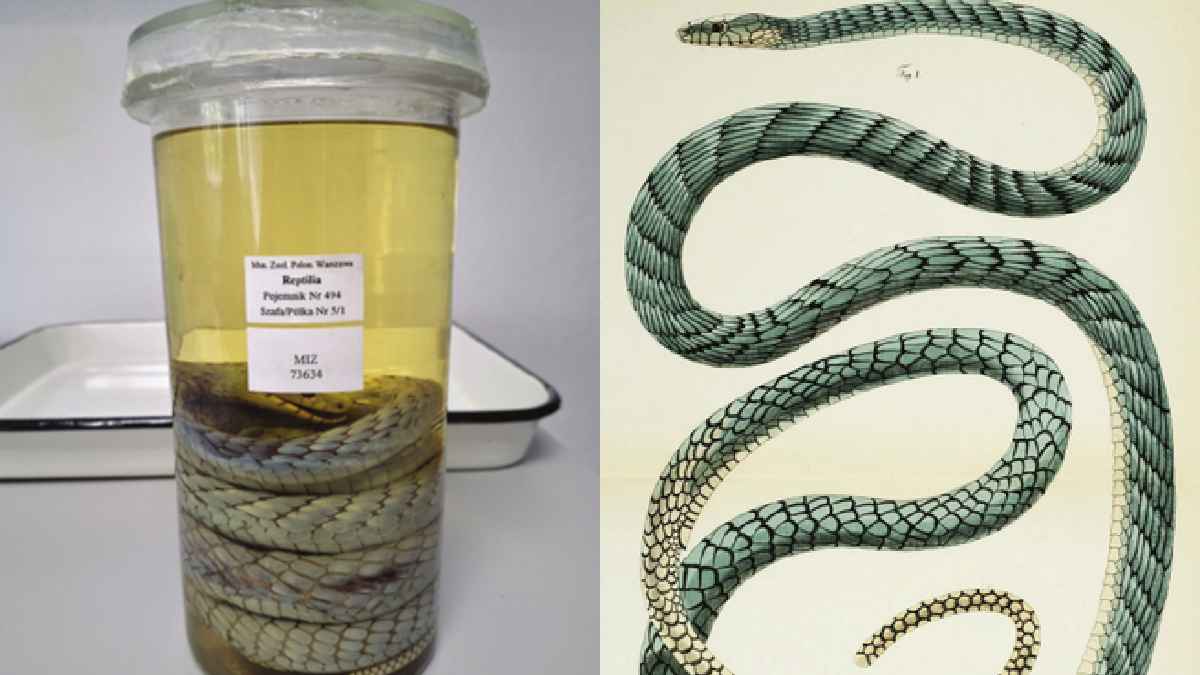
Scientists have recovered a rare green mamba collected on Sao Tome Island in 1885, long after the specimen was thought to have disappeared from scientific records.
The snake was collected by the Portuguese naturalist and botanist Adolfo Frederico Möller when he was working on Sao Tome. It was later studied by the Russian zoologist Jacques Vladimir von Bedriaga who examined and described the specimen.
However, over the years its location was not known, and researchers consider it to be a “lost” specimen.
Now the mystery has turned. Scientists discovered the preserved snake in the collections of the Museum and Institute of Zoology of the Polish Academy of Sciences in Warsaw.
The specimen, which we refer to as MIZ 73634, was found during the work of studying historical reptiles collected from Sao Tome and Principe.
It was still preserved in a jar and the historical labels we used to identify it were just as crucial as the name itself for us to know the reason why it was so important to us and how it was found.
The discovery is significant because the history of Sao Tome's green mamba specimens has been particularly difficult to trace.
Other specimens associated with the island were lost during the turbulent events of the 20th century, including World War II. So Bedriaga’s specimen became one of the missing pieces in the history of the snakes of the island.
Even more impressive is the fact that it survived in a Polish museum because many scientific collections were destroyed during the war in Poland. But despite the destruction, fires and chaos in the Warsaw Uprising, this particular specimen was kept in the museum's collections.
But it’s the rediscovery that is not just the old snake in a jar that is making researchers reconsider, in this case, what kind of species the specimen belongs to.
Bedriaga had identified the snake as the eastern green mamba, the Dendroaspis angusticeps. But later researchers questioned that identification and thought that this specimen might be related to the western green mamba, the Dendroaspis viridis.
Now modern science could allow for a better analysis of the specimen. Comparisons with modern green mambas and in some cases genetic analysis may provide clues about the snake's identity and its association with other populations.
There’s also an even larger mystery surrounding green mambas on Sao Tome. To this end, researchers are still looking to determine whether the island’s historical population was a unique species, a separate island population of an already known species, or a group that may have disappeared.
The findings were published in Annales Zoologici in April 2026 and scientists had a chance to go back to see a specimen that had disappeared for generations.
The story suggests the unexpected value of natural-history museums. Collections can hold specimens whose scientific significance may not be fully understood at the time.
One snake collected in 1885 survived in museum collection and has now been brought back to scientists’ attention.
What was once seen as a “ghost” specimen could therefore be an important clue in solving a long-standing mystery surrounding the green mambas of Sao Tome.