Russian Security Council Deputy Chairman Dmitry Medvedev has issued an attack on Germany’s current leadership and accused Berlin of “forgetting” the outcome of World War II and going toward what he called the “Nazi ways” of its predecessors. The remarks are just the latest in a growing spat between Moscow and many European governments as relations between Russia and the West continue to deteriorate.
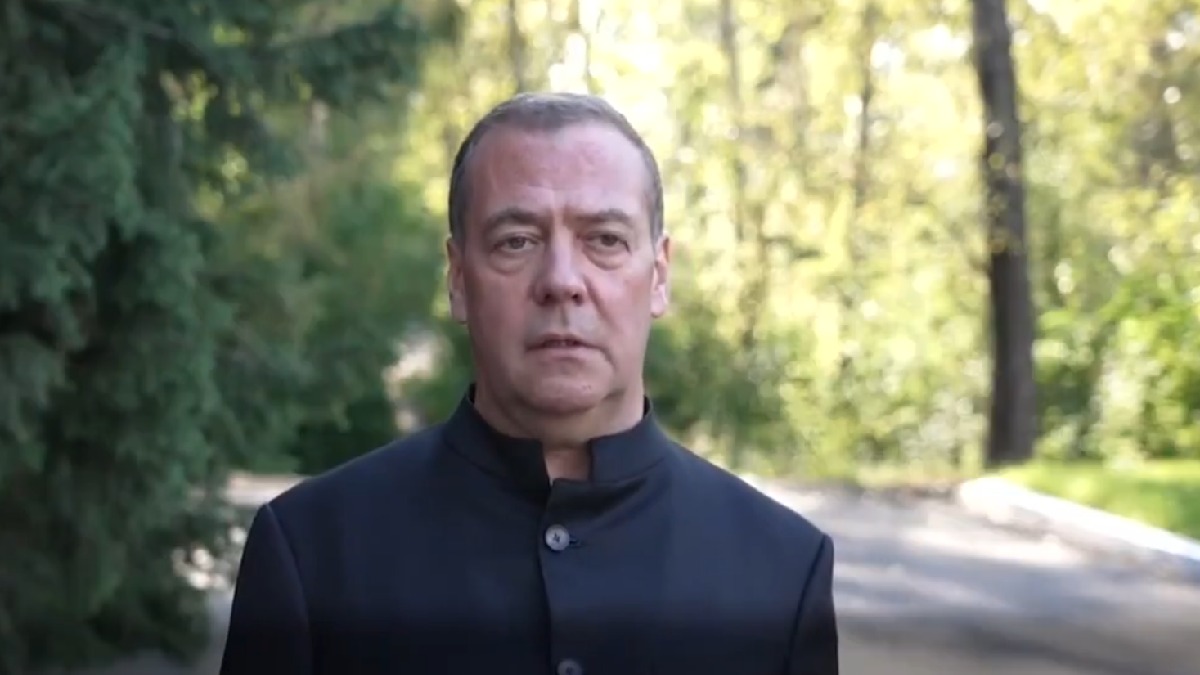
Medvedev made the comments in response to questions from Russian television channel RT during a visit to Russia’s Siberian Federal District. His comments were later made public by Russian state news agency TASS. The former Russian president and prime minister has frequently used strong language when criticizing Western governments and has emerged as one of Moscow’s most outspoken voices on relations with Europe.
Medvedev said Germany’s current political leadership has moved in a direction that he thinks is in line with the country’s post-war policy. The federal chancellor and members of the chancellor’s staff were “continuing to do the ‘sad work’ of earlier generations of German leaders,” he said.
Medvedev said Berlin was moving towards what he called a process of “forgetting the results of World War II.” The development was particularly surprising to him because, in his view, Germany had appeared to be in a very different position in the relatively recent past.
The Russian official also claimed that there may be links between current German political figures and those from previous generations. Some of the current leaders might have familial connections to people from previous generations and others are ideological leaders. Medvedev didn't provide any specific evidence for those claims in the remarks reported by TASS.
He went on to say that Germany’s leaders were acting like “neo-Nazis” and that they were trying to oppose Russia through various methods. These statements are Medvedev’s image of the German leadership and part of Moscow’s broader criticism of Berlin’s policies towards Russia.
Medvedev escalates criticism of Berlin
Medvedev’s comments come at a time of deteriorating relations between Russia and Germany. Berlin has taken a firm stance against Moscow since the beginning of the Russia-Ukraine war, while Russia has repeatedly criticised Germany's support of Ukraine and its broader alignment with European and NATO policies.
Germany has also been one of the major European countries involved in efforts to support Ukraine politically, economically and militarily. Moscow has consistently portrayed such measures as evidence of an increasingly hostile Western policy towards Russia. Berlin, on the other hand, has rejected Moscow’s framing of European support for Ukraine as an act of aggression.
The reference to World War II has particular historical and political significance in Russia. The Soviet Union suffered severe losses during the war against Nazi Germany, and victory against Nazi Germany has been a key part of Russia’s national history. Russian officials have used the legacy of the Second World War repeatedly to condemn European governments that Moscow believes are taking an adversarial approach.
Medvedev’s remarks therefore connect present-day Russia-Germany tensions with one of the most sensitive chapters in European history. By accusing Germany of returning to “Nazi” behaviour, he tried to frame Berlin’s present policy in terms of Germany’s wartime history.
The comments also reflect the general deterioration of political relations between Moscow and Western capitals. Official statements from both sides have more and more often been accusations, warnings and references to historical events as relations have gotten worse.
Germany’s current political system is, of course, radically different from the Nazi regime that ruled the country between 1933 and 1945. Medvedev’s comparison is a political accusation rather than an established description of Germany’s constitutional order or its present government.
But his remarks demonstrate how much historical memory still shapes the political discourse between Russia and Germany today. World War II has been a key reference point for Moscow’s messaging, especially when Russian officials are trying to criticize European governments.
German relations with Russia have undergone a pretty drastic transformation in recent years. Economic, diplomatic and security ties that once formed important parts of the European political landscape have been severely affected by the war in Ukraine. Berlin’s growing cooperation with its European and NATO partners has also contributed to Moscow’s criticisms.
🇷🇺⚔️🇩🇪 Medvedev reminded Germany of the lessons of history and urged against provoking confrontation with Russia
— dana (@dana916) September 3, 2026
"The current leadership of Germany, the Federal Chancellor, and a number of his officials have embarked on a path of forgetting the results of World War II," Dmitry… pic.twitter.com/NAUIVhj5Qo
Medvedev’s latest comments are therefore unlikely to be considered in isolation. They are part of a growing trend of increasingly harsh statements from Russian officials towards Germany and other Western countries.
As tensions between Russia and Europe continue, historical references will be at the heart of political messaging on both sides. Medvedev’s accusation that Germany is “forgetting” the outcome of World War II shows how much the legacy of the war is still engrained in contemporary political disputes.
The latest words also reveal how the language around Russia’s relationship with Germany has become far more hostile. How such rhetoric contributes to further diplomatic friction or remains part of Moscow’s broader political messaging will depend on how relations between Russia, Germany and the wider European bloc develop in the weeks ahead.