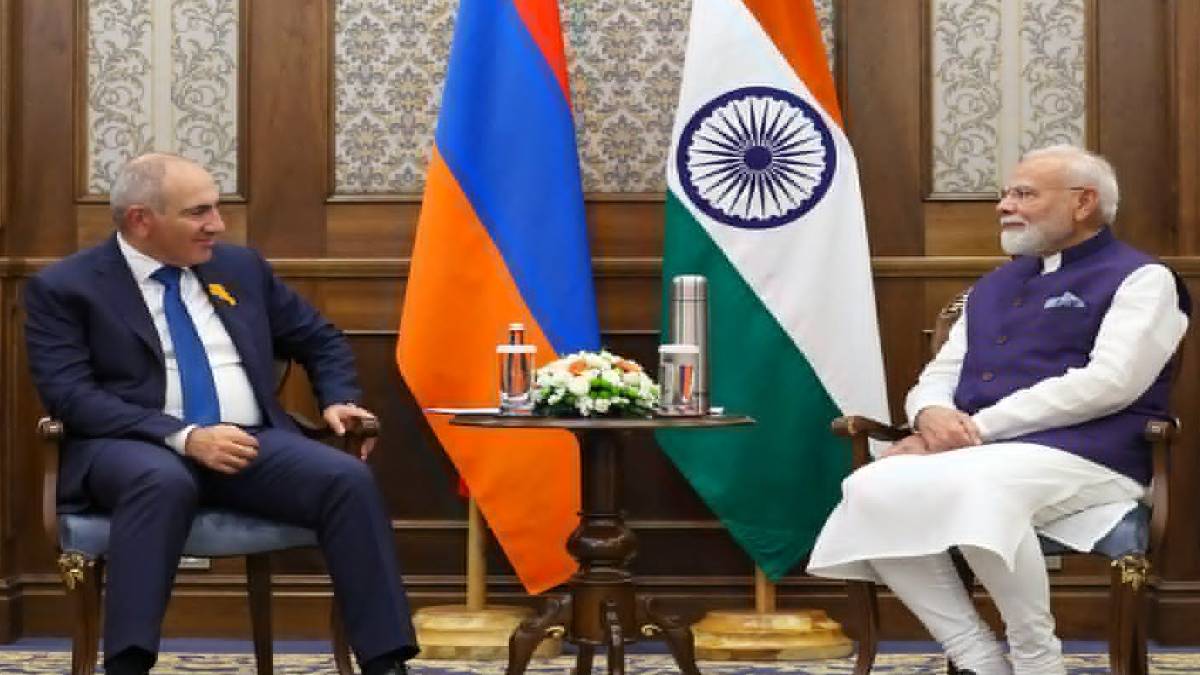
Narendra Modi’s meeting with Armenian Prime Minister Nikol Pashinyan on the sidelines of the Shanghai Cooperation Organisation (SCO) Summit in Bishkek has highlighted the rapidly increasing strategic relationship between India and Armenia. While the meeting is diplomatic, defence cooperation has become one of the most important pillars of the bilateral relationship.
Armenia has increasingly turned to India for military equipment as it tries to diversify its defence partnerships. In recent years, the country has purchased a growing number of Indian-made defence systems, including Akash air-defence systems, Pinaka multi-barrel rocket launchers, artillery guns, Swathi weapon-locating radars, drones and anti-drone systems.
The scale of the relationship is big. Armenia has emerged as one of India’s largest defence export destinations, according to the Indian Council of World Affairs. Armenia has signed defence deals worth about US$2.2 billion over the past six years, covering several Indian systems, it says.
Among the most interesting deals were India’s Akash air-defence systems. Armenia was the first foreign customer for the indigenous system after an agreement of about US$700 million in 2022. The deal was a huge step in India’s defence-export goal as Akash is a domestically developed surface-to-air missile system to counter aerial threats.
The partnership is not limited to missiles. Armenia has also acquired India's Pinaka multi-barrel rocket launcher system developed by the Defence Research and Development Organisation (DRDO). Pinaka is a high-volume rocket artillery capability and is one of India's most attractive defence exports.
Another major component is the Swathi weapon-locating radar. Armenia awarded an order for the system in 2020, and deliveries were completed by 2022, according to the Indian Council of World Affairs. Swathi helps detect incoming artillery, rocket, and mortar fire and helps locate the location from which enemy weapons have been launched.
India's artillery systems are also in Armenia's procurement portfolio. Armenia has purchased the Advanced Towed Artillery Gun System (ATAGS) and MArG 155mm self-propelled howitzer, expanding the range of Indian-made equipment being used by the Armenian armed forces. Armenia has also acquired drones and anti-drone equipment from Indian manufacturers.
The relationship has developed because Armenia has been keen to diversify its military suppliers. The turbulence in the South Caucasus (most notably the Nagorno-Karabakh conflict) pushed Yerevan to look beyond its defence relationships. India has become one of the countries willing to provide a wide range of military equipment.
India's more active role in Armenia's defence procurement also signals a larger shift in New Delhi's defence-export planning. For decades, India was mostly known as one of the world’s major arms importers. But in recent years it has been trying to become a defence manufacturer and exporter.
India's defence exports reached ₹38,424 crore in FY2025-26, according to the Ministry of Defence figures cited by India Today, with Indian defence products reaching more than 80 countries.
Armenia’s ability to play a bigger role in this strategy goes beyond individual contracts. It’s a major overseas customer for all kinds of Indian weapons systems, not just parts or spare parts. Reports have mentioned Armenia as one of the biggest buyers of finished Indian defence equipment like Akash, Pinaka and 155mm artillery systems.
This is why the latest Modi-Pashinyan meeting is held in the context of an ever-fostering defence relationship. The two countries also maintain cooperation in areas beyond military procurement, such as diplomacy, trade, technology and people-to-people relations.
As for India, the Armenia partnership was a chance to prove that indigenous defence technologies can compete in the international market. In Armenia, a wider and more diverse supplier base is available through cooperation with India.
The growing defence relationship also has wider geopolitical implications. India's growing engagement with Armenia is emblematic of New Delhi's growing diplomatic and strategic reach in the South Caucasus. With Armenia’s procurement decisions, we see the country’s push to build a more diversified defence network.
PM Modi's meeting with Pashinyan is more than a diplomatic one. It comes at a time when India-Armenia defence cooperation has developed into a very robust strategic partnership with Indian-made systems ranging from air defence and artillery to radar, rockets, drones and anti-drone equipment.
Armenia would remain a valuable market and strategic partner for India as India’s defence industry expands internationally. This shows that India’s own defence manufacturing drive is now more and more translating into long-term partnerships beyond the country’s traditional sphere of military cooperation.