Tokyo Metro is testing a new AI-based system that makes crowded trains easier to navigate for commuters.
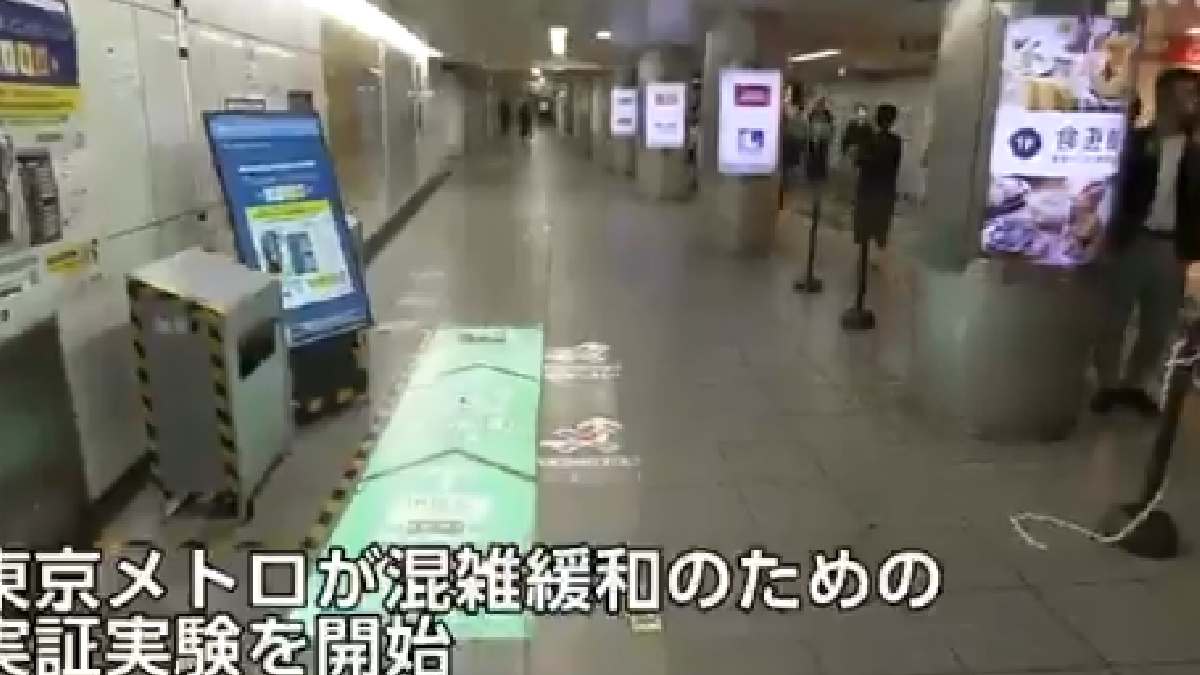
The technology will be implemented at Kita-Senju Station on the Chiyoda Line, and passengers will be shown in advance which coaches are less crowded and thus easier to navigate through projections on the floor of the station.
The experiment began on September 9, 2026, when Tokyo Metro worked with Sharp and Lester to see if visual guidance can affect how passengers move around a busy station.
Instead of asking commuters to rely on traditional displays, the trial brings crowding information closer to passengers with projected directions on the floor.
The system builds on Tokyo Metro's existing efforts to provide passengers with information about crowd levels inside individual train cars. Since December 2024, Kita-Senju Station has provided real-time information on the crowding conditions of arriving trains.
AI and depth-camera technology are used to measure the number of people inside different coaches. This information can be used to identify trains or train cars that have comparatively more space.
The new trial provides different ways to communicate that information. When a train approaches the station, floor projections can signify the direction passengers should take in order to reach a less crowded coach.
The hope is to encourage commuters to spread themselves more evenly along the platform and not stay in the same boarding areas.
Sharp's Omject projection technology is used as part of the experiment. The projected guidance can be adapted to changing crowd conditions so that the information shown to passengers reflects the situation of incoming trains.
The companies are also assessing whether passengers will actually change their movements after seeing the projections. Cameras are placed at different locations in the station for image analysis and passenger counting. Researchers can compare how people move depending on when and where the floor information is displayed.
🇯🇵⚡️Watch: : #Tokyo Metro is testing an AI system on the Chiyoda Line that shows passengers which incoming trains are less crowded by projecting the information onto station platforms
— World_Breaking_News03 (@Breaking2003) October 1, 2026
pic.twitter.com/rQoQbSsvzV
According to the information about the trial, the camera images are processed into numerical data in real time and are not stored. The system is therefore interested in passenger movement and crowd distribution instead of individual commuters.
The technology is part of Tokyo Metro’s broader use of data and AI to help passengers understand congestion. Metro CrowdNavi, the operator’s crowding-related information-based platform, also uses data from its train crowding measurement system to provide crowding information.
But for Tokyo’s busy railway network, the situation of passenger flow can be difficult, especially during peak times. Even telling passengers that a train is crowded and they are likely to stand up if they are crowded may not always change the way they decide to stand.
The floor projection experiment aims to see if direct and visual guidance can help commuters move to the places where there is more space in the train.
If the trial works out well, similar technologies could be applied to other crowded railway stations. But the current system is an experiment and its effectiveness will depend on the results of the passenger-flow analysis.
The trial shows how AI, real-time data, and projection technology are being used to solve a universal problem in urban transport: getting large numbers of people in a metro station through stations in the most efficient way and making better use of available space inside trains.