The U.S. president Donald Trump has announced what he described as the “biggest oil deal in world history,” presenting a broad agreement between the United States and Venezuela to rebuild Venezuela’s oil industry’s battered economy and provide Washington with a massive supply of crude that could change the South American country’s oil industry and provide Washington with a lot of oil.
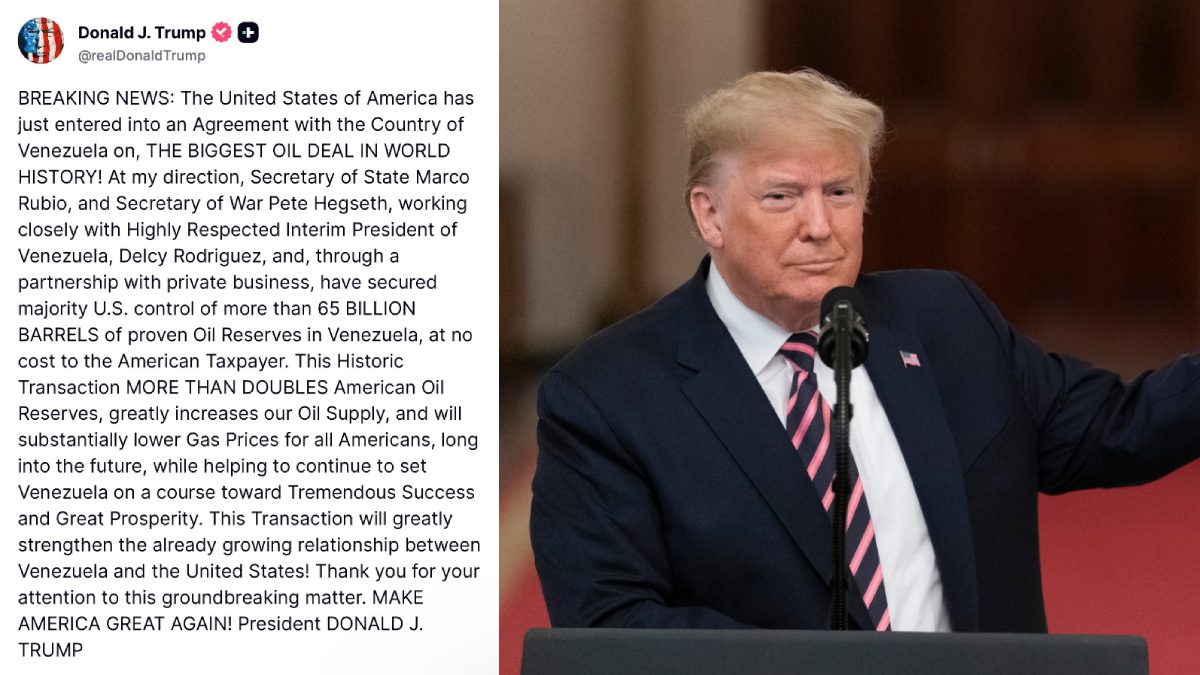
Trump announced the agreement in a social media post Friday that it had been reached by Secretary of State Marco Rubio, Defense Secretary Pete Hegseth, and Venezuela’s acting president Delcy Rodriguez. The announcement comes at a crucial time for the United States and now gasoline prices are up and global oil markets are under a huge threat.
According to the Venezuelan government, the agreement covers 17 oil fields with a proven potential of about 65 billion barrels. Venezuela estimates that the arrangement could attract approximately $100 billion in investment into Venezuela's energy sector and generate more than $209 billion in tax revenue for the Venezuelan government.
Rodriguez welcomed the agreement, and said it could be a gamechanger for Venezuela’s economic recovery. Her government has been reversing some of the policies that restricted participation of foreigners in the oil sector previously.
A U.S. official said that under the deal the US would partner with an unnamed private operator to create a new private company to develop the oil reserves. Rodriguez’s government has given the company rights to develop the fields for 100 years.
The structure would also give the United States an effective 55% share of the new company's output. The result would be a combination of ownership interest and the right to buy oil at cost. The company would become one of the world’s largest corporate owners of proven oil reserves, behind Saudi Aramco, if the deal happens as described.
The deal is especially significant because Venezuela has the world's largest proven crude oil reserves, around 303 billion barrels. That is 17% of all proven reserves in the world. But Venezuela is providing only a small fraction of world oil production because years of underinvestment, economic crisis and failing infrastructure have devastated its petroleum industry.
Trump’s administration is positioning the agreement as a possible solution to Venezuela’s economic crisis and America’s energy problems. Rubio said the deal would bring billions of dollars in private investment to Venezuela and could eventually help lower gasoline prices in the U.S.
But consumers should not expect an immediate drop in fuel prices as a result of the agreement. Energy experts have consistently warned that dramatically increasing Venezuelan oil production would require significant investment and may take years. Production facilities, pipelines, refineries and other critical infrastructure would need extensive repairs and modernization.
The political environment can also be challenging. US oil companies had earlier been interested in Venezuela's vast oil stores but were wary because of the instability and difficult business environment there. Trump had encouraged American energy executives to return to Venezuela after Maduro was ousted, and ExxonMobil CEO Darren Woods had said in March that the country was “un-investable” so prospective investors were concerned.
The announcement comes amid a dramatic shift in Venezuela’s political and economic landscape. A U.S. military operation ordered by Trump nearly nine months ago captured and took the former Venezuelan President Nicolas Maduro to the USA and holds him in jail on charges of federal narcoterrorism and drug trafficking. Maduro has pleaded not guilty.
Rodriguez subsequently moved to open Venezuela's oil industry to greater private participation. One of her first steps as President was legislation allowing for more privatization of the sector, a dramatic departure from the socialist economic model of former President Hugo Chavez and the Venezuelan government of the past two decades.
Trump has repeatedly accused Venezuela of taking American oil interests after Chavez nationalized hundreds of foreign-owned assets including properties belonging to US oil companies. The new agreement is a dramatic reversal of that long-running dispute, potentially returning American companies back into a country that has some of the world’s richest petroleum deposits.
The agreement is also being announced against the backdrop of severe international energy market pressures. Israel, the United States and Iran’s war has interrupted oil flows through the Strait of Hormuz, a critical global energy chokepoint through which about one-fifth of the world’s petroleum previously passed.
The United States has also been drawing down its Strategic Petroleum Reserve. Its holdings fell below 300 million barrels in early August, down more than 100 million barrels from the beginning of 2026.
Hence, US gasoline prices have become a big political issue for the Trump administration. The average price of gasoline in the country was around $4.09 per gallon on Friday, down from about $3.21 per gallon a year ago.
While the Venezuela agreement will eventually increase the supply of crude to US buyers, its impact on gasoline prices will depend on how quickly production can be restored, how much investment reaches the fields and how global oil markets evolve.
The oil purchased from the new Venezuelan company is expected to be directed toward replenishing the US Strategic Petroleum Reserve and supporting military requirements, the US official said on condition of anonymity.
This deal is a huge win for both the American and Venezuelan people.
— Secretary Marco Rubio (@SecRubio) August 28, 2026
It demonstrates how President Trump's bold foreign policy is driving America First wins: securing stable reserves and low-cost oil in our Hemisphere and lowering gas prices here at home.
For the Venezuelan… https://t.co/SMSRYGWmVb
The economic benefits are huge for Venezuela. Billions of dollars in new investment could revive an industry that once served as the backbone of the country’s economy. Higher production and higher government tax revenues could also provide Caracas with funds to rebuild infrastructure and stabilize the economy.
For Washington, in particular, the agreement provides access to a vast and relatively well-known resource base at a time when global energy security has become an increasingly urgent issue.
Whether Trump’s claim of the “biggest oil deal in world history” really does represent a rapid transformation in the global oil markets is uncertain. Venezuela’s oil reserves are vast and extensive, yet turning them into commercial production will take years of investment, infrastructure and political stability, decades of development and political stability.
But the deal is a big deal for Washington and Caracas and perhaps the start of a new era for the Venezuelan oil industry.