They have been working hard to restore the great bones of a prehistoric predator’s head and shoulders in one of the largest fossil restoration projects ever.
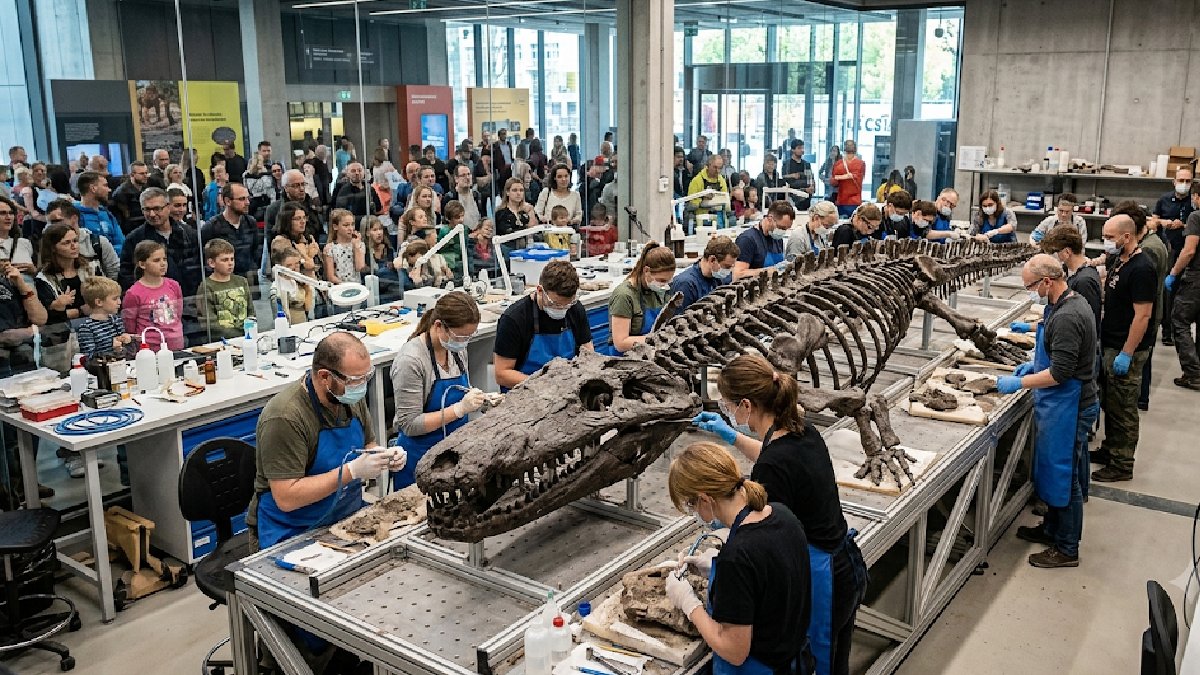
The spectacular skeleton, believed to be the remains of the fearsome predator that roamed the Earth millions of years ago, has been subjected to decades of natural wear, transport damage and aging. As the restoration team says, “we’re cleaning, cataloguing, stabilising and rebuilding so that every fossil fragment is preserved for future generations to come.”
Fossil conservation is unlike modern restoration work which requires precision. Even a tiny mistake can ruin irreplaceable bones that have survived for millions of years. The volunteers are trained in dust removal, labeling, photographing samples, and working with the professional paleontologists in reconstruction.
The restoration project has attracted students, retirees, teachers, engineers and history lovers in the past and present. In many ways, such work has been a once-in-a-lifetime experience to contribute to science while learning about prehistoric life.
Scientists believe that engagement with the public accelerates restoration work and draws public attention to fossil conservation and natural history museums. Public involvement also helps museums manage the restoration projects that would otherwise take much longer if they didn't have so much staff and money to do so.
The prehistoric predator represented by the skeleton was among the most powerful hunters of its time; it used powerful jaws, sharp teeth and massive body size to hunt prey over ancient landscapes. Scientists are still studying the fossil, but the restored skeleton will provide new insights into the anatomy, movement, growth patterns and evolutionary history of the animal.
Today’s technologies are very much part of the process along with manual restoration. 3D scanning, digital imaging, and computer-based reconstruction will allow scientists to find missing pieces and recreate damaged areas without altering the original fossils. Digital records will also enable scientists around the world to study the specimen without touching the fragile bones.
Museum officials say public interest in the project has exceeded expectations as thousands of volunteers signed up to volunteer just after registration started. Educational talks, guided restoration sessions, and museum tours are also part of the initiative, so that young people go on to get careers in paleontology and conservation science.
When restoration is completed, the huge skeleton will be the center of a new museum exhibition, and one of the most amazing prehistoric predators will be shown in front of thousands of people. Interactive displays, digital reconstructions and scientific explanations will be incorporated into the exhibit to look at life millions of years ago.
The project shows how scientists and ordinary citizens can work together to protect humanity’s natural heritage.
As thousands of dedicated volunteers continue their careful work, the ancient predator is coming back into the picture not as a living creature but as a remarkable window into Earth’s past.