
In the rolling hills of northwestern Turkey a development was born in a place that was lifted from a fantasy story from the countryside of northwestern Turkey. Hundreds of similar castles rise from the land of flat hills and pointed towers and imposing facades and European-like towers are all around them in the landscape with pointed towers and elegant buildings with European-style architecture and European-inspired designs. But despite the grandeur, the whole thing is largely empty, and what was once a luxury residential paradise has become one of Turkey’s most unusual ghost towns.
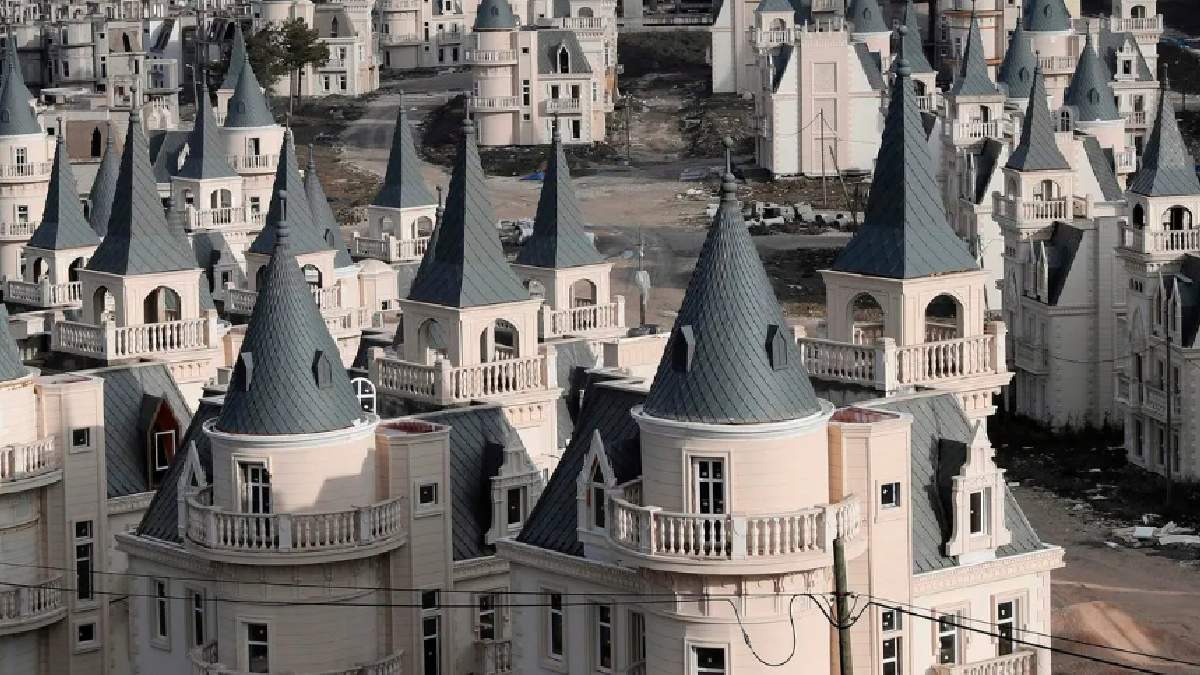
Burj Al Babas, the high-end project near Mudurnu town in Bolu province, was built for wealthy buyers in search of big holiday homes. Hundreds of castle-style villas were planned on the hills. Each house was meant to be a miniature European château in a surreal world of towers and elaborate architecture.
The project was launched by Sarot Group with a vision to transform the area into a luxury one. Hundreds of individual villas in place and facilities to enable the development to be a resort. Swimming pools, shopping areas, restaurants, entertainment facilities and other facilities were planned to be part of the larger complex.
Construction started with great enthusiasm as buyers from the Gulf region came to look at the unusual properties. The architecture was designed so as to have a unique look as each villa had many towers and decorative elements. From a distance the development seems like a huge series of fairytale castles rather than a basic building project.
But soon the dream also faced serious financial troubles. The developer had financial problems and finally filed for bankruptcy, which halted construction at that time. Many of the homes were only partially or substantially completed, but the development fell short of the bustling luxury community that had been planned as a reality.
The result was a very different image than the reality of that project. There were still castle-like structures scattered across the landscape, but few people there. Burj Al Babas became an abandoned place that was filled with holiday travelers and wealthy homeowners and not a place of progress.
The development also became a symbol for the risks faced by large scale property projects that were built on high-end luxury themes. Hundreds of highly customized homes had to be built and the economic circumstances were so bad that you could not realistically continue with them. The construction was brought to an end due to financial pressures.
The empty villas attracted international interest because they were so unusual. Images of the development showed hundreds of nearly identical castles stretching across the hills and the whole thing was rather eerie but fascinating. Unlike the old abandoned buildings, these structures were modern and were meant to look luxurious so they were even more striking in their disappearance.
The Burj Al Babas story is also very closely related to the larger problems Turkey’s property sector has faced at different times. Currency fluctuations, economic uncertainty, financing challenges and changing demand can make large developments very difficult. Projects that rely on foreign buyers are especially vulnerable when the economy turns in a different direction.
Even with its troubled past, the castle town is a fascinating architectural curiosity. That is because of its unique design and its attraction for photographers, urban explorers and travellers curious about strange places. The contrast between the fairytale architecture and the lack of activity gives the development an atmosphere unparalleled in almost every other place.
The original vision was to create a luxurious community where residents could enjoy the appearance of living in their own private European-style castle. But the unfinished development served as a reminder of how quickly ambitious dreams can meet financial and economic realities.
Today hundreds of castle-shaped homes set up together are a source of global attention. Burj Al Babas is an exciting architectural experiment and a cautionary tale of unchecked ambition in real estate. But what began as a fairytale-like luxury project became instantly famous for a very different reason - as a ghost town of castles with very few people.







Comments