Adani Group-backed Cemindia Projects Ltd, formerly ITD Cementation India, has emerged as the lowest bidder for a ₹665.61-crore civil works package under Bengaluru’s ambitious suburban rail project. It is another step in the expansion of Bengaluru’s suburban railway network, which is being implemented by Rail Infrastructure Development Company (Karnataka) Ltd., or K-RIDE.
The tender was taken forward by K-RIDE and was estimated to cost ₹671.65 crore. Cemindia Projects was quoted at a price of ₹665.61 crore, which is lower than Rail Vikas Nigam Ltd (RVNL), which submitted a bid of ₹759.05 crore. Although Cemindia has emerged as the lowest bidder, we have yet to take the contract from the bidding stage, so the current development is at the bidding stage and not a completed contract.
The package is particularly important because it contains one of Bengaluru’s most distinctive suburban rail structures. The works cover approximately 7.8 kilometres of elevated viaduct and ramps along Corridor-2, also known as the Mallige Line, between Benniganahalli and Chikkabanavara.
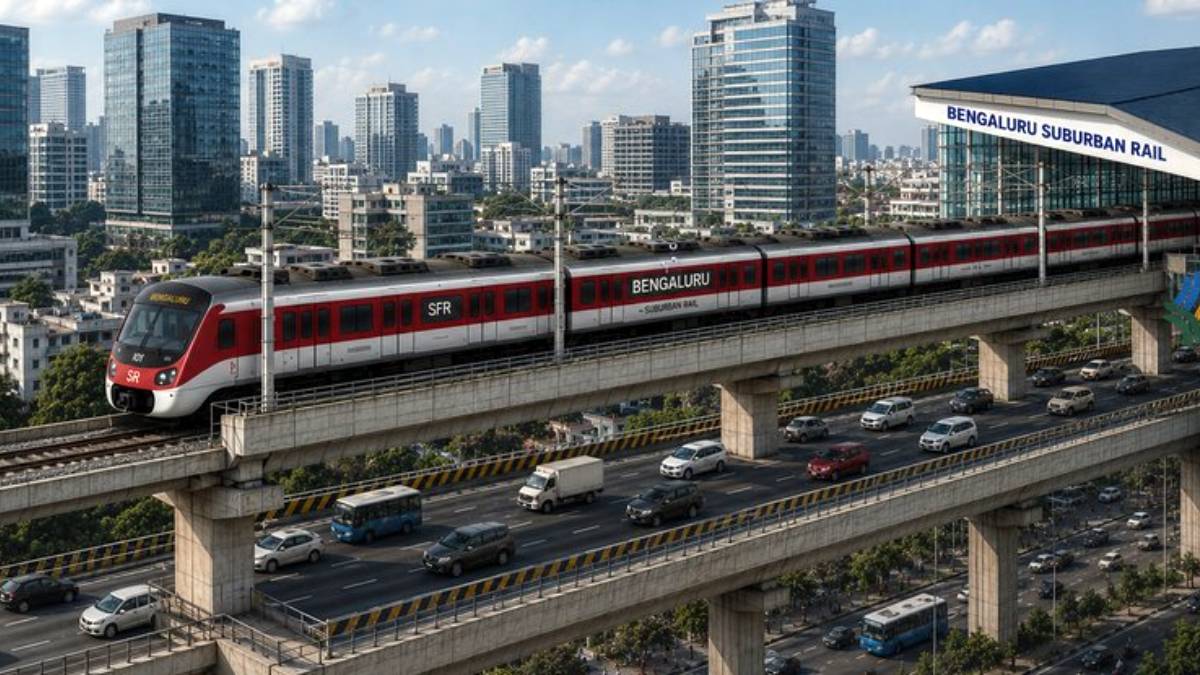
A major component of the package is a double-decker rail-cum-road flyover along Mohan Kumar Road between Mathikere and Yeshwanthpur. The double-decker structure will be about 1.2 kilometres long, with suburban railway infrastructure on one level and road traffic on another.
The design is intended to address one of Bengaluru’s biggest infrastructure challenges: limited road space in densely developed parts of the city. Instead of requiring separate corridors for rail and road infrastructure, the double-decker arrangement allows both modes to use the same footprint.
According to K-RIDE officials cited in reports, the upper level will carry the elevated suburban rail viaduct while the lower level will be a road flyover. This could help to optimise available right-of-way while allowing the suburban railway to pass through a heavily built-up urban area.
The package also includes a double-decker station at Mathikere with ramps and other infrastructure works. The station is expected to be an important part of the suburban railway corridor and will be integrated into Bengaluru’s existing transport system.
The larger Bengaluru Suburban Rail Project was designed to provide faster and more efficient rail connections between the city and its suburbs and satellite townships. Four corridors with a total length of more than 148 kilometres and an estimated cost of more than ₹15,700 crore were proposed for the project.
The project is intended to provide an alternative to Bengaluru’s heavily congested road network. The system would not only improve commuting in suburban areas through dedicated rail infrastructure, but also take pressure off the existing roads.
The latest Cemindia bid is part of a wider series of contracts being processed for the suburban rail project. K-RIDE is simultaneously progressing with other civil works, station packages, level-crossing elimination and rolling-stock-related contracts.
For the latest package, the proposed construction period is 24 months. If the contract is awarded and construction proceeds as per schedule, the double-decker infrastructure could become one of the most visible elements of Bengaluru’s evolving multimodal transport network.
Cemindia Projects and its parent firm are also in cahoots. And as the company has been taking more and more projects in the field of infrastructure such as roads, railways, bridges and other civil works in recent years, it could well get the Bengaluru package.
But for Bengaluru residents, the significance goes beyond the contractor. The double-decker design is the most ambitious alternative to solve the city’s infrastructure shortages through transport planning. With land and road space being limited in the future, stacking rail and road infrastructure could become more and more important for large mobility projects.
The suburban rail network is expected to play a complementary role to Namma Metro, BMTC buses, and other public transport systems. Better integration of all these modes of transportation could enable passengers to travel longer into the suburbs without reliance on private vehicles and have more control over their own transportation.
So the Cemindia development should be seen as a milestone in the construction of Bengaluru’s suburban railway network. But as the company is currently the lowest bidder and the contract has not yet been awarded, the next step will be the tender evaluation and formal award process.
If completed, the ₹665.61-crore package will be a 7.8 km elevated section, a unique double-decker rail-cum-road flyover and double-decker station at Mathikere. In doing so, the project could add a lot to Bengaluru’s transport infrastructure and a significant part of the city’s long-term plan to curb congestion and improve suburban connectivity.