A costly AI-based health screening program has come under scrutiny after it mistakenly flagged a woman in her 40s for a risk of pancreatic cancer, causing significant emotional distress before doctors later confirmed she was completely healthy.
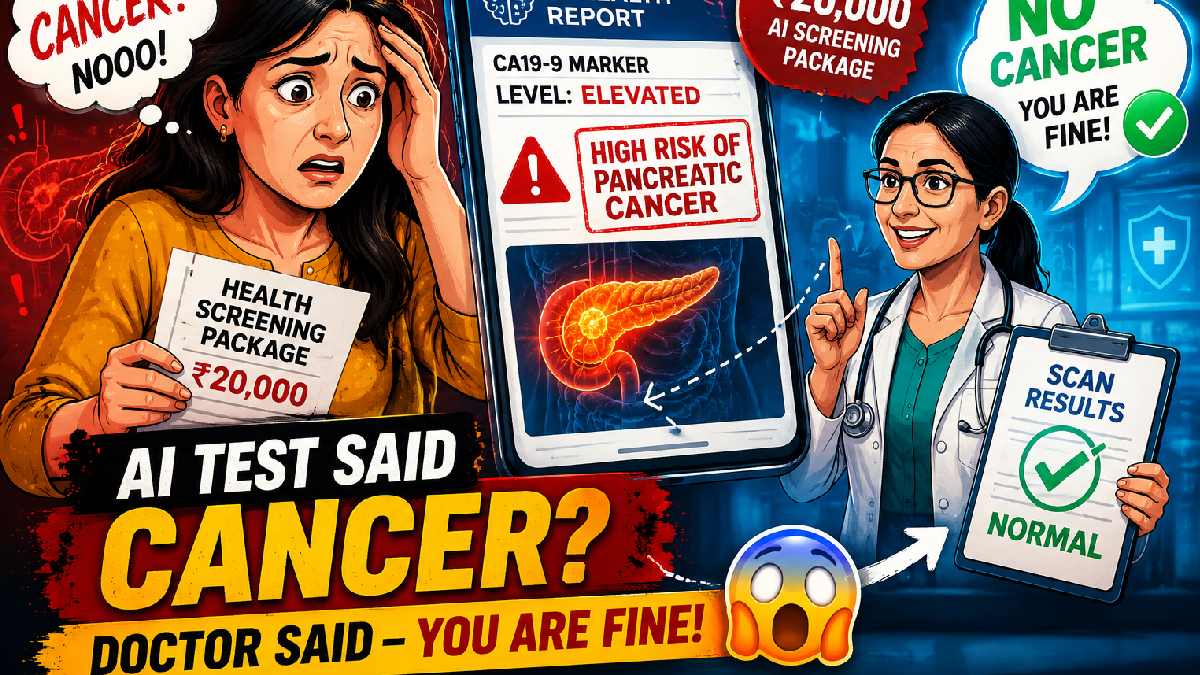
The incident that has now stirred up an online conversation involved a health screening test that could be priced at over ₹20,000. The report predicted a potential pancreatic cancer risk based on a mildly elevated CA19-9 marker. But subsequent medical assessment of her scans showed her scans were normal and there was no clinical evidence of cancer.
The case was highlighted by endocrinologist Dr Hema Venkataraman, who said the patient was referred to her after receiving what appeared to be a highly polished, “premium” diagnostic report that unnecessarily alarmed her. The report’s findings triggered immediate fear, despite the fact that the CA19-9 marker alone is not considered a reliable tool for cancer diagnosis.
Dr Venkataraman suggested tumour markers such as CA19-9 should be taken into account alongside imaging studies, clinical symptoms, and specialist evaluation. The use of a single lab value without medical context can lead to false conclusions and unnecessary panic, she said.
“Don’t do tests if you don’t know what to do with the results,” she advised, and noted that advanced packaging and AI-based health reports can perpetuate a false sense of accuracy and authority. In that case, more consultation and additional scans eventually convinced the patient that she did not have cancer.
The doctor also pointed out the irony of the situation, noting that the patient ended up spending nearly ₹20,000 on the screening and another ₹10,000 on follow-up consultations and tests to confirm that the initial alarming report was incorrect.
“₹20,000 spent creating anxiety…. another ₹10,000 spent proving the ₹20,000 was a mistake!” she commented.
For the same reason, the incident has prompted a conversation on social media about the rapid rise of AI-based preventive health packages. Users expressed relief that the patient was fine, but also expressed concern about overtesting and the psychological impact of automated health predictions.
Some users compared the situation to self-diagnosis through internet searches, and said AI health tools are essentially a more advanced version of “Googling symptoms and panicking.” Some also worried that such tools could be causing unnecessary medical stress or even distrust between patients and doctors.
At the same time, critics of the backlash argued that doctors may feel threatened by AI tools, and extreme cases of misdiagnosis or overinterpretation in both human and machine-driven systems were pointed to.
The incident highlights a growing challenge in modern healthcare: how do we balance innovation with responsible medical interpretation? AI can be a promising tool to improve early detection and efficiency, but experts stress that it must remain a supportive tool—not a substitute for clinical judgment.
The case is a reminder that in medicine, context matters as much as data, and not every alarming number tells the whole story, even if it seems to be the case.