The Bengaluru South District police have busted an alleged counterfeit currency processing unit operating from an under-construction house in Shanthilal Layout, Ramanagara, and arrested seven people in connection with the case.
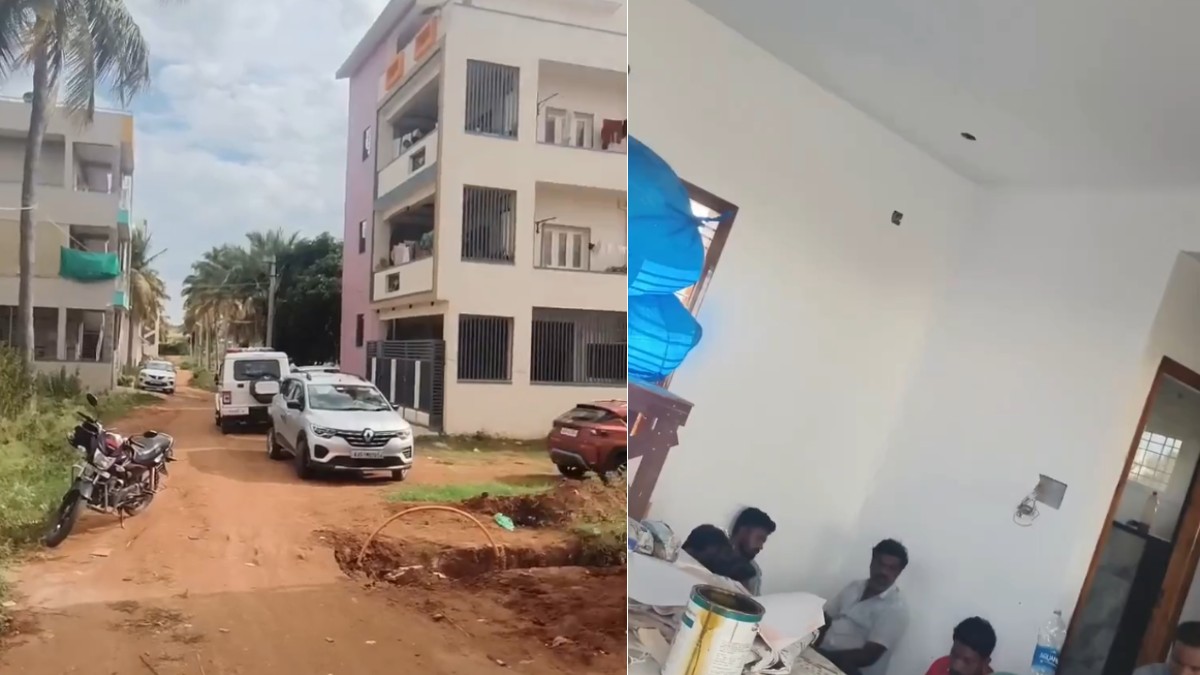
Police said the premises were being used for a secondary stage of processing material that was allegedly intended to be converted into counterfeit currency notes. The raid followed information received by a local police inspector, Superintendent of Police Rohan Jagadish said.
The raid found seven people in the house when police came in, sources said. The suspects were detained for investigation and questioned as investigators combed the suspected operation and its wider network.
Seven People arrested in police raid
The arrested persons were identified as Santhosh, the owner of the house, Sampath, Govindaraj, Renukaraj, Rajesh, Shivaraj and Satish.
According to police, Santhosh allowed the house to be used for the activity after Sampath approached him with a proposal to establish a fake currency processing unit. Santhosh was allegedly promised a commission in exchange for allowing the premises to be used.
The investigation is now into the individual roles of the seven individuals and whether they are in any way connected to the larger operation.
Police said this information was supplied by the local inspector and helped them locate the location and conduct the raid. We’ve got to investigate how long the unit was operational from the property and who else was involved.
Unit Was Not Producing Finished Notes
Police said that the operation discovered at the house was not related to the production of finished counterfeit currency notes.
They believe the premises were used for a secondary step in the process. White paper rolls were treated with chemical solutions and dried between glass panels under sunlight.
The processed material was then cut into pieces of the size used for currency notes and bundled for further processing.
Police seized around 10 bundles of the semi-processed material during the raid. The material did not have currency markings visible to the naked eye.
But ultraviolet light revealed an outline that appeared to be similar to signature features of currency notes, police said.
The discovery has led investigators to believe that the material was to be transported to another place or handed over to another group for the next step of processing.
Material cannot yet be classified as counterfeit currency.
Although the material was thought to have a criminal motive, it has been stressed by police that it is not counterfeit currency.
The reason is that the seized material had not been converted into finished fake notes at the time of the raid. No completed counterfeit currency was reported to have been recovered from the premises.
SP Rohan Jagadish described the location as a secondary processing unit.
“This seems to be a secondary processing unit. The material was to move to the next stage before becoming finished counterfeit notes,” he said.
Police said the distinction is important because the material recovered during the raid was still in a semi-processed form.
The accused told investigators that the material could eventually have a face value of nearly ₹5 lakh if it went through the remaining stages of processing. But the material recovered by police did not itself represent finished counterfeit currency.
Police Probe Source Of Paper And Wider Network
The investigators are now investigating many areas of the suspected operation, they say.
One key part of the investigation is tracing the source of the white paper rolls used at the unit. Police are also trying to determine where the chemical processing was carried out and who was expected to receive the semi-processed material.
The alleged next stage of the operation will also be analyzed. This could help police find other people involved in the network and establish how the material was intended to be turned into finished counterfeit notes.
The police are also looking at the financial arrangements behind the operation to understand what was offered to the house owner, a report said.
It will be determined if the seven arrested individuals were directly involved in the processing activity or had different roles in the alleged racket.
The Bengaluru South District police have busted an alleged counterfeit currency processing unit operating from an under-construction house in Shanthilal Layout, Ramanagara, and arrested seven people in connection with the case.
— Hate Detector 🔍 (@HateDetectors) September 1, 2026
Superintendent of Police Rohan Jagadish said the… pic.twitter.com/THP3zfaMVG
Investigation Continues
The case is still under investigation, and the allegations against the arrested individuals have not been established by a court.
Police are investigating the seized material and interviewing suspects and gathering information about the suspected supply chain. Investigators are particularly interested in the source of the material and who is linked to the next stage.
The seizure of semi-processed material has given police a starting point to investigate the suspected counterfeit currency network. But officials have stressed that so far, the material recovered is not final counterfeit notes.
Bengaluru South District police will continue their investigation to establish the full extent of the alleged operation and identify anyone else who may have been involved.