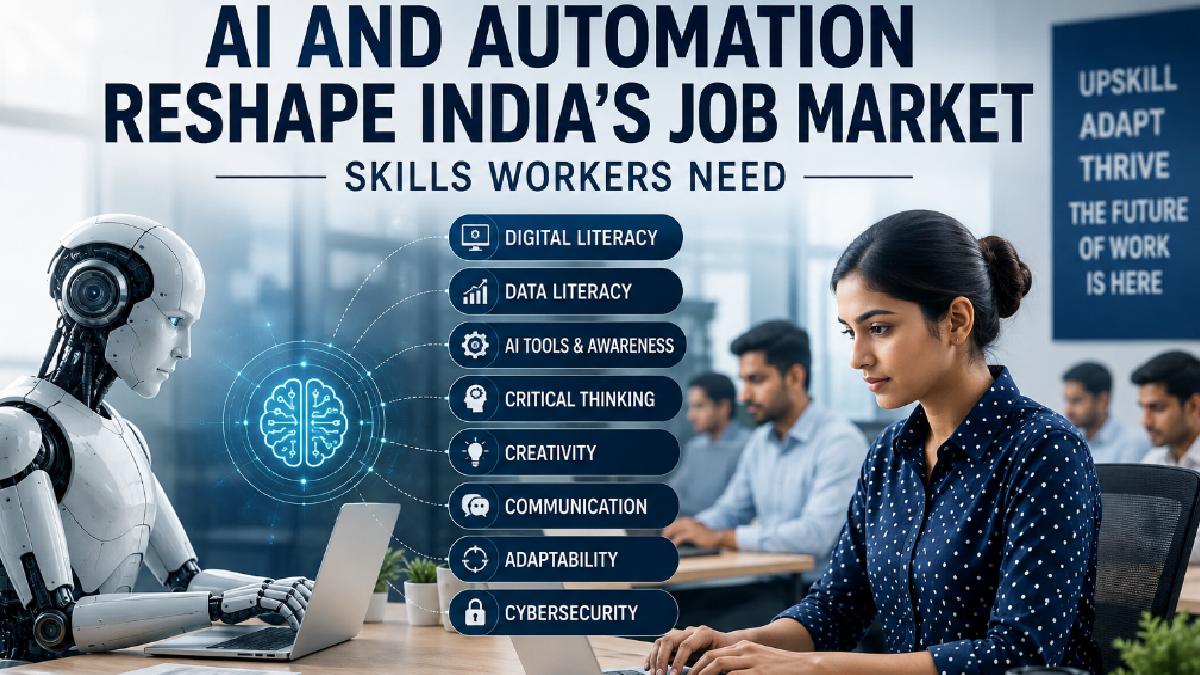
Artificial intelligence and automation are revolutionizing India’s job market and changing the way companies work and the skills that employers require from their employees and workers. Businesses are expanding their AI-based productivity and reducing repetitive work, and more so from information technology and banking to manufacturing, healthcare, retail and customer service, are increasingly using AI-powered tools.
The rise of these technologies has also raised concerns about job displacement. But the changing employment landscape is not simply about machines replacing people. Many jobs are being redesigned, with employees now expected to work alongside AI systems and automated tools. So those who constantly hone their skills could have a lot of room in the job market.
Digital literacy is one of the greatest skills that workers in the AI era must learn and use. Across industries, workers are increasingly being asked to learn and use digital platforms, cloud-based software and AI-driven applications. In contrast to programming or AI engineering, workers don’t necessarily have to be programmers or engineers, but they should have some knowledge of technology to be able to respond to changing workplace requirements.
How to use AI tools effectively is also an important advantage. Generative AI platforms can assist in writing, research, data analysis, coding, customer support and other professional tasks. People who are good enough to use these tools responsibly and efficiently can make the work more manageable and do more.
Data literacy is another skill to be learned. Data in today’s society is very large, and organisations are now making huge use of data. When workers know basic data, what trends are emerging and how to interpret them, many industries will be better off as a result.
For technical professionals, artificial intelligence, machine learning, data science and cybersecurity skills are also likely to remain valuable. AI systems are very much about the ability to build, manage and secure digital infrastructure for companies that are adopting AI. Cloud computing, software development and data engineering will also play an important role in India and its expanding technology ecosystem.
But technical knowledge will not be enough. Automation is taking over repetitive tasks, and so human skills are more and more important. Creativity, critical thinking, communication and problem-solving are hard to automate. Employers will need people who can analyse complex situations, come up with original ideas and make informed decisions.
Communication is especially important in a workplace where humans and technology are working together. This means employees need to be able to communicate ideas clearly, work with colleagues and communicate with customers. Leadership and teamwork are also important as companies adapt to new technologies and changing business models.
Adaptability will be one of the most important skills for workers in the future. Technology is evolving very quickly, and skills needed for a job can be altered in a relatively short period of time. Workers who are willing to learn new tools and constantly update their knowledge can be more prepared for changes in the employment market.
Thus continuous education is becoming a key part of career development. Traditional education is still an important foundation, but employees will be required to be constant innovators to develop skills into a more advanced level of work in their careers. Online courses, professional certification, work experience and practical projects can all be used to help workers keep up to date and relevant.
AI and automation will also impact different industries differently. Automation in manufacturing is driving product production and reducing repetitive physical labor. In the banking industry, AI can help detect fraud, customer service and data analysis. Healthcare organizations are also exploring the use of technology for diagnostics, record management and research.
The information technology industry also undergoes immense change. AI-based coding tools can assist software developers; automation can simplify testing and routine maintenance. This does not mean there is no need for very skilled technology professionals. Their roles will often fall into the domain of solving complicated problems, designing systems and managing AI-based systems.
For freshers entering the workforce, practical skills may become very much a necessity in today’s workforce. Companies will assess not only academic qualifications but whether candidates are able to utilize current technology and problem-solving and are flexible to take on new situations. Internships, personal projects, certifications and certifications make it possible to show job candidates how well they can do job and job interview skills.
India’s large and young workforce could benefit greatly from the growing demand for digital skills. But education and training will be critical to the preparation of workers for technological change. Companies, educational institutions and government agencies need to work together to strengthen reskilling and upskilling facilities.
Work in India will be much more closely connected to machines, and the future of work will be different. Traditional jobs and career opportunities will also decline with automation and robots, but workers may not always be ready for that.
Ultimately, the workers who will be the most likely to succeed in the AI-based job market will be those who combine technological knowledge with strong human skills. Digital literacy, AI awareness, data skills, creativity, communication, critical thinking and adaptability will all play an important role.
As AI and automation continue to transform industries, learning will be a continuum, rather than only a one-off thing in school or university. If India’s workforce is to embrace new technology and develop their individual human skills, then new technologies and skills alone are not enough to sustain careers in the future.