Bengaluru will soon make a major step towards solving the parking problem faced by the city’s motorists by launching an AI-based smart parking system in the vicinity of the densely populated Jayanagar.
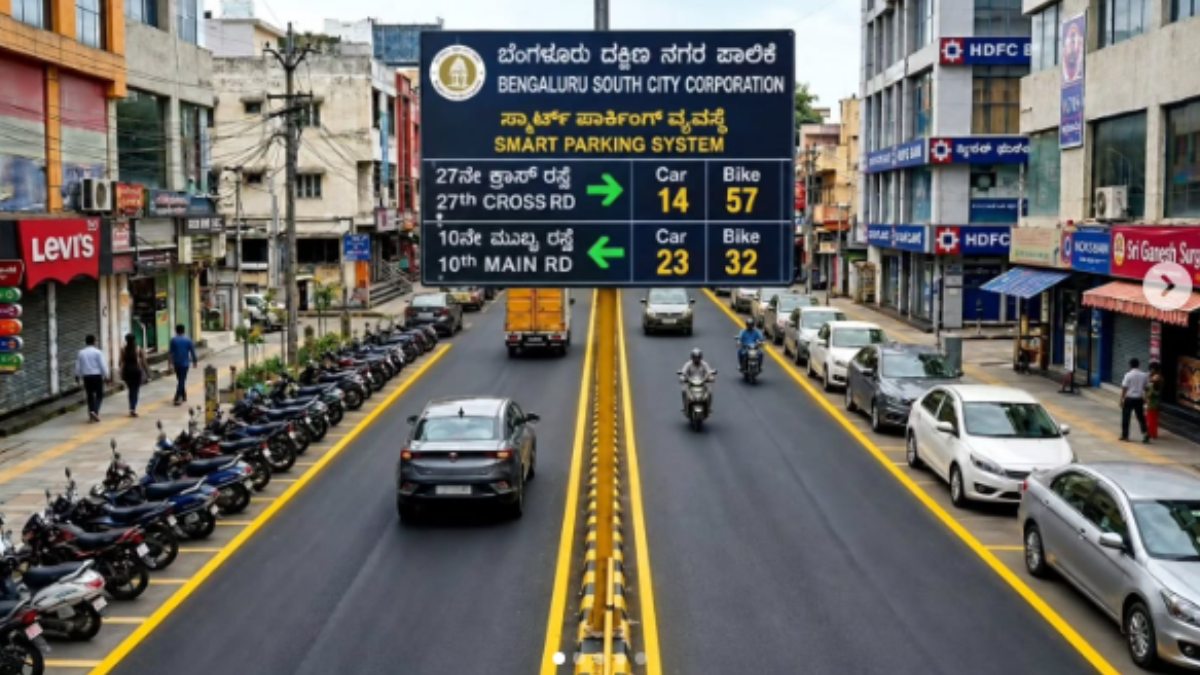
The idea is to make on-street parking more disciplined and to help people find out if there is a space to park and pay in a digital way. The civic administration signed up with Park Lens to implement the technology-based parking system with an agreement for implementation of the smart parking plan.
The high-level meeting was held under the leadership of civic commissioner K.N. Ramesh, with officials from the traffic police and BESCOM participating in discussions on how such a system will be implemented and operated.
One of the key features of the proposed system is angular parking at selected points. We want to avoid the drivers parking vehicles at random points and in a crosswise manner and create road congestion for other drivers.
By positioning the cars at an angle, people will be able to use parking areas more efficiently in general and drivers will be able to get into and out of the parking spaces. We expect the system to be introduced on some important roads in Jayanagar to be the first to be implemented as there is a lot of traffic and parking demand at the places.
Technology will be at the heart of the proposed parking system. Artificial intelligence (AI) cameras will be installed in the parking areas to monitor the space and identify if a parking space is occupied or vacant, which will help with more organised parking and maybe help drivers to find their parking spots more easily.
The cameras will also support digital monitoring of parking activity. Drivers will need to scan a QR code at the parking location to pay the fee using UPI. Digital payment will be necessary in the first five minutes after the car is parked.
The authorities are also planning a digital system to monitor parking violations. There are two major types of violations that have been identified unpaid parking and overstaying. Unpaid parking would occur when a motorist fails to pay the parking fee within the stipulated period. Overstay would occur when the vehicle remains parked beyond the permitted duration without digitally extending the parking period.
The proposed system will be able to detect such violations automatically. If the alert is issued, the officials could then respond to the situation at the location. This is to deter people from parking in spaces longer than permitted and make sure that there are parking spaces available for other people to park there.
One of the stricter enforcement measures under consideration is wheel clamps. If a vehicle is found to be breaking the smart parking laws, then the driver will be locked in the car and the driver will be disciplined by the appropriate penalty.
The vehicle would be released only after the required fine is paid. AI monitoring with the digital payment records and physical enforcement should help to identify violations and take action. BESCOM will play a key role, making sure that the AI camera network always gets its electricity. The civic administration has suggested using existing streetlight poles for installation of cameras wherever feasible.
The smart parking initiative has been launched as a pilot project on selected roads in Jayanagar. Motorists will be consulted and the system will be tested to assess whether it should be extended to other parts of the city.
Additional Commissioner Dr. Naveen Kumar Raju, Traffic DCP Gopal Byakod and other senior officials attended the meeting. If implemented as expected, the initiative will provide much more structured parking management in one of Bengaluru’s crowded areas.
Overall, our aim is to reduce parking congestion, enhance enforcement and encourage motorists to follow parking and payment rules in a manner that’s smart and efficient based on AI technologies, digital payments and coordination of enforcement by the city government and the traffic police.