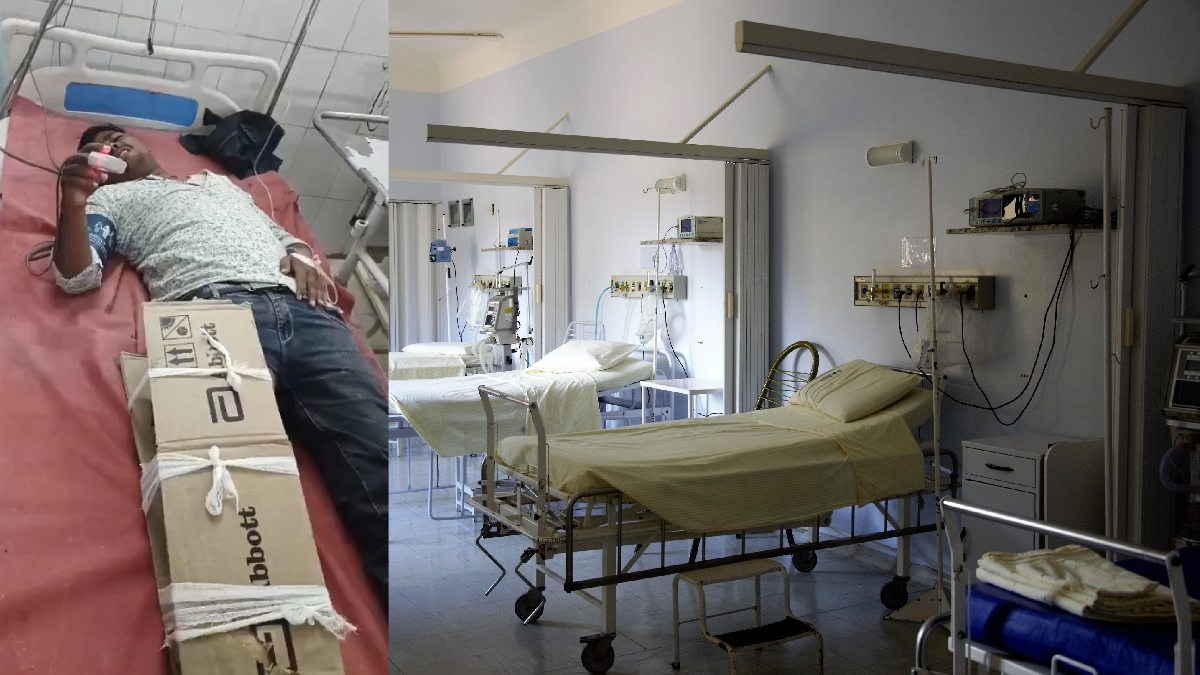
A Bihar government hospital emergency patient has become the focus of a national debate after a video showed medical staff using a cardboard splint to stabilize his fractured leg. Although the footage has been criticized on social media, hospital authorities say they used the cardboard as a temporary first-aid measure before transferring the patient to a higher medical facility with orthopedic specialists.
The incident revived the discussion of healthcare infrastructure, specialist shortages, and emergency medical services in rural and semi-urban areas of India.
Kunal Kumar sustained a serious leg fracture in a motorcycle accident near Har Sing Bridge on August 3. He was rushed to Manjhaul Sub-Divisional Hospital in Begusarai district, Bihar, where doctors first assessed his injuries.
As hospital officials explained, the facility did not have an orthopedic surgeon at the time. Emergency stabilization was needed, and the patient was referred to another hospital equipped to deal with complex fractures.
Why was Cardboard used?
Hospital in-charge, Abhinav Priyadarshi, said that the cardboard was not meant to be a replacement for orthopedic treatment but instead as a temporary splint. In emergency medicine, immobilizing a fractured limb is considered one of the most important first-aid steps before transporting a patient.
The cardboard was secured around the injured leg with bandages to prevent excessive movement during transportation. Medical professionals note that any rigid material (from commercially available splints, wooden boards, plastic supports, or even sturdy cardboard) can be used temporarily when specialized equipment is not available.
The primary objective is to minimize pain, minimize further tissue damage, and avoid complications while the patient is transferred to a facility where definitive treatment can be provided.
Medical Experts Explain the Practice
Healthcare professionals from the field of emergency trauma care have noted that improvised splints are recognized in first-aid and disaster medicine. In accident cases, if immobilization is delayed too long, the fractures can further undermine the surrounding muscles, blood vessels, or nerves.
Medical professionals stress that cardboard may appear to the public as an unusual but temporary stabilizing device and can be used to stabilize the body if it is properly applied. They emphasize, though, that these are only temporary measures for emergency transport and not substitutes for orthopedic procedures such as casting.
Public Opinion and Official Inquiry
However, despite these explanations, the video caused alarm online, and many asked why the government hospital wasn’t equipped with orthopedic care and emergency equipment needed.
The visuals were criticized for the quality of healthcare in smaller hospitals, especially in rural areas where specialist doctors are often unavailable.
Following the public response, the Civil Surgeon has apparently initiated an inquiry into the circumstances surrounding the treatment. Hospital procedures, staffing availability, emergency preparedness, and whether treatment protocols were appropriately followed will be the focus of the investigation.
The inquiry is supposed to determine if there were administrative weaknesses in place as well as the larger issues facing sub-divisional hospitals, officials said.
Broader Healthcare Challenges
The recent incident has once again highlighted the acute problems faced in healthcare delivery in many areas of India. Sub-divisional hospitals serve large populations but are often overwhelmed with shortages of specialist doctors, advanced medical equipment, and emergency trauma facilities.
In some government hospitals, orthopedic surgeons, anesthetists, radiologists, and other specialist personnel are in short supply, and patients are referred to district hospitals or medical colleges for more advanced treatment.
Healthcare experts say that referral systems are vital, but improved emergency care at local hospitals can have major impacts on patient care at these times, especially in those first 24 hours after an accident.
Need for Improved Rural Emergency Services
The Bihar incident illustrated the necessity of timely emergency first aid and the challenges that frontline healthcare workers face when resources are limited. Medical workers often need to make quick decisions to stabilize patients before referral, and they may use materials that are readily available if the equipment is not at hand.
𝐔𝐥𝐭𝐢𝐦𝐚𝐭𝐞𝐥𝐲, 𝐒𝐩𝐚𝐜𝐞 𝐓𝐞𝐜𝐡𝐧𝐨𝐥𝐨𝐠𝐲 𝐇𝐚𝐬 𝐋𝐚𝐧𝐝𝐞𝐝 𝐈𝐧 𝐇𝐞𝐚𝐥𝐭𝐡𝐜𝐚𝐫𝐞 𝐒𝐲𝐬𝐭𝐞𝐦
— তন্ময় l T͞anmoy l (@tanmoyofc) August 6, 2026
📍Begusarai, Bihar
A young man was injured in a Road Accident.
Instead of putting his Leg in a Plaster Cast, Doctors tied a piece of Cardboard around it and… pic.twitter.com/XGpC8ItmAc
At the same time, the episode underscores the need for more investment in rural healthcare infrastructure, increased staffing, and wider access to emergency medical supplies. Providing sub-divisional hospitals with trained specialists and modern trauma care resources would build confidence as well as accessibility to quality healthcare.
As the inquiry continues, the case will be part of the larger discussion of medically accepted emergency practices and the long-term healthcare systems of India in government hospitals.