The Centre is considering a huge overhaul of India’s higher education admissions system, including giving 50 per cent weight to Class 12 board examination scores in admissions based almost completely on entrance tests like NEET and JEE. If implemented, it represents one of the biggest changes to India’s competitive examination system in recent years and will fundamentally transform how students gain admission to medical/engineering colleges.
According to a PTI report citing sources familiar with the matter, the proposal is among a set of recommendations being considered by a nine-member committee set up in 2022 by the Ministry of Education. The panel was charged with responding to rising concerns about students’ reliance on coaching centres, the proliferation of “dummy schools” and the fairness and credibility of high-stakes entrance tests.
At present, the admission to undergraduate medical and engineering courses is almost entirely based on entrance tests such as the National Eligibility cum Entrance Test (NEET) and Joint Entrance Examination (JEE) scores. Students only need to be able to obtain a minimum qualifying percentage in their Class 12 board exams to be admitted to such entrance exams, but board scores do not currently determine the final admission merit list.
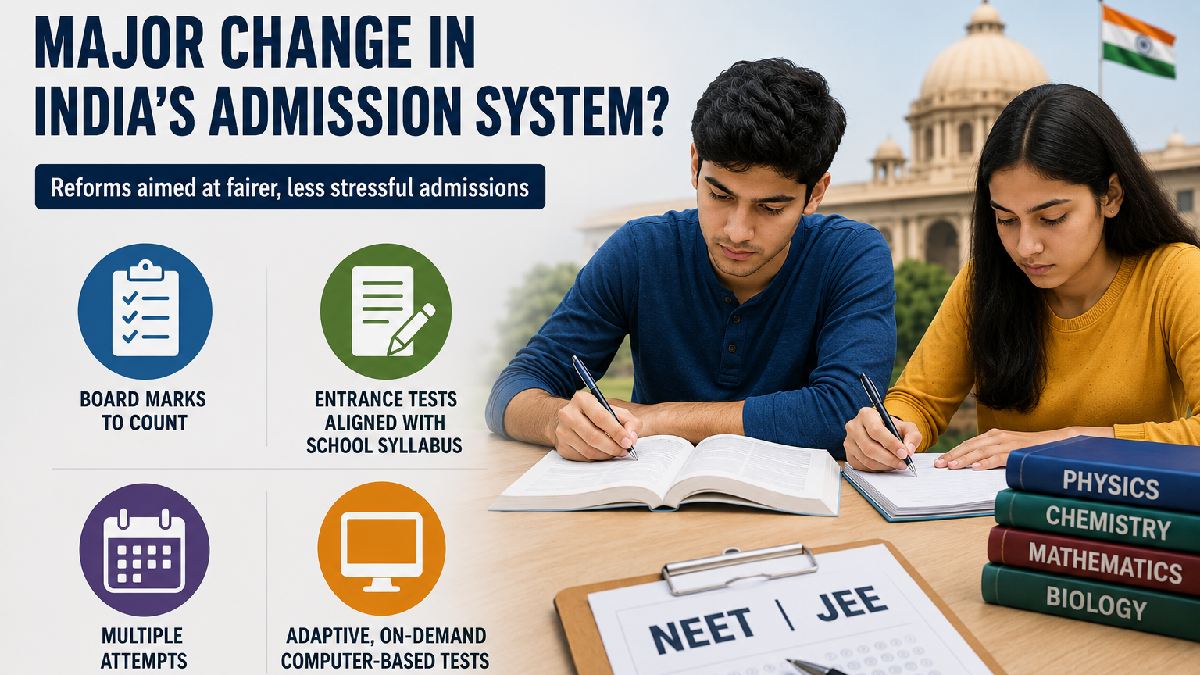
Under the proposal, Class 12 board examination scores would account for 50 per cent of admission merit, while entrance examination scores would make up the other 50 per cent. The idea is to reduce the overwhelming dependence on one examination and to get students to take equally involved in their school education.
The reforms are to reduce the high-pressure environment in competitive entrance exams, PTI said. Instead of focusing on one test on a single day, the new framework will attempt to have a balanced evaluation process in which students are judged on their academic performance across the whole school.

Another significant recommendation is to align the entrance exams with the school curriculum. Currently, many students depend on specialised coaching centres because entrance exams are extended beyond or very different from school and are not taught in the classroom. By bringing NEET and JEE syllabi to the classroom, the government aims to reduce students' reliance on expensive coaching centres and enhance classroom learning.
The committee is also considering the possibility of introducing multiple attempts for entrance examinations. This would allow the students to obtain better scores in different sessions and to reduce the pressure of a single opportunity. Similar methods have already been used in numerous international standardised tests, and have been partially adopted in the engineering entrance exams of India.
Additionally, the panel has proposed a gradual transition towards ‘adaptive, on-demand computer-based testing’. According to the model, exams could be conducted several times during the year by using technology to modify the difficulty of the questions based on responses of the candidates. Such systems are designed to provide a more accurate assessment of a student’s ability and thus be more flexible and reduce the logistical burden of conducting nationwide exams.
The proposed reforms come in the wake of several controversies surrounding India’s examination system, such as leaked question papers, alleged irregularities, evaluation errors and legal disputes over entrance examinations. These incidents have intensified the public debate on the transparency, reliability and fairness of the existing admission process, and the government has set about structural change.
The committee’s recommendations also aim to address the problem of ‘dummy schools’ where students formally enroll in schools and spend most of their time attending coaching institutes instead of regular classes. By making board examination performance even more important, policymakers hope students will engage more actively in school education rather than simply being coached.
Education experts have long argued that an admission system based on entrance exams promotes rote learning and excessive coaching at the expense of holistic academic development. If board exams were given a lot of weight, students would be at a higher level of conceptual understanding and would not only be studying competitive exams, but would be able to develop a better understanding of the concepts within them over the long term.
The committee will later submit its final report to the Ministry of Education. These recommendations will be referred to the government and then its decision will be made. As of now, no final decision has been made, however, and the existing admission process of NEET and JEE are going on.
If approved, however, the proposed reforms would transform professional education admissions in India, reducing reliance on a single high-stakes examination and providing a more balanced, school-based evaluation system for millions of aspiring doctors and engineers.