The world is eagerly awaiting one of the most spectacular astronomical events of the year: the first total solar eclipse of 2026. When the eclipse takes place on August 12, 2026, the Sun will be eclipsed in a narrow band from the Arctic to parts of southern Europe. The Moon will cross the sky in totality when it passes directly between the Earth and the Sun, completely blocking the Sun's bright disk and revealing its glowing outer atmosphere, known as the corona.
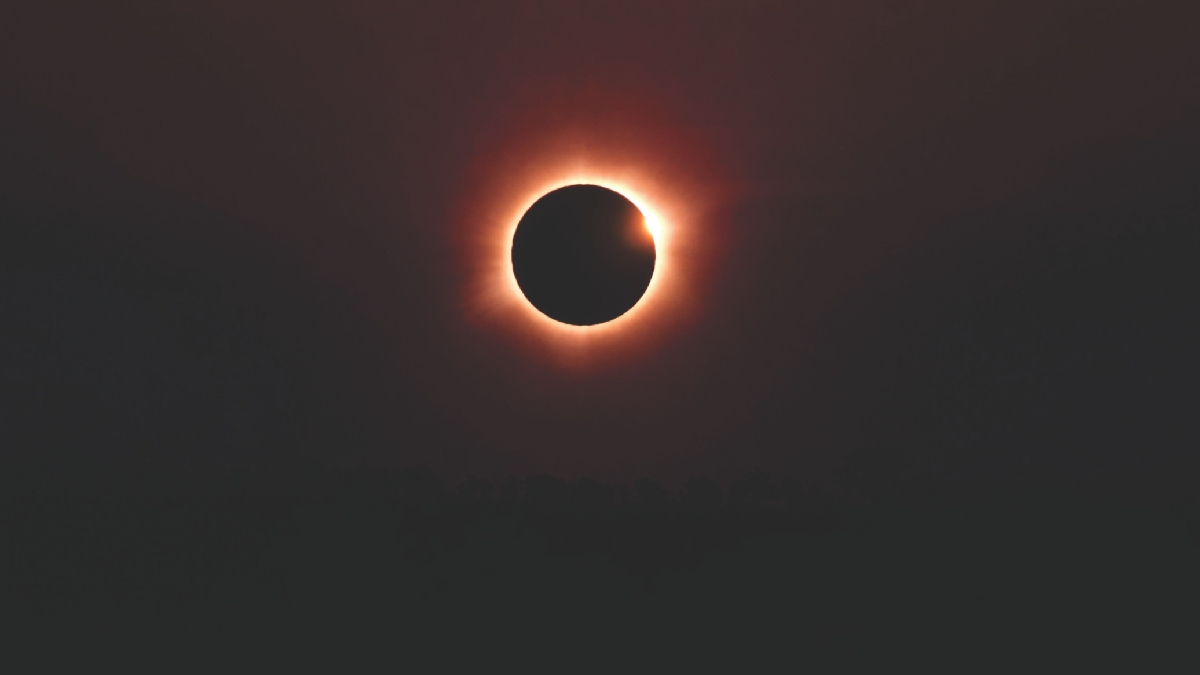
Astronomy enthusiasts, photographers, and travelers will be gathering in prime viewing locations around Europe to witness this rare celestial phenomenon. Although millions of people will see either a full or partial eclipse, Indian viewers won’t be able to view it because the Moon’s shadow will not pass through the Indian subcontinent.
Where will the total solar eclipse be visible?
The eclipse's path of totality will start over the Arctic and move through eastern Greenland and western Iceland. It will continue over a small portion of northeastern Portugal before reaching northern Spain, where the best viewing will be expected.
According to the European Space Agency (ESA), there are also a lot of Spanish cities where there will be totality, including León, Burgos, Valladolid, Santander, Bilbao, Zaragoza, Valencia, and Palma. In these areas, the total eclipse will be between 8:32 pm and 8:33 pm Central European Summer Time (CEST).
Much of Europe will see a partial solar eclipse outside the narrow path of totality, with Dublin, the capital of Ireland, having around 94 percent of the Sun covered. Paris will have almost 92 percent obscuration, and London will have about 91 percent coverage.
In North America, only a partial eclipse will be visible, with Newfoundland in Canada expected to provide one of the best views across the continent.
Will the Solar Eclipse be visible in India?
Unfortunately, India will not see any phase of the August 12, 2026 total solar eclipse. The Moon's shadow will still be over Europe, the Arctic, and parts of the Atlantic region, and so Indian observers will not be able to see a total or partial eclipse.
But Indian astronomy enthusiasts can still enjoy this event online with official broadcasts and live streaming from leading space organizations.
How can I watch the eclipse live?
For those who are unable to travel to Europe, the European Space Agency will broadcast the eclipse live on ESA Web TV and its official YouTube channel.
The live stream is scheduled to start at 7:30 pm CEST and last until 8:45 pm CEST, which corresponds to 11:00 pm to 12:15 am IST.
The broadcast will be hosted by the renowned space scientist Dame Dr. Maggie Aderin and will feature live telescope feeds from Spain's Observatorio Astrofísico de Javalambre, with backup observation sites in León and Frómista. It will have expert commentary on the science of solar eclipses, the significance of the event, and live observations from different locations.
Why this Eclipse is Special?
The August 12 eclipse is unique because it occurs close to the Moon’s lunar perigee, the point in its orbit where it is closest to Earth. As a result, the Moon will appear slightly larger in the sky than usual, allowing it to completely cover the Sun and extend the duration of totality.
This enables those in the path of totality to see the spectacular corona of the Sun for a longer time frame—something that can’t be seen during a normal day.
The eclipse also coincides with the Perseid meteor shower, one of the year’s most popular meteor displays. After sunset and after the eclipse ends, skywatchers may also see bright meteors streaking across the night sky, making August 12 an exceptional evening for astronomy lovers.
Safety Tips for Watching a Solar Eclipse
Experts continue to stress the need to protect your eyes while viewing a solar eclipse. Looking directly at the Sun without certified eclipse glasses can cause permanent eye damage. Only those in the path of totality may remove eclipse glasses for a few seconds when the Sun is completely covered by the Moon. At all other times, certified solar viewing filters or properly made solar telescopes should be used.
A Rare Treat for Astronomy Enthusiasts
The first total solar eclipse of 2026 will be among the year’s most spectacular astronomical events. Spain and other parts of Europe will see breathtaking moments of totality, and millions of others around the world will be able to watch it live online. While India will not be able to experience this eclipse, astronomy lovers can still enjoy the excitement virtually and follow expert commentary on one of nature’s most remarkable celestial shows.