Narendra Modi has unveiled a 7-pronged development framework called Sapta Dhara or Shakti Ki Saptadhara to help India to become a developed country by 2047. The roadmap is being carried out on his 80th Independence Day speech from the Red Fort on 15 August 2026, and it will be at the heart of India’s development to promote fast growth, self-reliance, innovation and national strength.
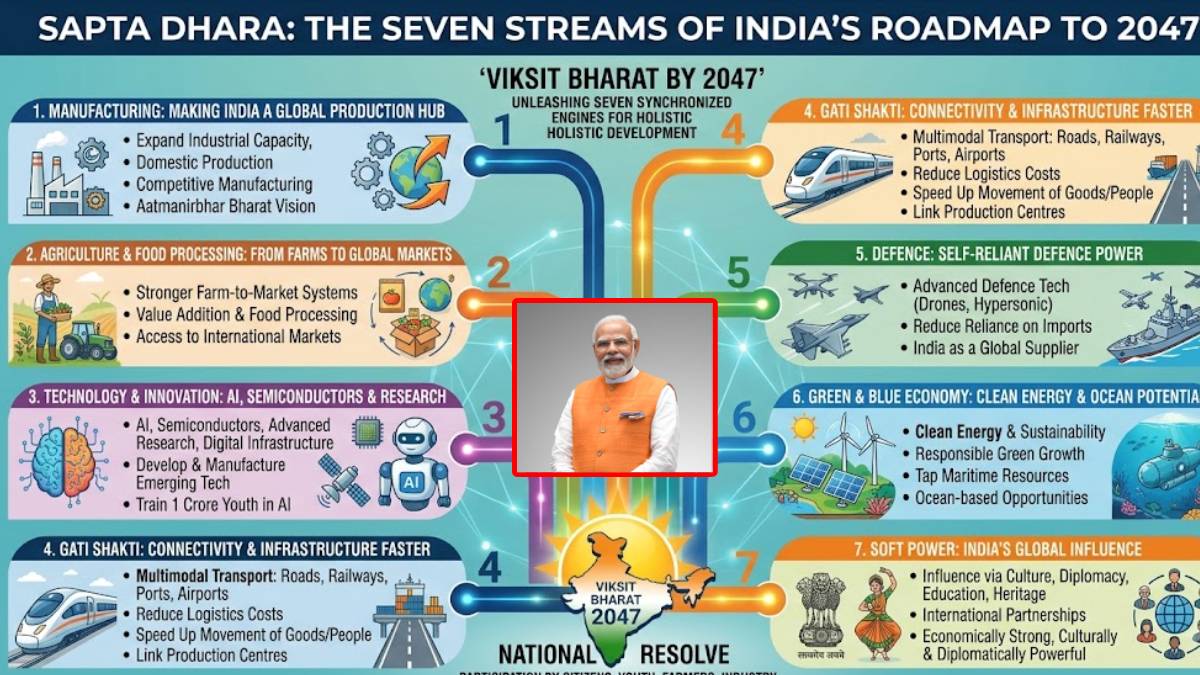
Sapta Dhara is a broad term that describes seven streams of strength. Rather than treating development as a series of disconnected schemes, the framework brings together seven strategic areas that can support each other: manufacturing, agriculture and food processing, technology and innovation, Gati Shakti, defence, green and blue economy and India’s soft power.
Hence,
1. Manufacturing: Making India a global production hub.
The first pillar is manufacturing power. The aim is to expand India’s industrial capacity, strengthen domestic production and position the country as a globally competitive manufacturing destination.
The focus on manufacturing also fits with the broader vision of Aatmanirbhar Bharat in which India can manufacture more of the goods, technologies and components it needs and become a major exporter.
2. Agriculture and Food Processing: From Farms to Global Markets
The second stream puts agriculture and food production at the heart of India’s growth story. The vision goes beyond growing farm output to create stronger farm-to-market and farm-to-export systems.
PM Modi has also emphasized value addition, food processing and greater access to international markets. Such an approach might even help farmers move from selling raw agricultural commodities to participating in higher-value supply chains.
3. Technology and Innovation: AI, Semiconductors and Research.
Technology is another important pillar of Sapta Dhara. India’s future growth is increasingly linked to artificial intelligence, semiconductors, advanced research, digital infrastructure and innovation.
In the Independence Day address, the Prime Minister also announced an initiative to train one crore young Indians in artificial intelligence as part of the nation’s strategy to build a workforce that will be able to excel in the technology-driven world economy.
The broader goal is clear: India should not only consume emerging technologies but increasingly develop, manufacture and export them.
4. Gati Shakti: Connectivity and Infrastructure Faster.
The fourth pillar is Gati Shakti, which is infrastructure, logistics and connectivity.
Efficient roads, railways, ports, airports and multimodal transport systems can reduce logistics costs and increase the movement of people and goods. Better connectivity can also strengthen manufacturing and exports through linking production centres with domestic and international markets.
Gati Shakti is therefore an important connecting layer between several other Sapta Dhara pillars.
5. Defence: Self-Reliant Defence Power.
Defence is another key component of the roadmap. PM Modi stressed the importance of building India’s capabilities in advanced defence technologies and reducing reliance on imports.
The focus is on drones, counter-drone systems and hypersonic technology, and for India to become self-reliant and be a global supplier of advanced defence systems.
6. Green and Blue Economy: Clean Energy and Ocean Potential.
The sixth stream combines the green and blue economies. The green economy is concerned with clean energy, sustainability and environmentally responsible growth, while the blue economy brings India’s vast maritime resources and ocean-based opportunities into the development strategy.
This pillar speaks to the challenge of achieving rapid economic growth while ensuring that growth remains sustainable over the long term.
7. Soft Power: India’s Global Influence.
The seventh pillar is India's soft power—the ability to influence the world through culture, diplomacy, education, heritage, values and international partnerships.
India’s global influence has grown across many domains and the Sapta Dhara framework places that influence alongside economic, technological and strategic capabilities. The objective is to build a country which is economically strong as well as culturally and diplomatically powerful.
Seven Streams, One Long-Term Vision
What makes Sapta Dhara so significant is how the seven pillars are connected. Technology and infrastructure are fundamental to manufacturing. Food processing, logistics and exports are good for agriculture, as well as research and manufacturing to do with defence. Green energy can drive industrial growth while the blue economy can provide new sources of energy and maritime expansion.
In this sense, Sapta Dhara isn’t just another list of priorities— it’s a deliberate attempt to align seven synchronized engines so that progress in one area can accelerate growth in others.
The ultimate goal is Viksit Bharat by 2047, when India completes 100 years of independence. PM Modi has put forward that goal not only as a government objective but as a national resolve requiring participation from citizens, youth, farmers, industry and institutions.
The problem now is implementation. Turning the seven streams into measurable outcomes will take sustained investment, policy continuity, skilled manpower, innovation, efficient institutions and strong coordination between the Centre, states and private sector.
If executed properly, Sapta Dhara would provide a common strategic framework for India’s next phase of development—linking production with technology, farms with global markets, infrastructure with industry, defence with innovation, sustainability with growth, and national capability with global influence.
With 2047 as the end point, the seven streams of Sapta Dhara are an ambitious roadmap for India’s transformation from a rapidly expanding economy to a larger global power.