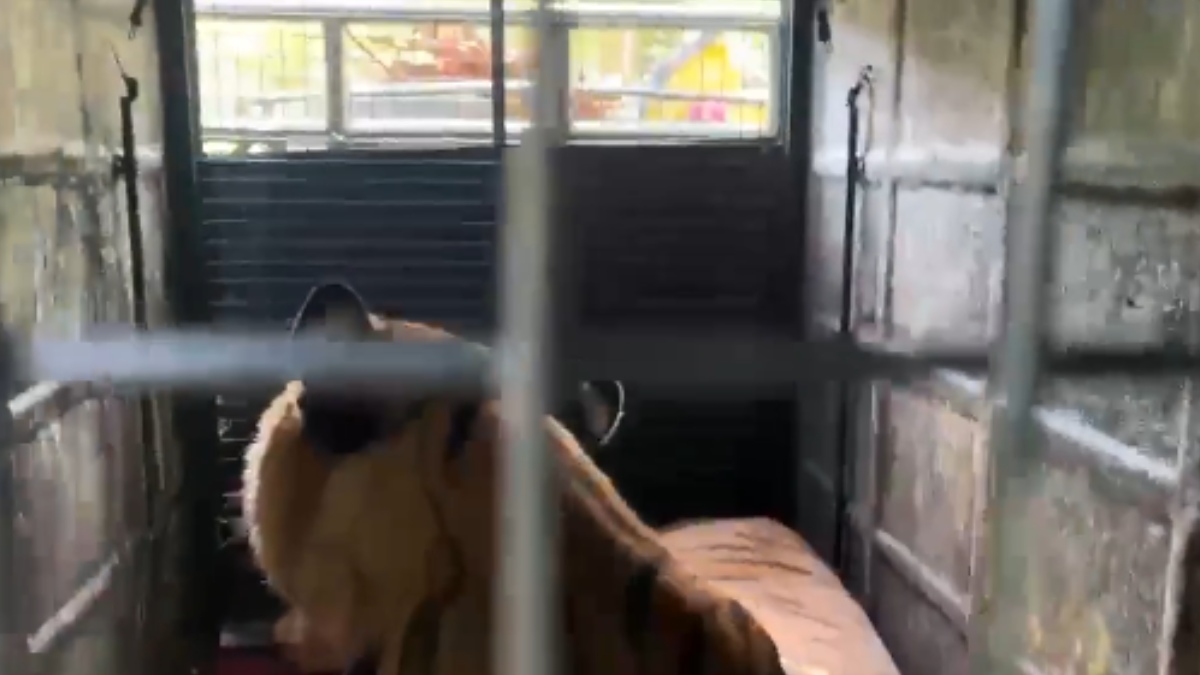
Gudalur, Nilgiris: A tiger suspected to be responsible for the deaths of two people in the Gudalur region of the Nilgiris has been captured by forest officials after a major search and seizure operation in the area.
Residents who had been living in terror and uncertainty in the wake of the deadly encounter will experience much relief. It is the second time in a decade that human-wildlife conflict has erupted in many parts of the Nilgiris in a region where settlements and forest habitats are close to each other.
The tiger had become a major concern for people living in and around Gudalur after two human deaths were reported in separate incidents. Forest officials intensified monitoring and started efforts to identify and capture the animal believed to be involved.
Teams were sent to such vulnerable areas and movement patterns and signs of tiger activity were closely monitored. There was a need for the coordination of forest staff with local authorities, especially for the difficult terrain and the safety of the residents.
Gudalur is located in the Nilgiris region, a rich forest region with a multitude of wild animals. The area forms part of a broader ecological corridor that is home to tigers, elephants, and other wild animals. But human settlements, roads, plantations, and agricultural areas close to forests can sometimes attract animals into areas inhabited by people. Such encounters can be dangerous if a wild animal makes repeated contact with human habitation or is suspected to attack people.
The deaths attributed to the tiger caused a lot of concern, and people began to be more circumspect about going to the forest edge. Forest officials had to balance the need to protect local communities with wildlife management procedures. Capturing a tiger is a tricky job - the tiger has to be located, monitored, and safely restrained so as not to put people or wildlife at risk.
The capture is a step forward for the situation, and the relief is expected to be felt by communities that had been following forest department efforts. The animal (or another wild animal) will be questioned to establish whether it is responsible for the attacks reported by the public. Such verification is important in situations of human-wildlife conflict when a lot of wild animals may be in the surrounding forest.
The incident also underscores the importance of continued monitoring in areas where human settlements line wildlife habitats. Forest officials frequently use camera traps, field observations, footprints, and other signs to determine animal movement and identify individuals who could pose a threat to people. Public cooperation is also crucial, especially when authorities issue warnings or restrict movement in areas considered vulnerable.
Tiger that killed two people in Gudalur, Nilgiris, captured pic.twitter.com/p3VsfrSxdY
— Vignesh Theni (@Vignesh_twitz) September 18, 2026
The capture gives Gudalur residents an immediate sense of relief after a period of concern over another possible encounter. But the incident is also a reminder of the delicate relationship between communities and wildlife in the Nilgiris. Conservation experts and authorities are still calling for long-term strategies to minimize encounters between people and wild animals and protect the forest ecosystem for all in the region.
And now that the tiger is captured, the Forest Department’s next steps will be to identify, conduct a medical examination, and assess the animal and its condition. The authorities will then be able to take the appropriate measures for wildlife management procedures.