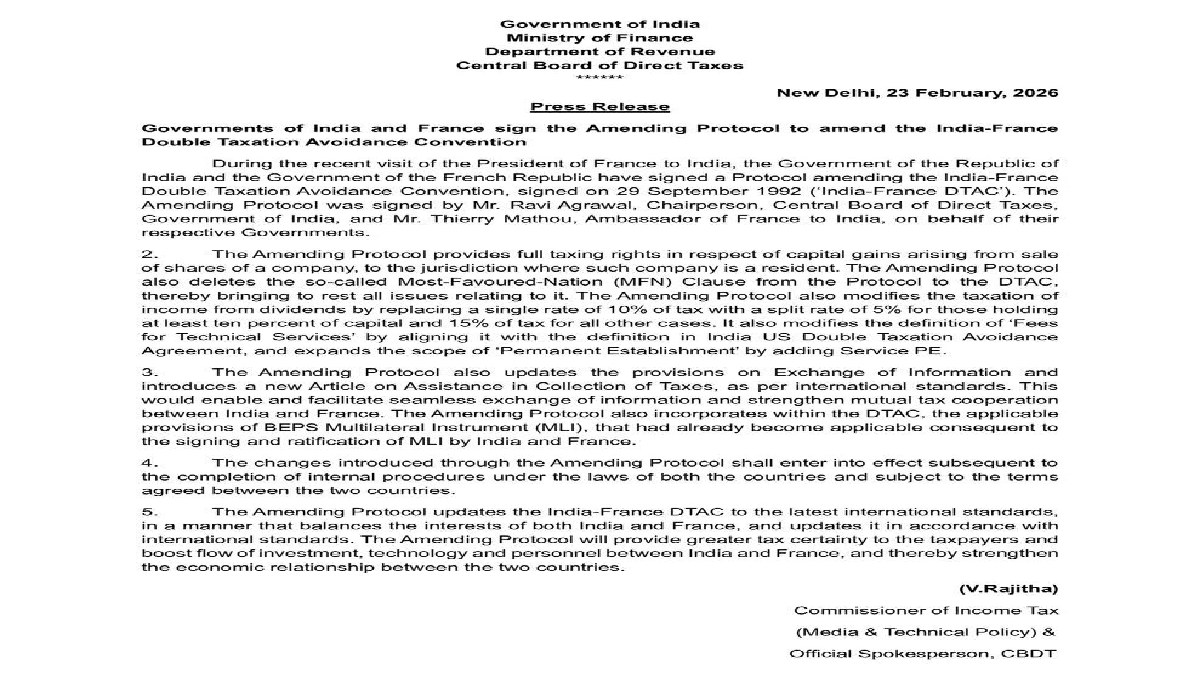
India signed an Amending Protocol with France to amend the Double Taxation Avoidance Convention (DTAC). The update reflects a commitment by the two countries to harmonize bilateral tax provisions with the current international system and enhance the clarity of their approach for cross-border economic activity.
Background
The protocol was settled between the Government of India and France. It amends the India–France DTAC that was signed on 29 September 1992. The changes sought to clear up interpretational complications, promote transparency and bring greater security to taxpayers and investors.
Key Amendments
- Capital Gains Taxation; The protocol is said to involve total taxing rights on the jurisdiction where a company is resident with respect to capital gains arising from the sale of shares. This clarification aims to limit controversies and ensure the treaty meets evolving global tax standards.
- Removal of the MFN Clause: The Most-Favoured-Nation (MFN) Clause has been removed, which clears up the confusion over its use.
- Modified Dividend Taxation: Taxing dividends for income has been made simpler through:
- One 10% tax rate, or
- A split rate structure:
- 5% for a shareholder who owns at least 10% of the company’s equity
- 15% for other cases
Updated Definition of Fees for Technical Services (FTS)
To enhance consistency and predictability of FTS results, it has been harmonized with internationally recognized standards.
- Extension of Permanent Establishment (PE) Clauses: New provisions are now recognized in the treaty, especially with regards to Service PE as part of today's business model and service-based operation.
- Better sharing of info and aid on tax collection: New provisions strengthen information sharing and introduce cooperation in tax collection to make it transparent and compliant.
- BEPS MLI Provisions Integration: Certain provisions of the Base Erosion and Profit Shifting (BEPS) Multilateral Instrument (MLI) have been incorporated into the DTAC framework.
Expected Impact
The amendments are designed to:
- To provide greater tax certainty to multinational enterprises and investors
- Reduce risk of double taxation
- Reduce potential cross border tax disputes
- Support investment and technology flows
- Enhance the economic cooperation of India and France
Access into effect
The Protocol should enter into force after the completion of legal and ratification procedures in both countries, per agreement.
The Amending Protocol is significant as it introduces both new parameters and new measures for India's tax system and offers the prospect of greater public confidence that will ease the problem for the country that would otherwise find it hard to meet with its trade obligations.