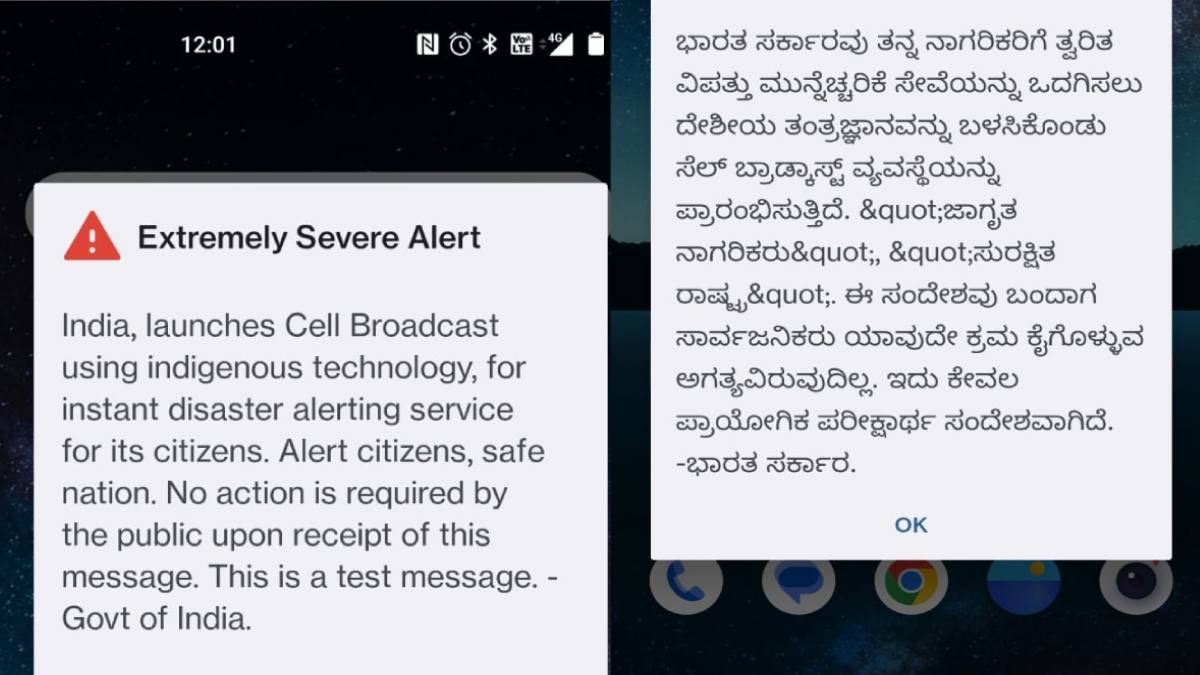
Millions of mobile phone users across India were surprised on Saturday after receiving a sudden government-issued notification titled “Extremely Severe Alert.” The alert, which appeared on smartphones with a loud notification sound and warning tone, caused confusion among many citizens before officials clarified that it was only a nationwide test of India’s newly launched emergency cell broadcast system.
The Government of India officially unveiled its indigenous emergency warning platform called “SACHET” today. The system was launched in the presence of Union Home Minister Amit Shah and Union Communications Minister Jyotiraditya Scindia.
The newly introduced platform aims to provide rapid disaster and emergency alerts directly to mobile phones during critical situations such as earthquakes, cyclones, floods, tsunamis, industrial accidents, or national emergencies. Officials stated that the test alerts sent on Saturday were part of a planned nationwide drill to evaluate the system’s efficiency and public reach.
The notification informed users that India had launched a domestic technology-based emergency alerting service and clearly stated that no action was required from the public. However, the sudden appearance of the message and its alarming title initially triggered panic and confusion among some users on social media.
At the heart of the new initiative is the SACHET Integrated Alert System, developed by the Centre for Development of Telematics (C-DOT), which is the Department of Telecommunications’ premier research and development organisation. The system has been designed based on the Common Alerting Protocol recommended by the International Telecommunication Union (ITU), ensuring compatibility with global emergency communication standards.
Government officials said the emergency broadcast network is now operational across all 36 states and union territories in India. The technology allows authorities to instantly push alerts to millions of mobile devices within specific geographic regions during emergencies, even if mobile networks are congested.
Unlike regular SMS services, cell broadcast technology does not require individual phone numbers and can send notifications simultaneously to all compatible devices connected to nearby cell towers. This makes it especially useful during disasters when communication systems often face heavy traffic and delays.
Citizens who had enabled test channels or emergency alerts in their mobile phone settings received the warning messages in English, Hindi, and several regional languages, depending on their location and device configuration.
Officials emphasised that Saturday’s notification was only a test and urged citizens not to panic upon receiving similar alerts during future drills. Authorities also highlighted that public awareness and preparedness are essential components of disaster management.
Experts believe the launch of the SACHET system marks a major step forward in strengthening India’s disaster response infrastructure. With climate-related disasters and extreme weather events becoming more frequent, rapid communication systems are increasingly seen as critical tools for saving lives and minimising damage.
The government is expected to continue conducting periodic test alerts in the future to improve system performance and ensure nationwide readiness during real emergencies.
Take A Look At How Netizens Are Reacting
हे कशासाठी आहे?
— शब्द माझा सखा...✨❤️ (@mayuri0204) May 2, 2026
भविष्यात पूर, भूकंप किंवा सुनामी यांसारख्या नैसर्गिक आपत्तींच्या वेळी नागरिकांना त्वरित सतर्क करण्यासाठी सरकार ही नवीन स्वदेशी तंत्रज्ञान प्रणाली वापरणार आहे. त्याच प्रणालीची कार्यक्षमता तपासण्यासाठी ही चाचणी सुरू आहे.#alert pic.twitter.com/3EUotLeOJ2
Sab 2 bar aya testing #alert ya muje hi 2 bar toda 😂😂😂😂 pic.twitter.com/FemK31GAYh
— Merlin Varughese (@MerlinVarughese) May 2, 2026
Did anyone received an alert message on Their Phone ? What was that ?? #Alert
— Mohit Virkar (@mohit_virkar) May 2, 2026
#WTF … BC got a mini heart attack with this exteremely severe #Alert from GOI pic.twitter.com/GNqhdu1JC8
— Muhammad Aasim Qamar (@qmaasim) May 2, 2026