If you’ve ever seen a train go by a railway station without stopping, you will find an interesting sight. A train races past the platform and just seconds later there is a member of the station staff who appears to hand the locomotive pilot (loco pilot) a small circular object. Many passengers won’t know what is being passed and why it is so important.
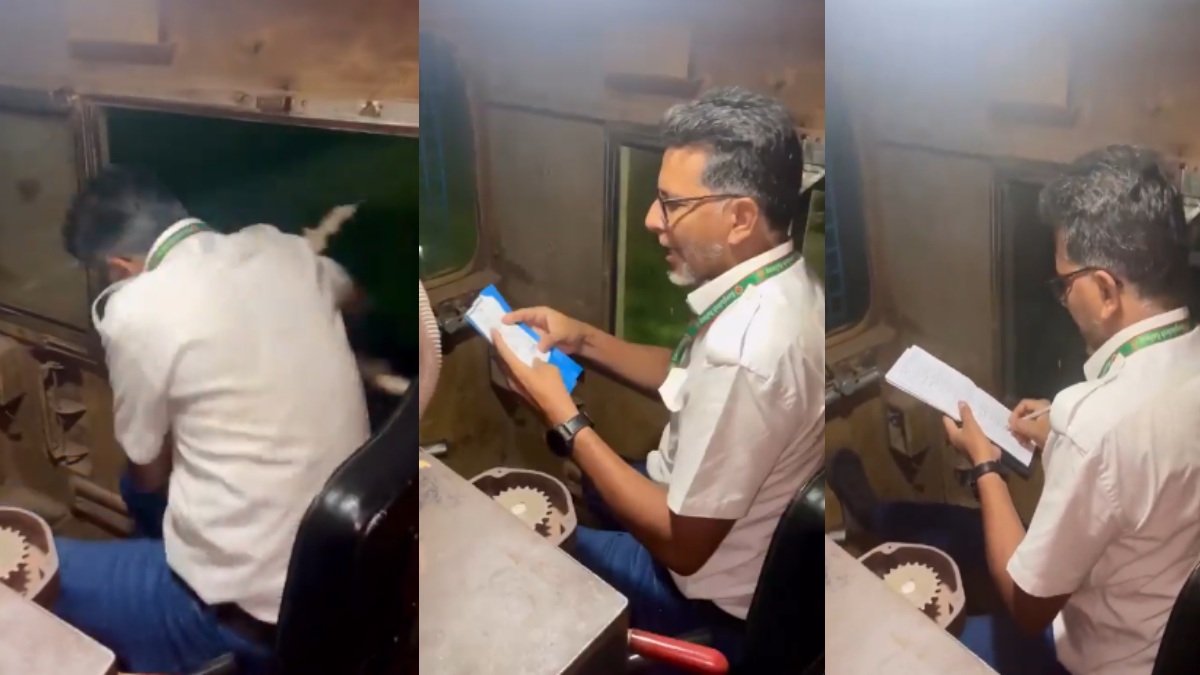
The object being exchanged is often referred to as a token or staff token and has long been a key part of railway safety on single-line railways. Modern signalling systems have reduced its use on many routes but token systems are still used in some areas where advanced electronic signalling has not yet been implemented.
What is a railway token?
The railway token is a specialised metal object which is circular, hoop-shaped or key-like depending on the signalling system in use. It is a physical authority for a train to enter and travel through a single-line section of track.
On a single line, trains travelling in opposite directions share the same track. To avoid collisions, only one train should be allowed to enter a section of the track at any point. The token is to prove that the train has exclusive permission to enter that part of the track.
Simply put, if the locomotive pilot possesses the token, no other train can legally enter that same stretch of track until the token is returned at the next designated station.
Why is it exchanged at high speed?
Many express and freight trains do not stop at every station. Instead of halting just to collect or hand over the token, specially trained railway staff perform the exchange while the train is moving.
The station staff holds the outgoing token using a hoop or carrier, allowing the locomotive pilot to collect it safely as the train passes. At the same time, the pilot releases the token for the section just completed, which is collected by another staff member.
The trains are able to exchange with each other and are able to keep their speed while still doing what is needed to maintain train operating and train service in both cases.
What happens if the loco pilot misses the token?
Hence, one of the most common questions among railway fans is what happens if the locomotive pilot doesn’t catch the token or accidentally drops it.
Contrary to popular opinion, the train is not immediately stopped in every case. The response is based on the circumstances and operating rules in that railway section.
In general, railway authorities follow safety procedures that may include:
- Communication between the station master, signal operators, and locomotive pilot using railway communication systems
- To check if the train has the legal authority to enter the next block section.
- If the train has not been given any authority to move through (like the required token on a token-operated section), then it can stop at the earliest safe time before going to the next section
When the train is stopped, railway staff will retrieve the missing or dropped token and follow the operating rules, and the train should resume. If it is necessary, we may also use other written or authorized procedures under the strict railway policy to allow the train to proceed safely.
The exact protocol depends on the signalling technology in use, local operating instructions, and whether the route uses traditional token systems or modern electronic signalling.
Why isn't it always an emergency?
Indian Railways places safety above everything else. Missing a token does not automatically create a dangerous situation because multiple layers of operational control exist.
Station masters, controllers, signal operators, and locomotive pilots keep in constant communication. Modern communication equipment, centralized traffic control, and electronic records help railway officials make the safest course of action.
Today, on very busy railway routes, the token exchanges have increasingly been replaced by systems such as Electronic Token Blocks, Automatic Block Signalling, or Centralized Traffic Control which remove the need for physical tokens entirely.
A Legacy of Railway Engineering
The token system has been in operation in railway operations for more than a century and is considered one of the most ingenious mechanical safety mechanisms ever developed. Before computers and digital signalling became common, this simple physical apparatus prevented countless accidents by requiring one train to be on a single track at the same time.
When token systems are still in place today, railway staff members undergo rigorous training to perform fast exchanges in a safe and accurate manner
99% लोगों ने ट्रेन में ये देखा होगा लेकिन इसका असली राज़ नहीं जानते!
— Jamal | Viral desk (@jamalk38) July 27, 2026
ट्रेन जब फुल स्पीड में किसी स्टेशन से बिना रुके गुजरती है तो उस वक्त लोको पायलट और स्टेशन मास्टर के बीच एक छोटी-सी गोल चीज़ बिजली जैसी रफ्तार में एक्सचेंज होती है!
सवाल ये है आखिर ये होती क्या है? इसे… pic.twitter.com/yLXx3BsccR
The small circular object a locomotive pilot and station staff exchange is not limited to a metal ring, but is the most important railway safety device to keep trains running for decades. Modern technology is slowly replacing traditional token systems, but there still exist some railway routes where it is still necessary.
If a token is missed or dropped, Indian Railways has safety procedures to be followed, not just guesswork. Every decision is made in accordance with the operating rules and in line with passenger safety. If you see this lightning-fast interchange at a train station the next time, you will know you are watching one of the most interesting and historically significant safety practices in railway operations.