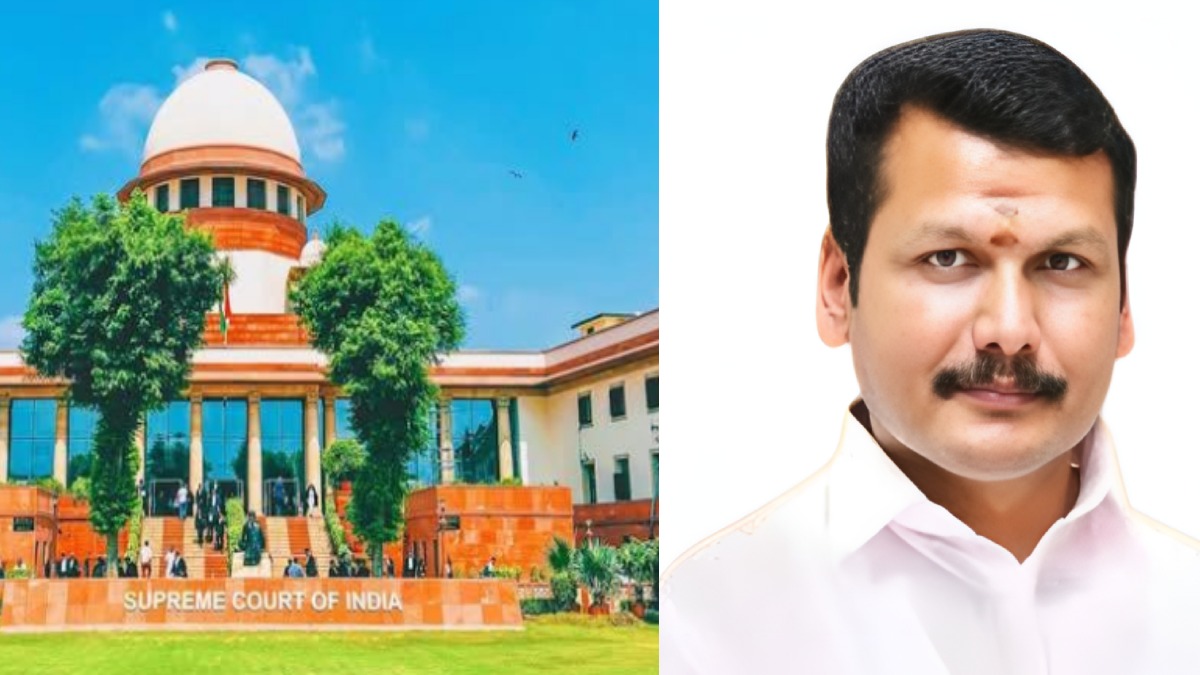
Supreme Court Judge Justice V. Mohana has recused herself from hearing the anticipatory bail plea filed by DMK MLA Senthil Balaji.

The recusal is a procedural decision that does not represent a decision on the merits of Balaji’s anticipatory bail application. With the judge’s decision to step down, the matter will be brought to an appropriate bench for further consideration.
Senthil Balaji is a prominent leader of Dravida Munnetra Kazhagam (DMK) and a former Tamil Nadu minister. His legal matters have attracted significant political and public attention because of his position in the state's political landscape.
An anticipatory bail plea refers to a person who fears arrest in connection with a criminal case. Such a plea is made if one wishes to be released from arrest and, if the court takes no action, it will be a bail plea.
In the present case, the Supreme Court was to hear Balaji’s plea. But Justice V. Mohana recused herself from the hearing. The reason for the recusal was not disclosed.

Judicial recusal is when a judge decides not to hear a particular case. Such decisions may be made for conflicts of interest, past associations, personal circumstances, or for the sake of judicial propriety.
A judge’s recusal doesn’t mean that the court has made up its mind about the allegations, the applicant, or the merits of the case. It also does not mean that the anticipatory bail plea was accepted or rejected.
After recusal, the matter may be transferred or listed again before another bench in accordance with Supreme Court administrative procedures. The next date of hearing and the composition of the bench can be decided by the court.
The development will be closely watched as Senthil Balaji’s political profile and legal problems are both associated with the case. The DMK leader is still very much on the scene of Tamil Nadu politics, and court proceedings involving him can take many political parties and the public by surprise.
The anticipatory bail plea will be considered separately by the bench assigned to hear the matter. The court may consider the allegations, the nature of the investigation, the applicant’s submissions, and the arguments of the investigating agency or other respondents.
The court may also consider the seriousness of the allegations, the possibility of interference with the investigation, and the applicant’s cooperation with authorities. These are, of course, very much in mind for anticipatory bail cases, and the final decision is predicated on the specific facts and legal arguments.
The recusal has not changed the legal status of the anticipatory bail plea. It only means that Justice V. Mohana will not participate in the hearing or decision concerning the matter.
Details will be available once the case goes before another Supreme Court bench. The next hearing may give us a better understanding of the legal case and what’s to happen next.
So far, the Supreme Court judge’s recusal is just procedural in the case, and the issue of anticipatory bail has yet to be decided by a suitable bench.