Karnataka’s significant contribution to India's areca nut economy has once again come into focus after the Union Government provided important information in Parliament regarding GST collections from the areca nut trade.
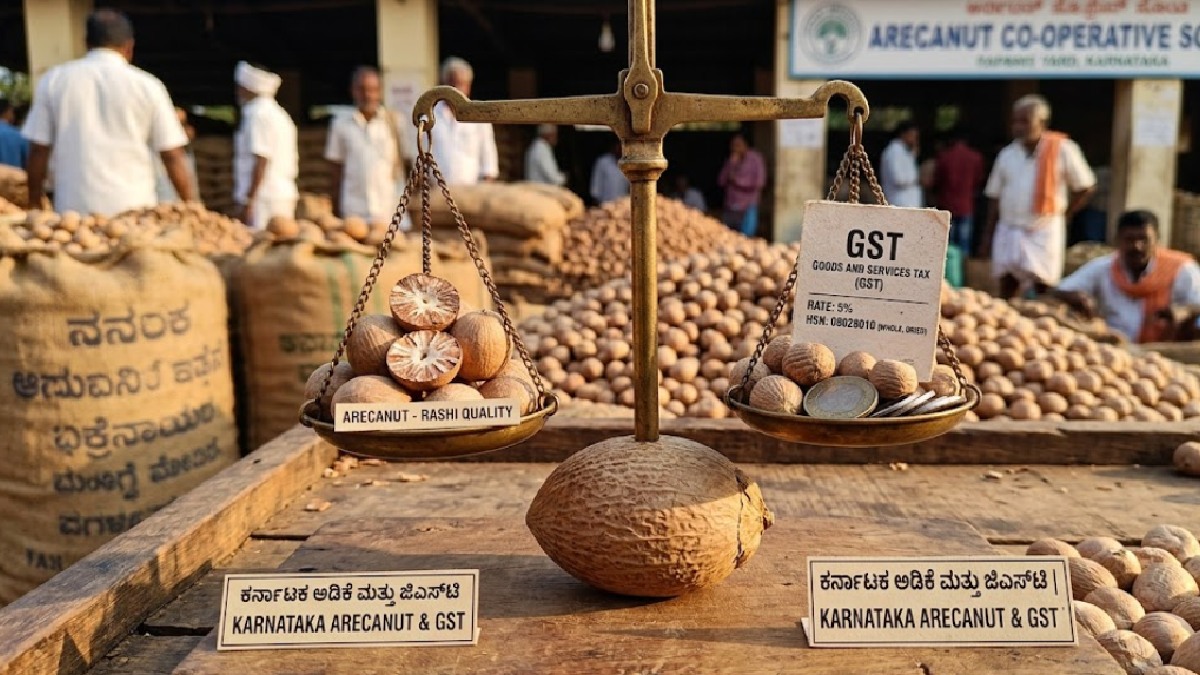
The information was given in response to a question by Shivamogga MP B.Y. Raghavendra, who asked about GST collections generated from the sale and business activities related to areca nut across the country, including the contribution from Karnataka.
Areca nut is one of Karnataka’s most significant commercial crops and is a very important part of the Malnad and coastal economy. Thousands of farming families in Shivamogga, Chikkamagaluru, Dakshina Kannada, Udupi, Davangere and Uttara Kannada depend on areca nut cultivation and its activities directly or indirectly.
Karnataka’s Importance in the Areca Nut Economy
Karnataka is one of India’s key areca nut producing states. The climate and geography of the Malnad and coastal belts are very favourable for areca nut production. Farmers in these areas have been growing this crop for over 20 years, and it is a part of the rural economy.
In Shivamogga district, Sagara, Soraba, Hosanagara, Thirthahalli and Bhadravati have a strong dependence on areca nut cultivation. For many families, the crop is an important source of agricultural income.
But it is the economic value of areca nut that far exceeds its agricultural value.
The sector supports a wide range of traders, commission agents, transport operators, warehouse owners, processing units, labourers and other service providers. The crop is therefore involved in economic activity at several stages from farm gate to wholesale markets and processing centres.
GST Collection Highlights the Scale of Trade
The GST system brought a unified indirect tax framework for the supply of goods and services in India. Agricultural transactions can generate tax revenues at various stages of the supply and business chain depending on the relevant tax provisions and the nature of the transaction.
As areca nut production and trade are huge in Karnataka, the state is a very important part of the country’s areca nut business ecosystem.
The information sought by B.Y. Raghavendra is important because GST-related data can give an indication of the scale of formal commercial activity associated with the sector. It also brings attention to Karnataka’s importance as a major production, trading and market hub for areca nut.
Why B.Y. Raghavendra’s Question Matters
The issue is particularly relevant to farmers in Shivamogga and other areca nut-growing areas.
Areca nut farmers encounter difficulties with price fluctuations, market uncertainty, imports, crop diseases, weather conditions and changing government policies. Taxation and the sector’s overall economic impact on the country’s economic performance are therefore of policy importance from a wider perspective.
GST collection figures alone do not determine the price received by farmers. However, such data can help demonstrate the commercial scale of an industry and draw greater attention to the economic contribution made by farmers, traders and allied businesses.
For a sector that has a large production and trading network, infrastructure (storage facilities, processing units, transportation networks and organised markets) can be of great use in reducing losses and improving efficiency.
Areca Nut and the Malnad Rural Economy
In the Malnad region, areca nut cultivation is closely linked to the rural economy.
Employment is generated in a variety of stages from plantation maintenance, harvesting, processing, transportation, storage, and marketing. Local businesses and service providers benefit from the circulation of income generated by the crop.
This makes areca nut much more than an agricultural commodity. It is an essential economic activity supporting farmers, workers, traders and many related businesses.
Shivamogga, in particular, has emerged as one of the key centres for Karnataka's areca nut trade. So the performance of the sector has implications for individual farmers and rural commerce in the region.
What Areca Nut Farmers Need
While GST collections show the economic importance of the sector, farmers are primarily concerned with stable prices, reliable markets and sustainable cultivation.
Policy support for the sector could focus on market stability, quality standards, storage infrastructure, processing facilities, scientific cultivation practices and measures that protect farmers from extreme price volatility.
Import-related policies are also an important concern for domestic growers, as changes in supply can impact market prices. At the same time, farmers need access to better technology, crop management practices and effective disease-control measures to protect productivity.
Scope for Greater Policy Attention
The Centre’s response to the parliamentary question has once again highlighted the major commercial importance of Karnataka’s areca nut sector.
For Karnataka’s farmers, the bigger goal is not just higher tax collection. The economic value generated by the sector has to be invested in the development of better rural infrastructure, greater access to markets and more opportunities for farmers.
As Karnataka is still one of India’s major areca nut production and trading centres, the current policy attention to the crop could benefit its wider agricultural economy.
The discussion around GST collections thus provides an opportunity to look beyond taxation and to explore the entire areca nut value chain—from farmers and traders to processing, transportation, storage and national markets.
For thousands of families in Shivamogga, Chikkamagaluru and Karnataka’s coastal and Malnad regions, the future of the areca nut sector is closely linked to their livelihoods as well as the performance of the rural economy.