For millions of devotees, some of nature’s most beautiful creations are not just geological formations but of much spiritual significance. The Shaligram has a special place in Sanatan tradition for the most cherished. Shaligrams are naturally formed stones often associated with Bhagwan Vishnu in the sacred Himalayan region of Nepal. A large Shaligram unearthed near Muktinath has become well known for its remarkable appearance and deep religious significance.
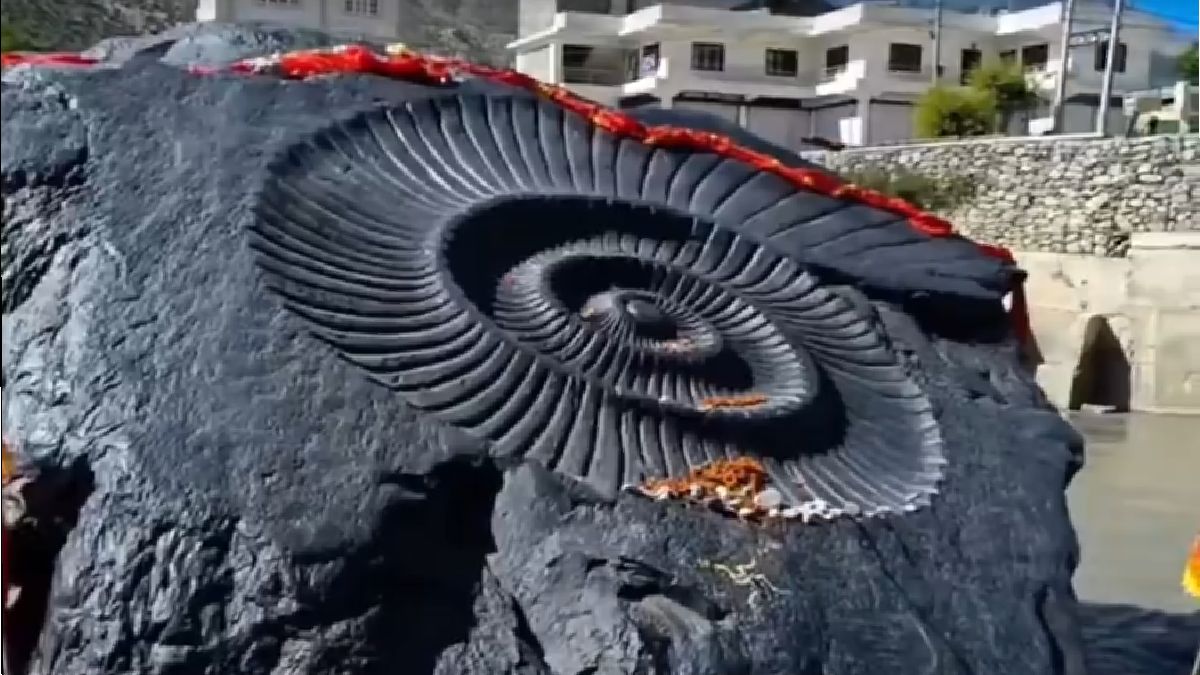
Muktinath, a place where Bhagwan Vishnu is venerated in Nepal, is one of the most venerated pilgrimage spots for Hindus in the Mustang region. The holy site is of great importance for Hindu and Buddhist devotees. And Shaligram stones in the area add another dimension to it.
Shaligrams are found mostly at the Kali Gandaki River, which flows through the Himalayan mountains of Nepal. Shaligrams are not the traditional religious idols of humans and are naturally produced stones. And they have been identified as manifestations of Vishnu since the beginning.
The massive Shaligram near Muktinath is so amazing because of its size and natural appearance. Over an extended period of geological time, natural forces such as flowing water, erosion and pressure have shaped stones in the Himalayan landscape. What modern observers might view as an extraordinary geological object is viewed by devotees with a different view—that of a sacred object carrying divine symbolism.
Shaligram is very much a part of Hindu tradition as well. Shaligram worship is associated with Vaishnavism, the tradition of Bhagwan Vishnu. And people keep Shaligrams in their homes and temples as a symbol of Vishnu and worship them as well. Natural markings are considered significant and different kinds of Shaligrams represent different manifestations or attributes of God—whether in one form or another.
The Shaligram and Kali Gandaki region are also spiritually linked to its religious identity. The river is sacred and generations of pilgrims have traversed the mountains of Himalayan terrain to visit Muktinath and live there spiritually. The landscape (massive mountains and ancient valleys and glacial rivers) is a place where nature and religion are inextricably intertwined.
For pilgrims, therefore, a Shaligram is much more than an unusual stone. It is a meeting point between the physical world and the sacred. The fact that these stones are naturally formed is itself a major part of their religious appeal. There is no sculptor or artisan there; the stone is assumed to have derived its unique shape from nature, and faith gives it a deeper spiritual meaning.
The story of the great Shaligram also illustrates the close tie between the Himalayas and Sanatan customs. In Nepal, mountain areas are a hotbed for pilgrimage, meditation and sacred geography. And places like Muktinath are still a magnet for people who wish to travel far to find blessings and spiritual fulfilment.
A stone shaped by millions of years, revered as a sacred manifestation of Bhagwan Vishnu.
— 𝐊𝐫𝐢𝐬𝐡𝐧𝐚𝐩𝐫𝐞𝐞𝐭𝐢 (@Krishnavallabhi) August 28, 2026
The massive Shaligram found near Muktinath, Nepal, is a breathtaking blend of ancient nature, faith and Sanatan tradition.
A wonder carved by time, worshipped by generations. 🙏 pic.twitter.com/0vvJZ794LP
At the same time, the Shaligram is a fascinating reminder of the very rich geological history of the Himalayan region. The stones around the Kali Gandaki have been formed by natural processes over long periods. So the forms of these stones can be understood both geologically as well as culturally from a cultural point of view—ancient structures formed by nature which have been developed and then grown to become significant after centuries of worship.
The big Shaligram near Muktinath, in particular, is a potent emblem of the convergence of nature, faith and tradition in one object. For devotees, it is a sacred image of Bhagwan Vishnu. For others, it is a striking manifestation of natural forces that have shaped the Himalayas for so long. Both those aspects together form Nepal’s spiritual and cultural heritage.
From the flowing waters of the Kali Gandaki to the high-altitude pilgrimage paths leading to Muktinath, the Shaligram is still an adventure. It is a tradition in which the divine is not always carved by human hands; it is a canvas for worship.