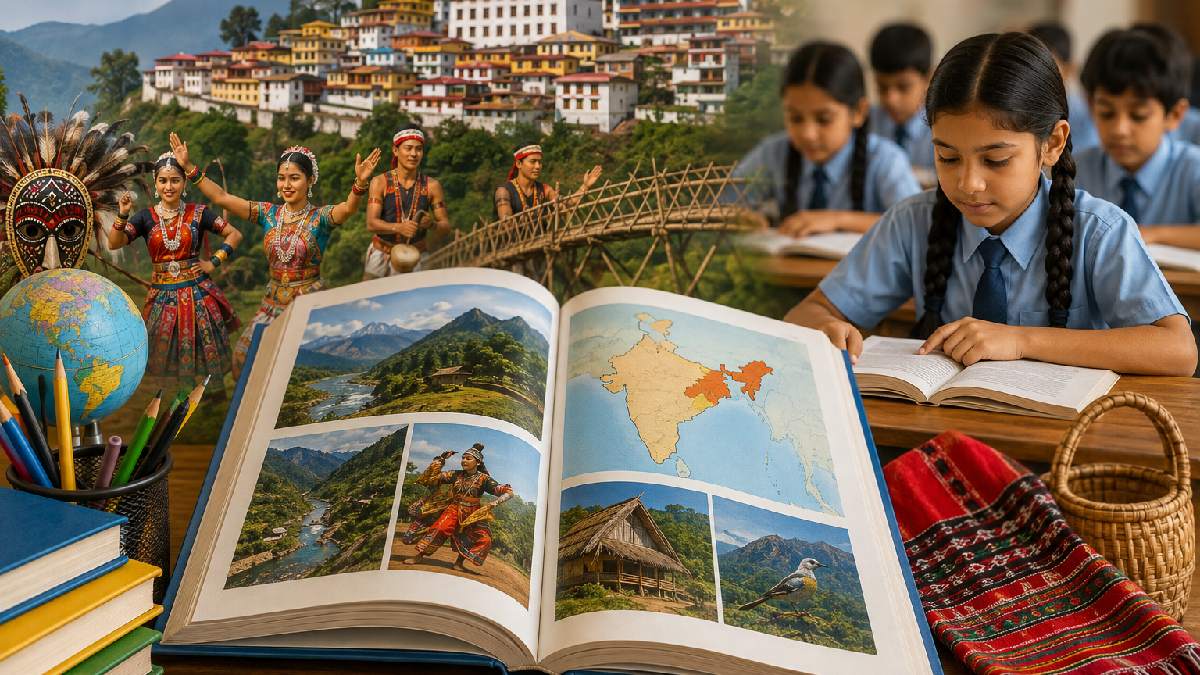
The Centre has informed the Rajya Sabha that the history, culture, traditions, heritage and contributions of the North-Eastern States have been integrated into NCERT textbooks for students from Grades 1 to 8. The idea is for students in all parts of the country to have a better context of the region and promote cultural diversity and inclusivity in school.
Rajya Sabha member Birendra Prasad Baishya asked whether the Government was considering including the history, culture, and heritage of the North-Eastern States in the NCERT curriculum so that students nationwide could get a better understanding of the region.
Responding to the question, Minister of State for Education Jayant Chaudhary said the National Council of Educational Research and Training (NCERT) conducted a series of district-level consultations with States and Union Territories, including the North-Eastern States, as part of the implementation of the NEP 2020. Such consultations helped to identify regional priorities and to get feedback on the effectiveness of the policy.
According to the minister, State Focus Groups developed detailed Position Papers based on these consultations. In turn these papers played an important role in shaping the National Curriculum Frameworks (NCF), particularly the National Curriculum Framework for School Education (NCF-SE) 2023.
Chaudhary said in the House that NEP 2020 and NCF-SE 2023 have been designed to ensure inclusive and equitable quality education, and that we respect India's diversity and local context. The policy promotes curriculum, pedagogy and planning of education to reflect India’s cultural richness and regional diversity, he said.
He also highlighted that the "Knowledge of India" component under NEP 2020 will help students to get a full picture of India's ancient history and contributions to the modern world, current achievements, current challenges, and future aspirations in education, health, science and environmental sustainability. These topics should be presented in a factual and scientific manner, he said.
The minister also pointed out that the policy places a big emphasis on Indian Knowledge Systems. Tribal knowledge, indigenous traditions, and traditional methods of learning are being incorporated into mathematics, astronomy, philosophy, yoga, architecture, medicine, agriculture, engineering, linguistics, literature, governance, sports and environmental conservation.
In addressing the specific concern related to the North-East, Chaudhary said NCERT's new textbooks for Grades 1 to 8 now include the history, culture, traditions, art, heritage and contributions of the North-Eastern States. These are intended to enhance students’ understanding of the region’s rich culture and its involvement in India’s development.
The Minister also told Parliament that NCERT has introduced Grade 6 R3 language textbooks and Grade 9 age-appropriate learning material in 22 Indian languages, including Assamese, Bodo, Manipuri and others. These materials incorporate cultural elements from the North-Eastern States and students can engage with regional cultures in their learning materials.
In addition to textbooks, NCERT has been conducting capacity-building programmes across States and Union Territories, including the North-East, to familiarise teachers and educators with the objectives of NEP 2020, NCF-SE 2023, cultural rootedness and Indian Knowledge Systems. These are measures that enhance classroom implementation of the revised curriculum.
He also mentioned that the National Syllabus and Teaching-Learning Material Committee and various Curricular Area Groups responsible for developing educational content include experts, scholars, and NCERT faculty from the North-Eastern States. They also ensure that regional perspectives and cultural representation are well represented in curriculum development.
The Centre's statement is a testimony to the government’s overall efforts to make school education more inclusive in which India’s cultures are represented. By incorporating the North-Eastern States’ heritage and contributions in NCERT textbooks in the context of multilingual learning resources, a new curriculum was created that aims to promote an awareness and appreciation for the North East States’ heritage and achievements in a way that fosters national integration in the minds of the nation and is in line with NEP 2020 and NCF-SE 2023.