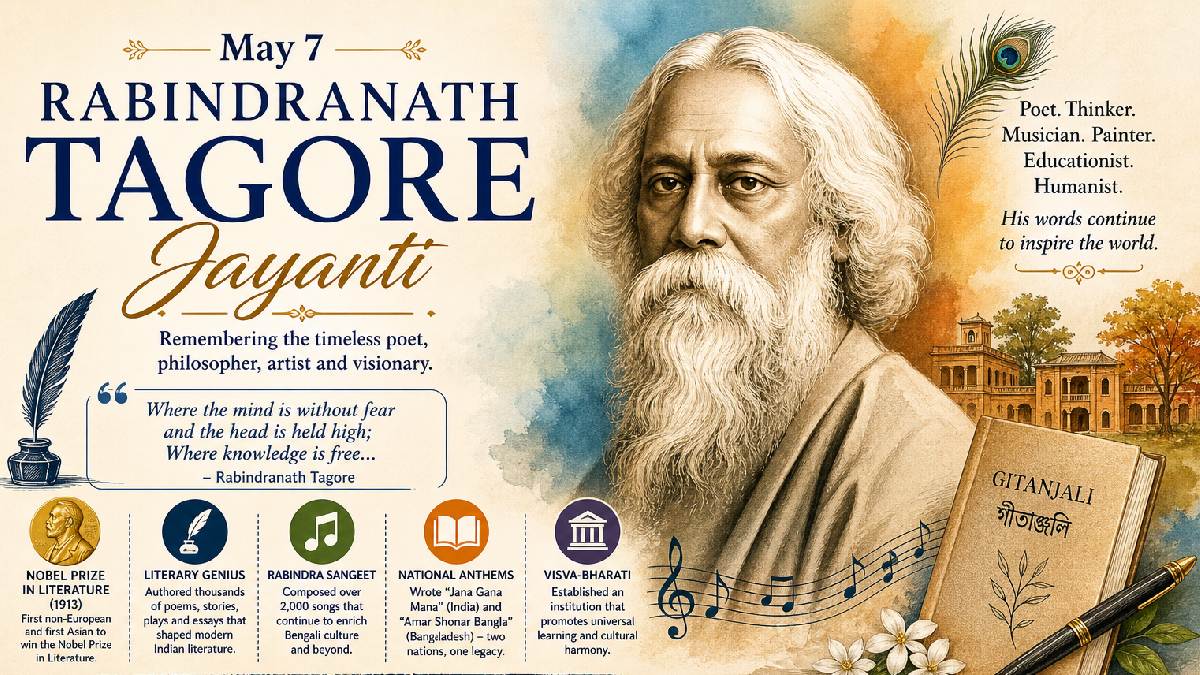
Every year on May 7, India and many parts of the world celebrate Rabindranath Tagore Jayanti, honoring the birth anniversary of one of history’s greatest literary and cultural icons — Rabindranath Tagore. A poet, philosopher, musician, painter, educator, and social thinker, Tagore’s contributions transformed literature, music, art, and education not only in India but across the globe.
His timeless writings and humanistic ideals continue to inspire generations, making Tagore Jayanti an important cultural and intellectual observance.
Why May 7 Is Celebrated
Rabindranath Tagore was born on May 7, 1861, in Kolkata, then known as Calcutta during British rule.
In the Bengali calendar, his birth anniversary is observed as “Pochishe Boishakh” (the 25th day of the Bengali month of Boishakh), which usually falls in late April or early May. However, May 7 is widely recognized internationally as his official birth anniversary.
Early Life and Literary Journey
Born into the influential Tagore family, Rabindranath displayed extraordinary talent from a very young age. He grew up in a culturally rich environment that encouraged literature, music, art, and intellectual thought.
Tagore revolutionized Bengali literature by blending traditional Indian culture with modern philosophical and literary ideas. His poetry, stories, essays, songs, and plays introduced fresh artistic expression while preserving India’s cultural identity.
Over his lifetime, he authored numerous literary masterpieces that remain celebrated worldwide.
Nobel Prize and Global Recognition
In 1913, Rabindranath Tagore created history by becoming the first non-European and first Asian to win the Nobel Prize in Literature for his acclaimed poetry collection Gitanjali.
The award brought global recognition to Indian literature and established Tagore as one of the world’s leading literary voices. His writings, deeply rooted in spirituality, humanity, and universal peace, resonated with readers across cultures and nations.
Contribution to Music and National Identity
Tagore’s influence extended far beyond literature. He composed more than 2,000 songs, collectively known as Rabindra Sangeet, which continue to hold a special place in Bengali culture and Indian music.
Remarkably, he also wrote the national anthems of two nations:
- India’s national anthem — Jana Gana Mana
- Bangladesh’s national anthem — Amar Shonar Bangla
His music and poetry reflected patriotism, humanism, and deep emotional connection with nature and society.
Vision for Education and Visva-Bharati
Tagore strongly believed that education should encourage creativity, independent thinking, and harmony with nature.
To bring his educational philosophy to life, he founded Visva-Bharati University in Santiniketan. The institution aimed to combine Eastern and Western educational traditions while promoting global learning and cultural exchange.
Scholars, artists, and thinkers from around the world were drawn to his ideas on freedom, creativity, and human unity.
Celebrations and Traditions
Rabindranath Tagore Jayanti is celebrated with great enthusiasm, especially in West Bengal and Bengali communities worldwide.
The celebrations include:
- Poetry recitations
- Rabindra Sangeet performances
- Dance dramas
- Literary discussions
- Cultural festivals
- Educational events
Schools, colleges, universities, and cultural organizations organize programs to honor his contributions to literature, music, education, and social thought.
Why Tagore’s Legacy Matters Today
In today’s fast-changing and divided world, Tagore’s messages of peace, unity, creativity, and universal humanism remain deeply relevant.
His works encourage:
- Critical thinking
- Artistic expression
- Respect for cultural diversity
- Compassion and harmony
- Intellectual freedom
Tagore believed that humanity transcends borders, religion, and politics — an idea that continues to inspire people globally.
A Timeless Cultural Icon
Rabindranath Tagore Jayanti is more than a remembrance of a legendary poet. It is a celebration of creativity, culture, knowledge, and the enduring power of art and humanity.
More than a century later, Rabindranath Tagore continues to influence literature, music, education, and philosophy across generations and countries.
On May 7, the world remembers the poet whose words still echo with wisdom, beauty, and truth — a timeless voice that continues to inspire humanity.