The debt resolution case of Zee Group founder Subhash Chandra has revived some debate after the National Company Law Tribunal (NCLT) approved a repayment plan of around ₹6.5 crore against admitted creditor claims of ₹22,006.57 crore.
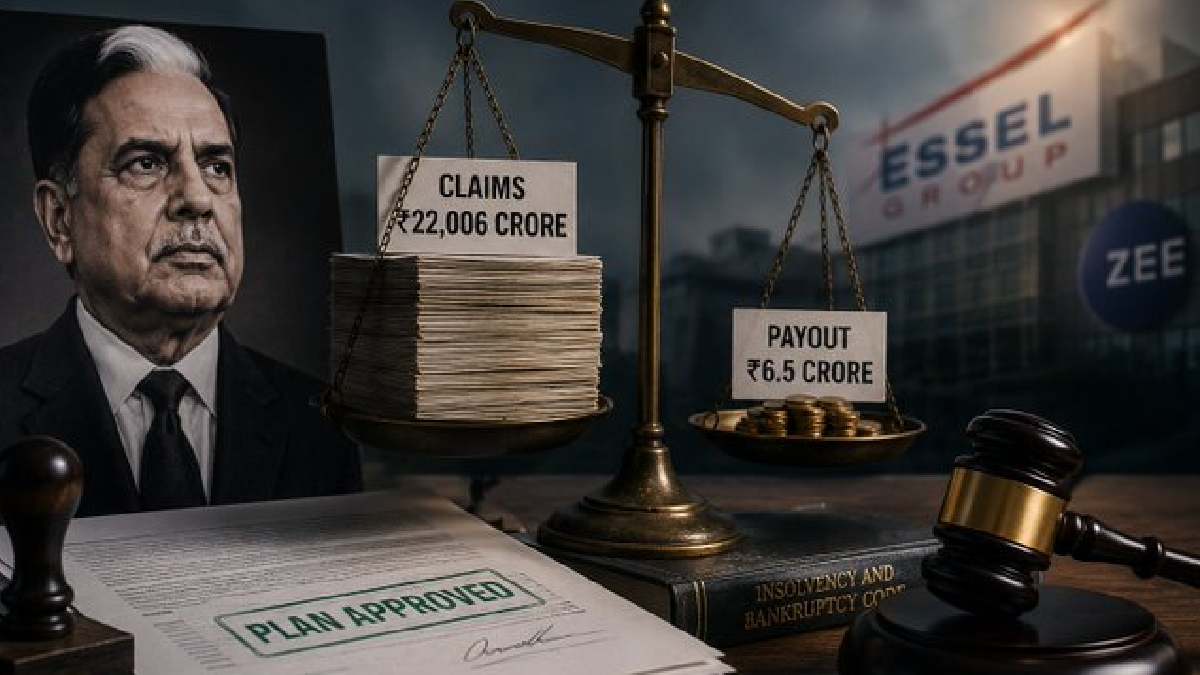
The amount claimed and the proposed recovery not being in line has led lenders to question the decision.
At first glance, the numbers show only a recovery of about 0.03% of admitted claims, which leaves creditors at a haircut of nearly 99.97%.
But the case involves personal guarantees provided by Chandra for loans taken by companies linked to Essel Group, making the matter more complicated than a simple personal loan dispute.
How Did the Case Begin
The insolvency proceedings against Chandra started from a ₹170-crore loan taken by Vivek Infracon, for which Chandra had given a personal guarantee.
When the loan defaulted in 2022, the insolvency proceedings were initiated against him. In 2024, the NCLT admitted the personal insolvency case of Chandra.
Lenders filed claims amounting to ₹22,000 crore along the way. Chandra has said he did not personally borrow this amount. His claim is that he was a guarantor for loans taken by various companies.
This distinction is important because it is Chandra's liability as a personal guarantor instead of the entire ₹22,006.57 crore as money directly borrowed by him.
Why Has the ₹6.5 Crore Figure Become Controversial
Under the approved plan, around ₹6.25 crore is proposed or creditors and another ₹25 lakh for insolvency, bringing the total amount to about ₹6.5 crore.
Some lenders have protested the plan on the basis that the recovery is very small compared to what they admitted to have done.
LIC Housing Finance, for instance, had an admitted claim of around ₹1,322.39 crore, but was offered around ₹38 lakh under the proposal. The lenders said the low recovery made the plan difficult to justify.
The issue also has brought attention to the way in which Chandra's assets and financial position were assessed during the insolvency process.
HDFC Bank May Challenge the Decision
HDFC Bank has opposed the repayment plan and voted against it. The lender has said it is considering an appeal against the NCLT decision.
Its admitted claim was about 3.2% of the total claims in the proceedings, and the approved plan would lead only to a limited recovery for the lender.
Other major lenders, including Axis Bank, Canara Bank, RBL Bank and Union Bank of India, also voted against the proposal, according to the voting record attached to the NCLT order.
Despite the objections, the plan was approved by creditors with 80.81% of the voting share. The NCLT therefore rejected the objections raised by dissenting lenders and approved the repayment proposal.
What Does Subhash Chandra Say
Chandra has defended the repayment arrangement and disputed the way the ₹22,000-crore figure has been presented.
He has said he did not personally borrow money from the lenders named in the proceedings and that his claims mostly relate to guarantees he had provided for loans taken by companies.
Chandra has also said that the borrowing companies have already repaid a lot of their previous debt and the ₹22,006 crore figure should not be seen as a personal debt owed by him.
The case has now become an important test of how India’s insolvency framework deals with personal guarantors, especially when creditors’ admitted claims are much higher than the assets available for recovery.
Lenders are now considering further legal action, and the ₹6.5 crore settlement is unlikely to be the final chapter in the Subhash Chandra debt dispute.