Tamil Nadu has put forward a major infrastructure project to the central government, seeking to build a 700-km-long, eight-lane express route from Chennai to Kanyakumari that will help connect the North to the South and accelerate economic growth, industrialisation, tourism, and logistics in the state.
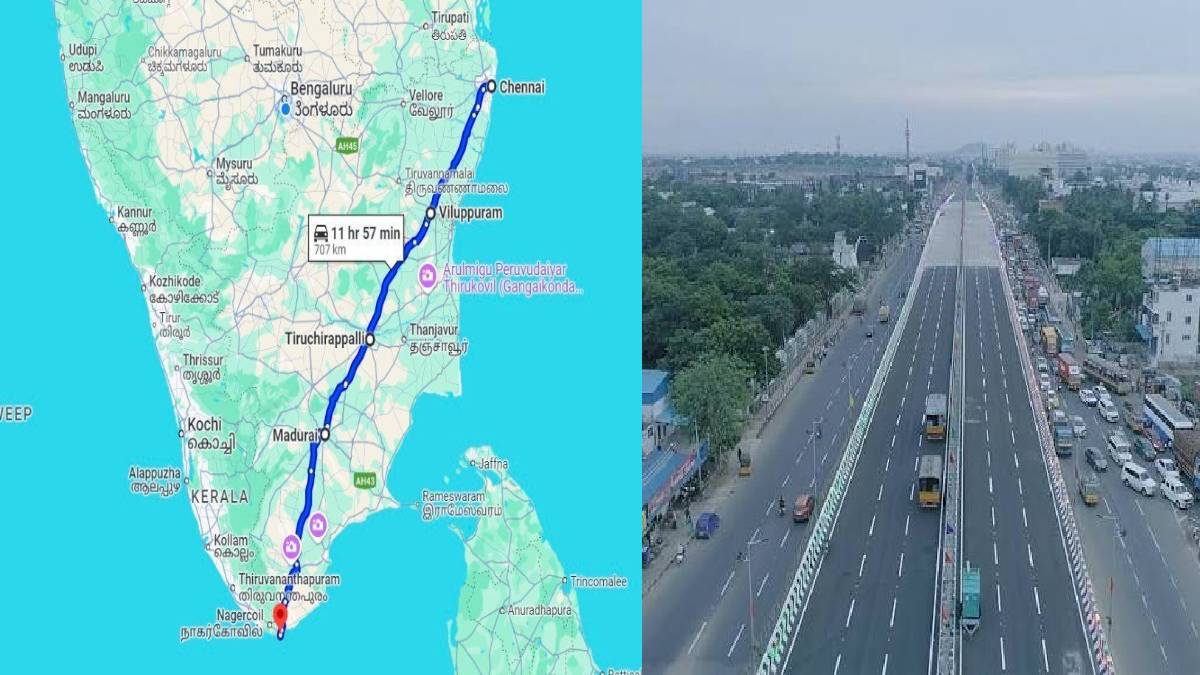
The proposed express corridor would be one of Tamil Nadu’s biggest road infrastructure projects and a fast-paced transportation route from the state capital, Chennai, to Kanyakumari, the southernmost tip of India. If approved, the corridor would complement the state’s growing network of highways and industrial corridors to improve travel efficiency, safety, and speed.
Transforming Road Connectivity
The Chennai-Kanyakumari corridor would mean that the travel time between the two cities would be significantly reduced, as access to the area through a modern, access-controlled expressway would always be available to the public. Driving from Chennai to Kanyakumari can take over 10-12 hours depending on the traffic situation. An eight-lane express corridor would shorten the journey, improve fuel efficiency, and reduce congestion on existing national roads.
The project will also improve connectivity in some districts of Tamil Nadu, connecting major urban centres, industrial hubs, logistics parks, ports, airports, and tourism destinations.
Boost for Industry and Trade
Tamil Nadu is among India's most industrialized states, with strong manufacturing, automobile, electronics, textile, renewable energy, and IT sectors. The state’s competitive advantage will be strengthened with better infrastructure and more domestic and foreign investment.
A dedicated, fast corridor would allow for goods to move faster between production centres and ports, lowering logistics costs and strengthening supply chains. Production industries on the route would get to move raw materials and finished goods faster and at a better cost/time.
The express corridor could also serve to enhance the state's growing export-oriented economy by improving access to Chennai Port, Ennore Port, Tuticorin Port, and other logistics facilities.
Tourism and Regional Development
Besides the industrial benefits, the proposed expressway is expected to be a significant boost to tourism. Kanyakumari is one of the most visited tourist destinations in India and draws millions of domestic and international visitors each year. Better road access would facilitate tourism to some heritage, religious, and coastal destinations along the route, including Madurai, Tirunelveli, Rameswaram (the connecting roads), and other cultural places.
The project may also spur development in smaller towns as it will drive investments into the hospitality industry as well as in retail, warehousing, logistics, and the service sector.
Employment and Economic Impact
Large-scale highway projects create substantial employment in the construction and operational stages. Thousands of jobs in engineering, construction, transportation, equipment manufacturing, and various fields can be created if this project gets approval.
The better road infrastructure is also what usually pushes industrial parks, commercial hubs, residential townships, and other small businesses along the corridor to grow and become a long-term economic engine of growth.
The Centre’s Approval is Key.
If the project requires significant financial investment and coordination between the state and central governments, this will require the Union Government will need to approve it. A detailed feasibility study, environmental investigation, land acquisition plan, and funding mechanisms would be carried out before construction to determine the feasibility, environmental assessment, and land acquisition plan. Planning will be part of the evaluation process for the project to begin.
If sanctioned, the Chennai–Kanyakumari express corridor could become one of the most transformative infrastructure projects in southern India and fit with the country’s broader vision of expanding high-speed road networks through national infrastructure development projects.
Looking Ahead
Tamil Nadu has continuously invested in improving transport infrastructure to support economic growth and regional connectivity. The 700 km eight-lane Chennai–Kanyakumari express corridor is the vision of the state for the future to develop world-class infrastructure that will be able to meet future transportation demands.
If this proposal is implemented, the express corridor could transform travel in Tamil Nadu, improve interstate connectivity, strengthen supply chains, boost tourism, and contribute significantly to India’s infrastructure-led growth agenda.