The government has introduced safeguards to ensure that consumers do not pay Merchant Discount Rate (MDR) charges on eligible Unified Payments Interface (UPI) transactions. Under the new framework, UPI users will continue to make person-to-person payments free of charge while MDR will be reserved for certain merchant transactions above a certain threshold.
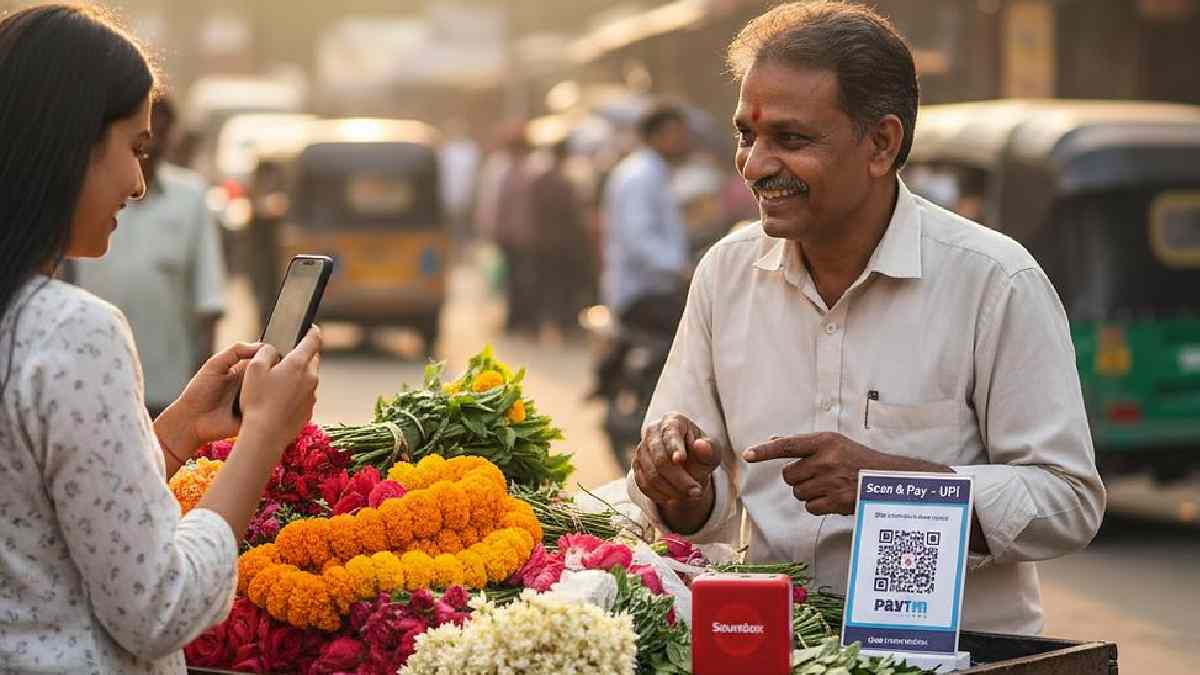
The clarification comes after the government amended the Payment and Settlement Systems Act, 2007, and then notified a framework governing MDR on some UPI merchant transactions. According to the Ministry of Finance, banks have been instructed to ensure that merchants do not pass MDR costs on to customers. UPI application providers have also been prohibited from imposing platform fees or hidden charges on users.
UPI payments to remain free to consumers
Under the proposed framework, consumers will not be required to pay MDR when making UPI payments. Person-to-person (P2P) transactions will be completely free, regardless of the amount transferred.
Merchant payments up to ₹2,000 will also be free of MDR. The government added that almost 96% of P2M transactions are still unaffected since they either fall below the ₹2,000 level or are covered by the zero-MDR framework for small merchants.
The government has stressed that MDR is not a tax collected by the government or NPCI. Instead, it is a charge within the payments ecosystem which is distributed among participating institutions like banks and payment service providers.
MDR applies only to certain merchant transactions
Under the new framework, a nominal MDR of 0.4% will be applied to P2M UPI transactions above ₹2,000. For transactions of ₹75,000 and above, the MDR will be capped at ₹300 per transaction.
Some essential sectors (railways, telecommunications, insurance, fuel and agricultural inputs) will have a separate flat MDR of ₹5 for eligible transactions above ₹2,000. Capital market transactions, including payments by mutual funds, securities, stockbrokers and dealers, will be subject to an MDR of 0.02%, and there will be a maximum of ₹300.
These are charges that are intended to be within the merchant payments ecosystem when not directly for consumers.
Merchants Cannot Pass MDR to customers
One of the key consumer-protection provisions is that merchants should not recover MDR from customers by adding a separate UPI fee to the bill.
The Ministry of Finance said banks have been advised to ensure that merchants do not pass MDR charges on to consumers. UPI application providers are also expressly prohibited from imposing platform fees or hidden charges on users.
That means customers paying through UPI should not be asked to pay an extra amount simply because they selected UPI as their payment method.
As such, it is intended to maintain the convenience and affordability of digital payment while also providing a revenue structure for a bigger UPI ecosystem.
Small Merchants continue to get protection
Small businesses and street vendors are still covered by a zero-MDR model. Merchants that receive up to ₹1 lakh per month through UPI QR codes under the Person-to-Person-Merchant (P2PM) category will still receive zero MDR on their transactions.
The government said that this would protect small businesses from additional payment costs and also allow for the widespread use of digital payments in informal and micro-businesses.
The framework also includes a dedicated fund for promoting UPI adoption among small merchants. Five per cent of total MDR collections will be contributed to this fund, according to the Finance Ministry.
Why is the government introducing the MDR framework?
The government has said the changes are intended to keep the long-term sustainability of India’s rapidly expanding digital payments ecosystem.
UPI processes billions of transactions each month, and the money is still being spent on cybersecurity, fraud prevention, technology, and payment infrastructure. The government has argued that a sustainable revenue model can help payment companies and banks sustain and expand these systems in rural and semi-urban areas.
At the same time, the government has stressed that ordinary consumers and small merchants should remain protected from additional costs.
What UPI Users Need to Know
For consumers, however, the key takeaway is that UPI payments are free. P2P transfers do not carry MDR, and merchant payments up to ₹2,000 are outside of the MDR framework. Even if MDR is used for merchant payments that are larger than ₹2,000, this is not something that is going to be passed on to the customer.
Users who are charged a separate UPI fee by a merchant can check the bill and payment details and raise the issue through the appropriate banking or payment-service grievance mechanism.
Thus, there is a distinction between charges within the merchant payment ecosystem and charges to consumers. Although eligible merchants might face MDR on certain higher-value transactions, the government has put safeguards in place to prevent those costs from becoming an additional burden on UPI users.