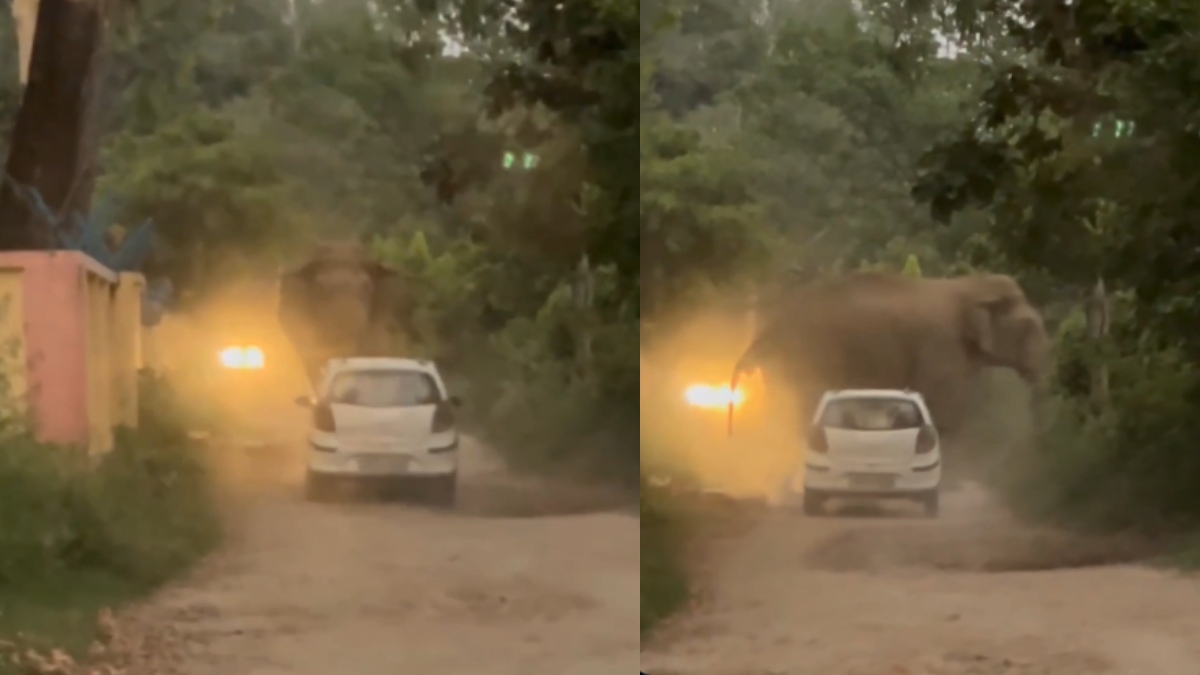
Facebook video circulating on social media has caused alarm after it shows a woman driving an Alto car on a forest road when she suddenly encounters a huge wild elephant right in her path. Instead of stopping or reversing the vehicle, she continues to drive toward the elephant and honk the horn.
Wildlife experts and wildlife fans say such behaviour can provoke elephants and potentially end up in a deadly way.
The video has gone viral on many social media sites and captures the tense moment as the elephant stands calmly on the road. Despite the presence of the elephant, the driver thinks that the loud horn and the approaching vehicle will force the elephant to move aside.
As the distance between the car and the elephant narrows, the driver continues honking without slowing down. Fortunately, the elephant finally walks away from the road, allowing the vehicle to pass without any physical confrontation.
They were safe but experts say that could have been so different. Wild elephants are among the largest and strongest land animals in the world. They are generally peaceful if they are not disturbed but they become defensive or aggressive if they feel threatened by others or their herd. If you approach an elephant aggressively with a moving vehicle and continuously honk, the elephant might perceive that as a challenge or provocation and an aggressive charge will be attempted.
Forest officials and wildlife conservationists have warned on a regular basis that motorists traveling through forest corridors and protected wildlife areas should be extremely cautious. Tracks through forests will meet with traditional animal routes, including elephants, deer, bison, and other wildlife. Drivers will be required to slow down, stay safe, turn off unnecessary lights or loud noises, and give animals time to move safely.
Elephants are intelligent, have excellent memory and social skills, but are also very sensitive to perceived threats. Loud noises, sudden movements, and vehicles too close can trigger defensive responses. An adult elephant weighing more than a ton can easily overturn or crush a passenger vehicle if it is threatened. Wildlife experts note that no passenger car can be used to protect the occupants in an elephant attack.
The video has generated millions of views on the internet. Many of the people who saw the video were shocked that the driver continued to try to push the elephant forward and not wait for it to move.
If drivers encounter elephants on forest roads, they should take very basic precautionary measures, experts say. Drivers should immediately slow down, stop at a safe distance, do not honk unnecessarily, stay in the car, keep windows closed, and wait for the elephant to move away calmly. If the elephant is aggressive or starts approaching the vehicle, reversing slowly to give the driver more space may be a good choice.
Wildlife officials also remind people that forest roads are traversed by animals and humans are visitors to those areas. Wildlife conservation, and not disturbing them negatively, is what we are trying to keep for our lives and wildlife. There are state guidelines in India for motorists travelling in elephant corridors especially at dawn, dusk, and at night when elephants are more active.
Human activities near forest areas, conservationists say, have made human-wildlife interactions more frequent. As road networks spread through forested landscapes, educating people about responsible driving in wildlife zones has become more important. Drivers are advised to be patient, obey speed restrictions, and prioritize safety over convenience.
That viral incident also illustrates how social media can help to educate people about wildlife behavior. It was initially viewed by many users as an entertaining or dramatic video, but experts say they hope that the video will teach them what not to do when they meet a wild elephant.
In this video, a woman is driving an Alto car through a forest road when a huge elephant appears in front of her.
— Saffron Chargers (@SaffronChargers) August 7, 2026
Instead of stopping the car or reversing, she drives straight toward the elephant at high speed while continuously honking. Even after getting close to the elephant,… pic.twitter.com/mV5ob7MTVz
Fortunately, neither the driver nor the elephant were injured in this case. Wildlife officers stressed the driver's actions were serious. A different response from the elephant could have resulted in severe damage to the vehicle and serious injury to its occupants.
The incident was a reminder that wildlife must always be treated with care and caution. When travelling through forests, patience and responsible driving can prevent unnecessary conflict between humans and animals. Allowing wildlife to move freely without disturbance is the safest approach for everyone involved.