Republic of Ireland players wore black armbands and did not take part in the customary pre-match handshakes with Israel during their UEFA Nations League match in Debrecen, Hungary, on Sunday, September 27.
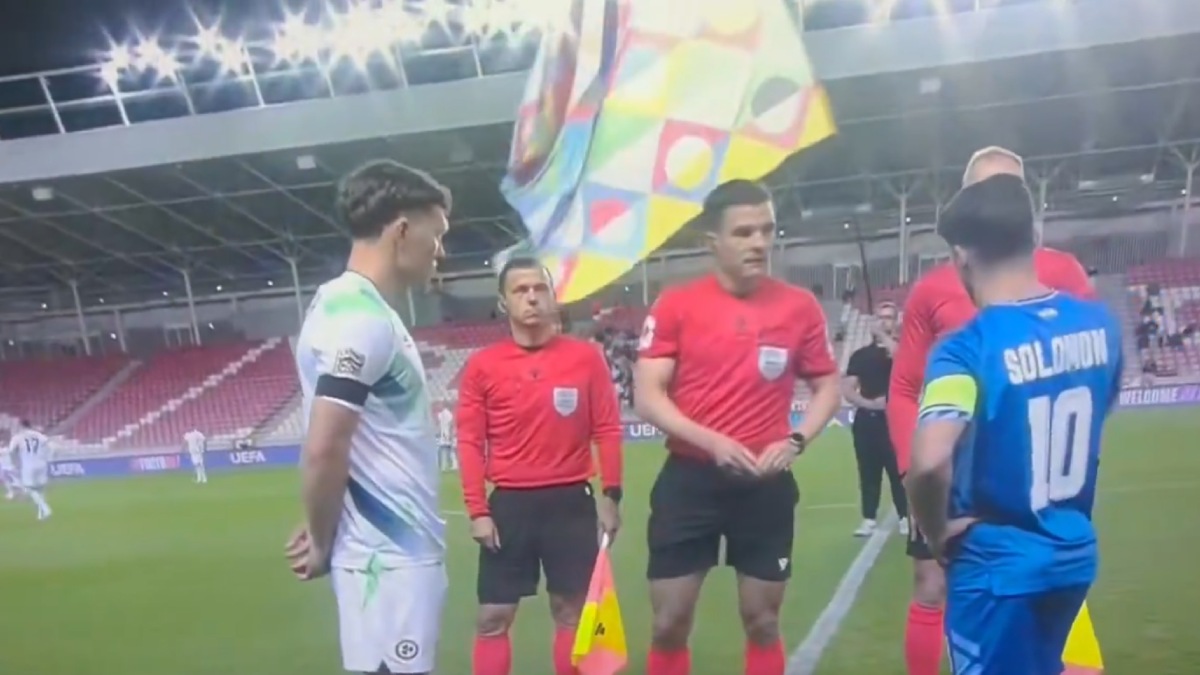
The actions came amid political controversy surrounding the match and the Gaza war. Ireland’s players bowed their heads during Israel’s national anthem before the match. UEFA said the Football Association of Ireland had informed UEFA before the game that the players would not take part in the handshake ceremony.
The match itself ended in a 3-0 victory for Ireland, with Troy Parrott, Adam Idah and Jack Moylan scoring in the first half.
Ireland players do not do a traditional handshake.
The usual pre-match protocol was changed before the Nations League Group B3 match.
Ireland captain Dara O’Shea shook hands with match officials but did not shake hands with Israel captain Manor Solomon. The Irish players also remained with their hands behind their backs during the Israeli national anthem and bowed their heads.
Moreover, both teams also didn’t exchange pennants.
The Irish players wore black armbands during the match. The FAI had said the armbands were in recognition of those lost in the conflict. Reports suggested this gesture was connected to the larger conflict over Israel’s military campaign in Gaza and Ireland’s longstanding political position on the conflict.
The game was played in a largely empty Nagyerdei Stadium in Debrecen with only a small number of Israeli supporters reported to be present.
The match started after the boycott.
The match was under heavy criticism before the start of the match, and Ireland had been calling on the team to boycott its two Nations League matches against Israel.
Ireland decided to play after most of the team voted to play the match. Reserve goalkeeper Gavin Bazunu withdrew from the squad before the match as he said his decision was based on his personal belief that it would be wrong to participate given the killing of innocent people.
The Football Association of Ireland had also called for UEFA to take action against Israel over the Gaza conflict. UEFA did not suspend Israel from the competition and the two Nations League games were played at neutral venues.
The first match was played in Hungary, while Ireland’s nominal home match against Israel is scheduled for October 4 in Bačka Topola, Serbia. The return match will also be played without fans.
Israel has rejected accusations that its actions in Gaza constitute genocide. The political conflict has put more scrutiny on sporting events involving Israel.
Ireland take control with three first-half goals.
On the field, Ireland had a quick start and very quickly settled the game before half-time.
Troy Parrott opened the scoring in the 13th minute. Adam Idah doubled Ireland's lead three minutes later before Jack Moylan added a third goal in the 25th minute.
Ireland went into the interval with a 3-0 advantage.
Israel improved after the break and made some chances, but Ireland goalkeeper Caoimhín Kelleher made a number of crucial saves to keep the clean sheet. The game got more physical in the second half with Ireland’s Idah and Israel’s Raz Shlomo getting yellow cards following a clash.
So Ireland won in a game that went beyond the sporting arena.
The political reaction follows players’ actions.
The players’ actions drew reactions from both sides of the political debate.
Israeli Foreign Minister Gideon Saar criticised Ireland's stance after the game. “Ireland is on the 'wrong side of history,” he said. “The Irish players wore black armbands, refused handshakes and bowed their heads during Israel’s anthem.
However, the Football Association of Ireland had said that the match would go ahead and that the squad would be able to voice its position through the agreed match arrangements.
The situation is indicative of the more general political tension surrounding sports contests involving Israel. Ireland has long supported Palestinian statehood, and in 2024 the Irish government formally recognised the Palestinian state alongside Spain and Norway.
For the players, the immediate focus is back to the Nations League. Ireland and Israel will meet again on October 4 in Serbia, where another closely watched fixture is expected.
The first meeting ended with Ireland taking the points on the pitch, and the pre-match protocol and players’ gestures ensured that the match also became a major talking point away from the football itself.