
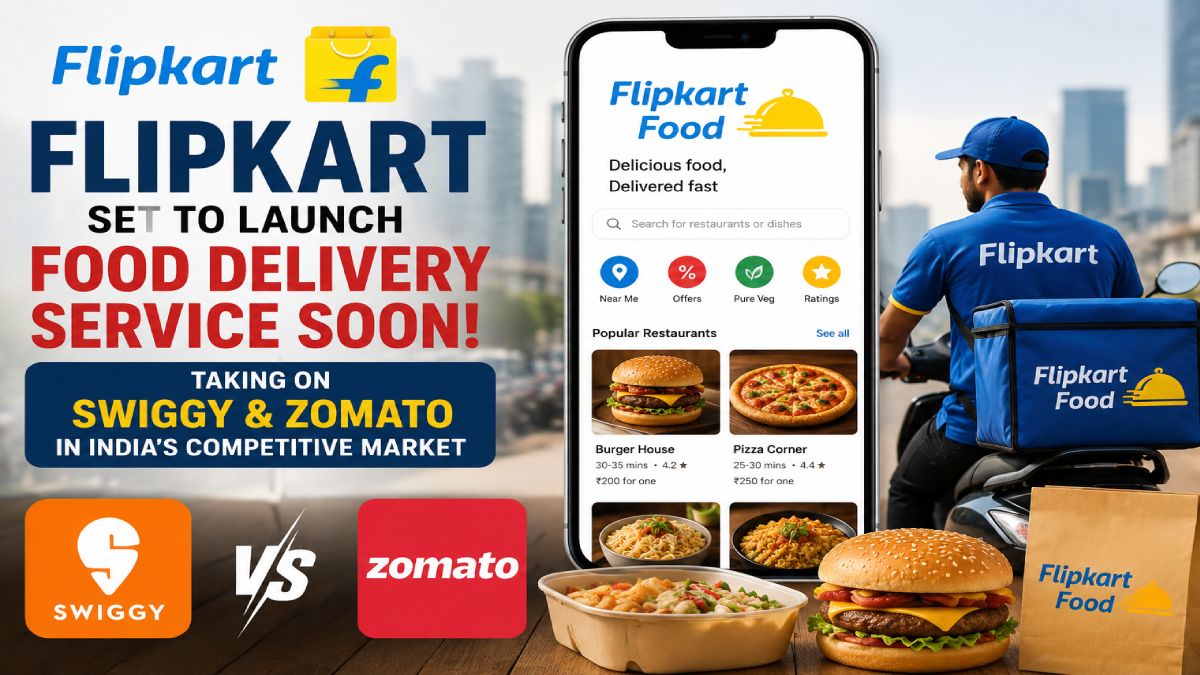
The e-commerce giant Flipkart is preparing to enter India’s crowded online food delivery market with a new service called Eat-In by Minutes, and it may be in line to challenge Swiggy and Zomato. The company has begun testing the food ordering and delivery service in Bengaluru and will launch it in October 2026.
The move could present another major competitor in a space where two big players are already in place, and so many more are going to be there in the future. Flipkart will also go beyond e-commerce and quick-commerce services to go back to its e-commerce operations. While the launch date appears to be imminent, the company has not formally announced the date, where it will launch, what will be the location of the service in India in the first place or even the details of the service.
According to India Today Tech, which cited TechCrunch, Flipkart is testing the service under the name Eat-In by Minutes. The new name seems to tie in with Flipkart Minutes, a quick-commerce business on Flipkart Group. Bengaluru is the first city to test it, but it is unclear which more cities will be added when the platform becomes available.
Flipkart Group CEO Kalyan Krishnamurthy said that he was planning to arrive at food delivery by July 2026. The recent testing shows that it is already translating those plans into an operational service. But until Flipkart announces an official launch date and rollout details, the proposed launch date and other rollout plans should be considered as news, not commitments.
One of the great things about the testing programme is that it is already in place among Flipkart employees. Originally limited to a few hundred employees, this internal testing was reported to have been expanded to about 8,000 employees. A new food delivery tab has been added to the Flipkart shopping app.
This might be an opportunity for the company to test the ordering process, restaurant listings, delivery process and customer experience before releasing the service to the public. The food delivery section will be available alongside the existing Flipkart Minutes and travel booking service. Internal testing at this scale would allow the company to look at operational challenges and gain feedback before a larger launch into a very competitive market.
Flipkart is reported to use its logistics arm eKart to handle food deliveries in a dedicated delivery network. The restaurants listed through ONDC (government-backed Open Network for Digital Commerce) and restaurants that have direct agreements with Flipkart are expected to be part of the proposed platform.
The deal would enable customers to access participating restaurants on the platform and give Flipkart a part of the delivery process. Food delivery personnel are expected to work separately from quick-commerce staff, which is not the case with groceries and other everyday items. Delivery workers have also been spotted wearing T-shirts that read Eat-In by Minutes in Bengaluru. If implemented as described, the logistics setup could become an important part of Flipkart's strategy to establish its presence in the food delivery business.
Flipkart would create more competition in a market where Swiggy and Zomato have the advantage. Ken Research's report says Zomato held a 58% share of the market in 2024 and Swiggy 34%. Rapido has made its first entry into the food delivery business as Ownly, although it has been active in a few areas.
Some large technology companies were interested in entering the food delivery market in India before and have tried to enter it but have faced challenges in becoming a strong winner. Uber sold its Uber Eats business in India to Zomato in 2020. Flipkart will thus have to compete not only with brand recognition but also on the availability of restaurants, delivery reliability, pricing, the customer experience and overall ordering experience. The company’s existing customer base and logistics infrastructure might be beneficial, but that will not be enough to carry it through the challenges.
The online food delivery market in India is still highly competitive, and there are still opportunities to expand. Bernstein's estimates suggest that online delivery is only about 15% of the total food services market and is growing at an annual rate of about 18% to 20%. These data indicate that there is still a lot of food consumption going on outside the online delivery platforms, giving the companies a space to attract more customers and to expand ordering practices. Flipkart would try to extend its shopping app to consumers who already use its other services, but in the long run its value for customers and restaurant partners will depend on the business.
The launch of Eat-In by Minutes would be a big boon for India’s digital commerce industry if Flipkart is able to scale it out beyond testing in the lab to a larger public launch. Another competitor in the market could mean more restaurant options, special offers and alternative platforms to existing websites.
And restaurants could also have access to that channel for reaching a wider base. But food delivery, delivery costs and customer retention will be the real issues. Currently, Bengaluru is the focus of Flipkart’s testing efforts, and the industry is waiting for an official announcement on the launch date, service areas and pricing structure. If the rollout is well executed, India’s food delivery battle might soon become even more competitive.




Comments
Leave a Comment