
Interest income in India is generally exempt from Goods and Services Tax (GST) under the provisions of the Central Goods and Services Tax (CGST) Act, 2017. According to Notification No. Entry 27 of the Central Tax (Rate), services involving the extension of deposits, loans, or advances are specifically exempted from GST.
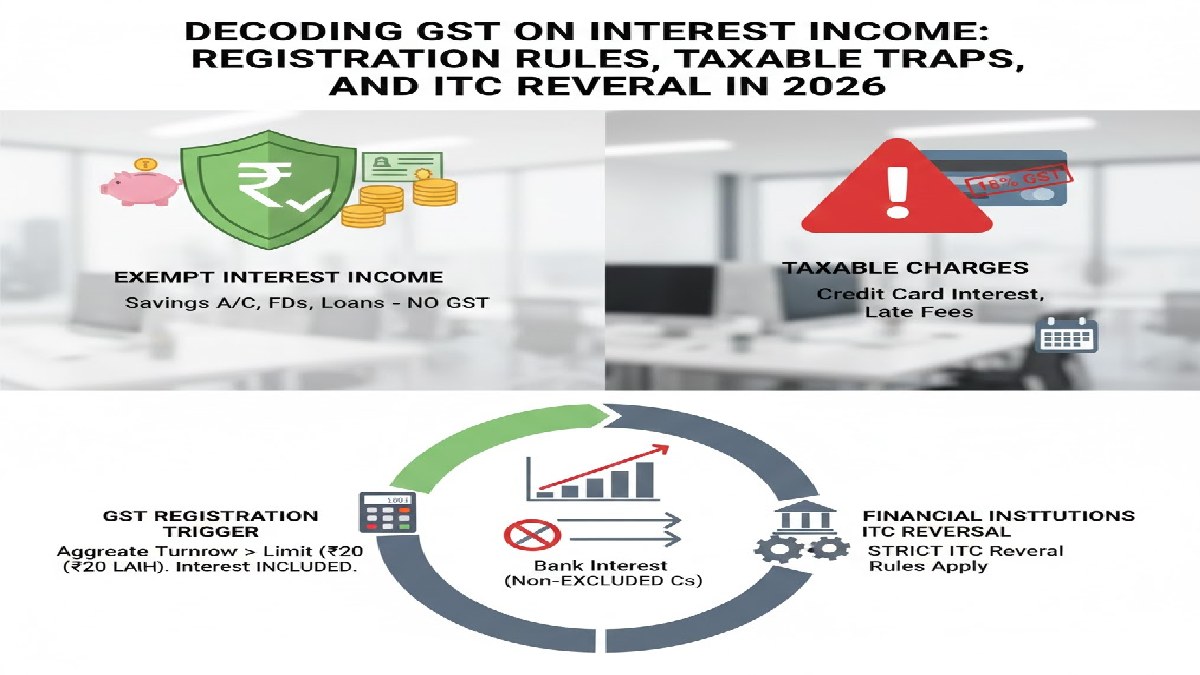
Consequently, interest income arising from sources such as fixed deposits (FDs), savings bank accounts, recurring deposits (RDs), loans or advances granted to third parties, and Post Office savings instruments is treated as exempt financial income under GST law and does not attract GST.
However, it is important to distinguish between exempt interest income and certain financial service charges which remain taxable. Interest or penalty fees charged in relation to outstanding credit card balances, as well as overdue or delayed payment fees, fall outside this exemption. These charges are considered consideration for taxable supplies and are subject to GST at the standard rate of 18%. This differentiation is crucial for businesses and financial institutions to correctly apply GST on their financial transactions.

Though interest income is exempt from GST, it must nonetheless be included when calculating aggregate turnover for the purpose of determining GST registration eligibility. For instance, if a business earns ₹18,00,000 from primary business activities and ₹3,00,000 as interest income, the total aggregate turnover becomes ₹21,00,000.
Since this exceeds the general threshold limit of ₹20 lakh (₹40 lakh in certain cases for goods suppliers), the business is required to register for GST. Thus, while interest income itself is not taxed under GST, it can impact a taxpayer’s liability to register and comply under GST law.
Input Tax Credit (ITC) reversal is another important compliance aspect related to interest income. Under Rules 42 and 43 of the CGST Rules, 2017, taxpayers engaged in both taxable and exempt supplies must reverse a proportionate amount of common ITC. In the case of non-financial entities, the value of exempt supplies excludes the interest income from deposits, loans, or advances.
As a result, most businesses do not need to reverse ITC solely on account of earning interest income from bank deposits. However, this ITC reversal relaxation does not apply to entities operating in the financial sector, such as banking companies, Non-Banking Financial Companies (NBFCs), and financial institutions, which must strictly follow applicable GST rules for ITC reversal.
In conclusion, while interest income earned on deposits and loans is generally exempt from GST, businesses and financial institutions must carefully consider several compliance factors. Interest income contributes to the aggregate turnover and therefore affects the GST registration threshold. Taxable financial charges like credit card interest attract GST at standard rates.
Most non-financial businesses are exempt from ITC reversal issues related solely to interest income, whereas financial sector entities must comply with specific ITC reversal requirements. Proper classification and reporting of interest income are essential for ensuring full GST compliance and avoiding penalties under the CGST framework.







Comments