
India’s banking system in 2026 is governed by the Income-tax Act 2025 (effective April 2026) and regulations issued by the Reserve Bank of India (RBI). This article is organized in a very clear, accurate, and verified way to explain the banking limits, tax rules and compliance requirements.
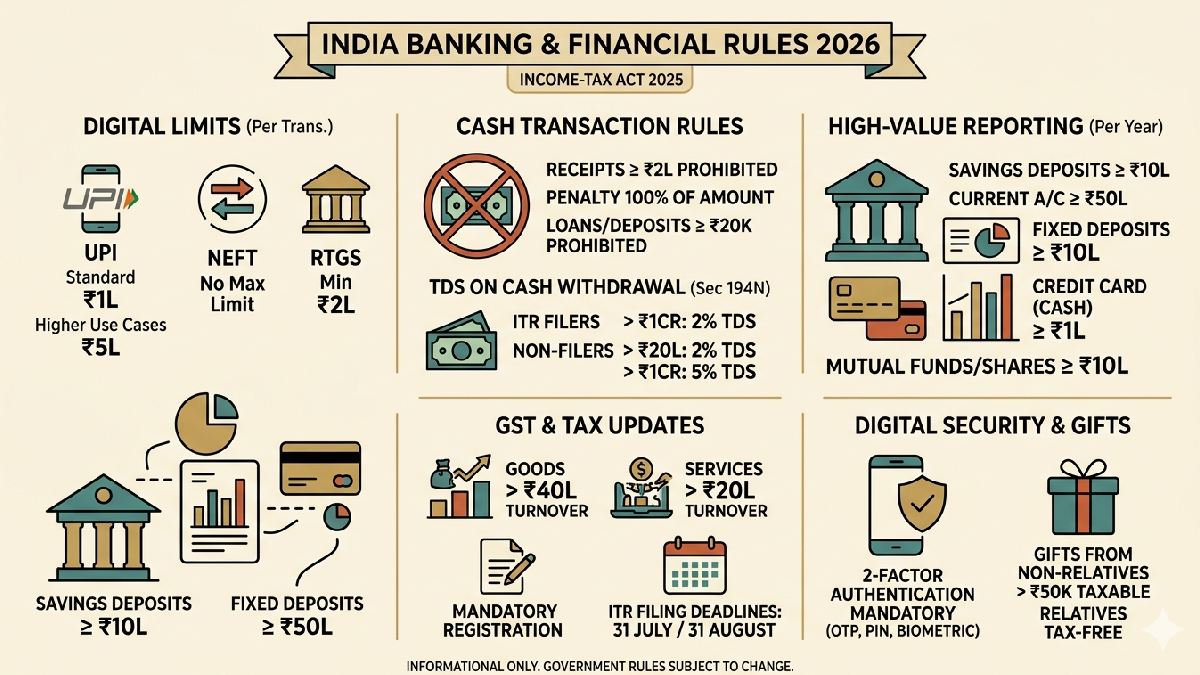
Digital Payment Limits (UPI, NEFT, RTGS, IMPS)
UPI (Unified Payments Interface)
- Standard limit: ₹1 lakh per transaction.
- Higher limits (up to ₹5 lakh) apply only to certain categories like IPOs, hospitals and select use cases.
IMPS (Immediate Payment Service)
ALSO READ

- Limit: Up to ₹5 lakh per transaction (may vary by bank).
NEFT (National Electronic Funds Transfer)
- No minimum or maximum limit (banks may set internal limits).
RTGS (Real-Time Gross Settlement)
- Minimum: ₹2 lakh.
- No upper limit.
Cash Transaction Rules
Section 269ST – Cash Receipt Restriction
ALSO READ


- Cash receipts of ₹2 lakh or more are not allowed: From one person in a single day , For a single transaction , For one event or occasion.
- Penalty: Equal to 100% of the amount received.
Section 269SS – Loans and Deposits
- Accepting or repaying ₹20,000 or more in cash is prohibited.
TDS on Cash Withdrawals (Section 194N)
- For ITR Filers: No TDS up to ₹1 crore , 2% TDS on withdrawals above ₹1 crore.
- For Non-Filers (Last 3 Years): 2% TDS on withdrawals above ₹20 lakh , 5% TDS on withdrawals above ₹1 crore.
- This applies only to high-value cash withdrawals.
- High-Value Transaction Reporting
- Banks report certain transactions to the Income Tax Department:
- Savings account deposits: ₹10 lakh per year.
- Current account deposits or withdrawals: ₹50 lakh per year.
- Fixed deposits: ₹10 lakh per year.
- Credit card payments (cash): ₹1 lakh per year.
- Credit card payments (digital): ₹10 lakh per year.
- Investments in mutual funds or shares: ₹10 lakh per year.
- These are reporting thresholds, not limits.
- GST Registration Threshold
- Goods businesses: ₹40 lakh annual turnover.
- Service businesses: ₹20 lakh annual turnover.
- GST registration becomes mandatory when turnover exceeds these limits.
- Income Tax Updates (Effective April 2026)
- Implementation of the Income-tax Act, 2025.
- New compliance structure and definitions.
- ITR Filing Deadlines
- ITR-1 and ITR-2: 31 July.
- ITR-3 and ITR-4: 31 August.
- Digital Payment Security
- As per RBI guidelines:
- Two-factor authentication is mandatory.
- Applies to UPI, debit cards, credit cards, and net banking.
- It requires OTP, PIN or biometric verification.
- Gift Tax Rules
- Gifts from non-relatives exceeding ₹50,000 per year are taxable.
- Gifts from relatives are tax-free.
- Cash gifts must meet cash transaction limits.
- Practical Compliance Tips
- Prefer digital transactions over cash.
- File income tax returns consistently.
- Keep separate accounts for business and personal use.
- Avoid unexplained high-value transactions.
- There is no fixed ceiling on how much money you can deposit or transfer through banks in India. But big transactions are monitored and must be properly explained if required. The regulatory focus in 2026 is on transparency, compliance and reducing reliance on cash transactions.
- Disclaimer
- This is only for informational purposes and is not the latest legal advice. Government rules on banking and tax are subject to change. It should not be considered legal or financial advice. Consult a qualified professional for guidance specific to your situation.








Comments