(Effective from 1 April 2026)
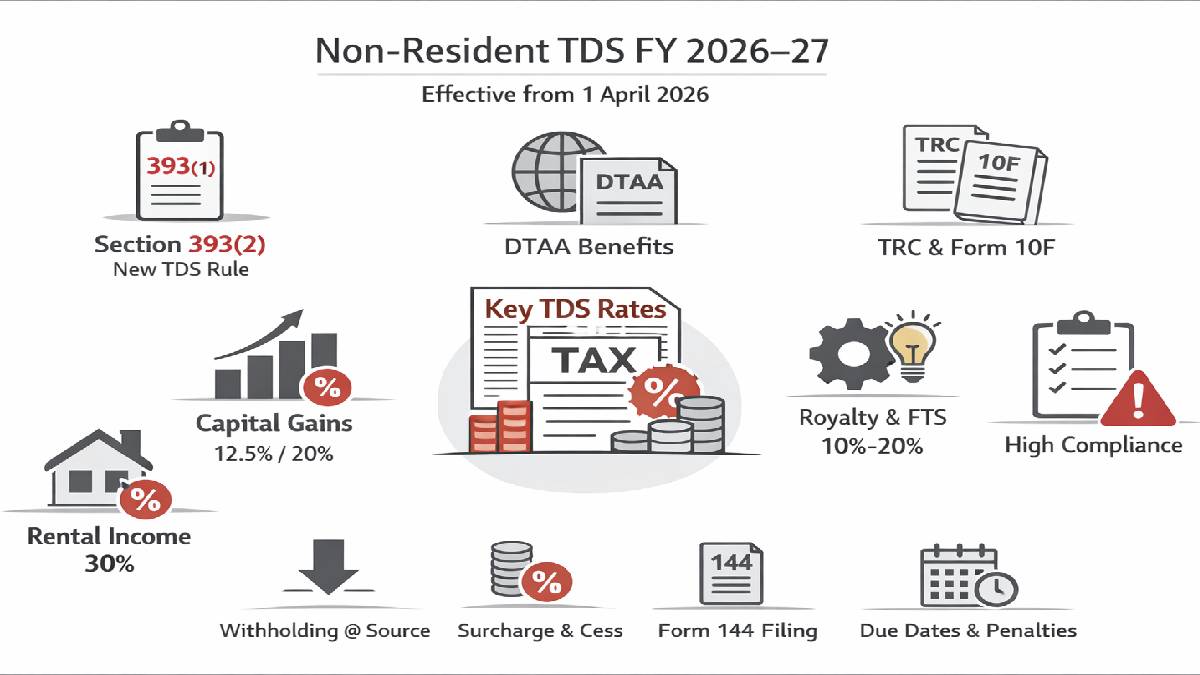
With the introduction of the Income Tax Act, 2025, the provisions governing Tax Deducted at Source (TDS) on payments to non-residents are now revised. Tax rates are fairly similar but section references and compliance procedures have been updated and businesses and professionals involved with cross-border transactions need to keep up with them.
Legal Framework
Payments to non-residents (people and foreign companies) are governed by:
Section 393(2) (replacing the earlier Section 195).
This provision requires that any amount chargeable to tax in India and paid to a non-resident is subject to TDS at applicable rates.
Key points:
- No minimum threshold – TDS applies from the first rupee in most cases.
- Applicable to all persons responsible for making such payments.
Double Taxation Avoidance Agreement (DTAA)
DTAA provisions have a profound role in determining the applicable withholding tax rate.
A lower TDS rate can be applied only if:
- Tax Residency Certificate (TRC) is obtained.
- Form 10F is furnished.
- Beneficial ownership declaration is available.
In the absence of these documents, domestic tax rates will apply.
Additional considerations:
- Surcharge and 4% cess apply under domestic law.
- DTAA rates are generally applied on a gross basis without additional surcharge and cess.
Key TDS Rates – FY 2026–27
- Salary Income (Section 392): Taxed as slab rates for non-resident taxes. TDS based on the estimated annual income.
- EPF Withdrawal: TDS at 10% where withdrawal exceeds INR 50,000. Subject to prescribed conditions.
- Interest Income:
-
-
NRO Account Interest: 30%
-
Securities or dividend-linked interest: 10% to 20%
-
Foreign currency loans or bonds: 5% (subject to conditions)
-
Infrastructure Debt Fund: 5%
-
- Royalty and Fees for Technical Services (FTS): 10% to 20% under domestic law. Often reduced to around 10% under DTAA, subject to treaty terms.
- Income of Sports Persons and Entertainers: Flat TDS rate of 20%. No basic exemption.
- Capital Gains:
-
Long-term capital gains: 12.5%
-
Listed shares (Section 112A): 12.5% on gains above exemption limits
-
Short-term capital gains (Section 111A): 20%
-
- Rental Income: TDS at 30%. Deduction is required on gross rental income, not net income.
- Dividend Income: 20% or DTAA rate, whichever is lower.
- Other Income: Non-resident individuals: 20%, foreign companies: 40% (plus surcharge and cess).
Practical Considerations
Property Transactions Involving Non-Residents
- The buyer is responsible for deducting TDS.
- TDS is generally 12.5% of long-term assets.
TDS should be deducted on the gross sale consideration, not on capital gains.
- This often results in cash flow constraints for the seller.
Non-Availability of PAN
If the non-resident does not have a PAN (Permanent Account Number), then higher TDS may apply, under the applicable provisions.
Foreign Companies
- Standard withholding rate: 40% plus surcharge and cess.
- DTAA provisions may significantly reduce the effective tax rate.
Compliance Requirements (From April 2026)
- Use Section 393(2) in all relevant filings and documentation.
- File Form 144 (instead of Form 27Q).
- Issue TDS certificates with updated section references.
Due Dates:
- TDS deposit: By the 7th of the following month.
- For March: By 30 April.
Additional requirements:
- Form 13, where applicable, when possible, apply for lower or nil TDS.
- Ensure TRC and Form 10F are available before payment.
- Use of wrong section reference means compliance mismatch.
- Failure to deduct TDS leads to higher interest and penalties.
- Delay in deposit or filing will lead to additional financial risk.
- Not taking DTAA provisions into account results in excess tax deduction.
- Incomplete documentation leads to higher withholding tax rates.
- Incorrect handling of property transactions involving non-residents.
Key References
- Section 393(2) – Non-resident TDS
- Section 392 – Salary
- Finance Act 2026
- Budget 2026 amendments
- Applicable DTAA agreements
The move to Section 393(2) is more than a change in numbering. It provides important procedural upgrades that need to be made in compliance and documentation.
Organizations dealing with non-resident payments should:
- Evaluate DTAA benefits carefully.
- Ensure complete and accurate documentation.
- Keep up with the process of compliance.
Proper planning and execution can help avoid excess tax deductions, penalties, and disputes.