Elon Musk is doing things his way again. SpaceX is about to embark on what could become the biggest public offering in history, and the billionaire is violating every rule of Wall Street. There is no price range, no drama. Just a straight-up, “take it or leave it” offer. And here's the kicker: He might pull it off.
The Numbers That Matter
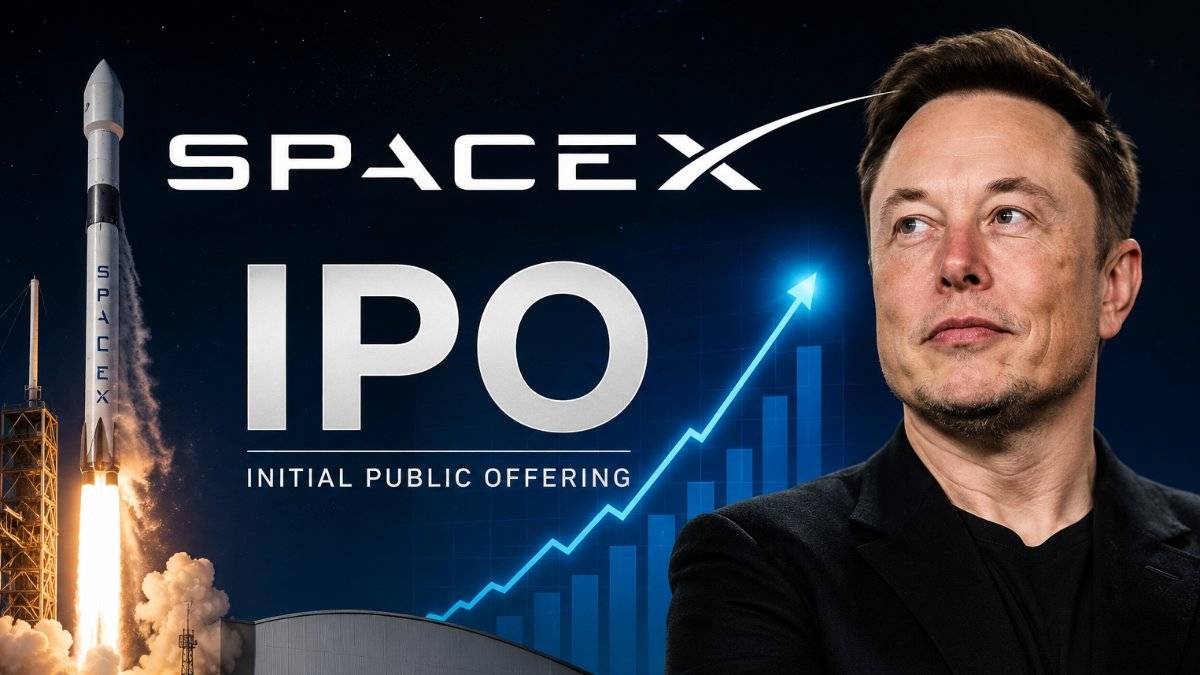
SpaceX has set its IPO price at $135 per share and will sell 555,555,555 shares to raise about $75 billion. At that price, the company would fetch a $1.75 trillion valuation, which puts it above Meta Platforms, Berkshire Hathaway and even Musk’s own Tesla, which is $1.3 trillion. The company will be listed on the Nasdaq on June 12, and trading will begin after pricing on June 11.
Why This IPO Is Different. In a typical IPO, companies announce a price range, hit the road to meet investors, gauge demand, and then tweak the numbers. Not SpaceX. The company has set a fixed price more than a week before its market debut -- and so it is in a very unusual way to “remove uncertainty” from the process, insiders say, it’s so that to investors it is the price. Take it or leave it.
They believed they had sufficient demand for their shares, similar to their private funding rounds, people close to the deal said, The Wall Street Journal reported. Musk has also secured a 366-day lockup period on his personal holdings— meaning he won't sell a single share for at least a year after the IPO— a vote of confidence aimed directly at skeptical investors.
The Retail Revolution
Perhaps most striking is SpaceX's plan to give up to 30% of the offering to individual investors— a very big retail tranche for a mega-IPO. Musk is essentially betting on his cult-like following to show up and buy shares. A 30% share allocation to retail investors would be equivalent to about $22.5 billion in ordinary people rather than institutional whales. That is unheard of for an offering of this size.
The move has caused debate. Some see it as democratizing access to one of the most exciting companies on the planet. But others worry it might “prematurely consume post-listing buying demand” as Interactive Brokers’ chief strategist put it. The Bear Case: Is $1.75 Trillion too much? Not everyone is buying Musk’s vision at least not at this price.
Morningstar, the independent research company, has valued SpaceX at just $780 billion less than half of its IPO target. Analyst Nicolas Owens was blunt: “We think the company has been significantly overvalued and investors will have a chance to buy the stock at a higher price after the IPO”.
The numbers are worth examining. SpaceX reported $18.7 billion in revenue for 2025 (33% growth), but a net loss of $4.9 billion. Most of that is from its AI businesses, namely recently acquired xAI, which Musk merged with SpaceX. At the proposed valuation, SpaceX would trade at roughly 93 times sales. By comparison, the price-to-sales ratio of the S&P 500 is only 3.38. Tesla is only 16.73 times sales.
The Bull case: You're Not Just Buying Rockets. For supporters, the traditional metrics miss the point entirely.
SpaceX isn’t just a rocket company anymore. It’s a satellite internet provider through Starlink, which generated $11.3 billion in revenue with $4.4 billion of operating profit in 2025. It’s an AI infrastructure play through xAI. And yes, it's still the only company regularly launching astronauts and cargo to the International Space Station.
The company has no direct peers, Reuters noted. So traditional valuation models are challenging at best.
Starlink has changed the economics. With 50% revenue growth and profitability, satellite broadband business alone provides a foundation that didn’t exist only a few years ago. That maturity is exactly why analysts believe Musk is finally willing to take SpaceX public after resisting for over 20 years.
The Vision Premium: Mars, AI, and Space Data Centers. Here's where the valuation debate gets truly fascinating. Morningstar ran three scenarios for SpaceX’s ambitious plan to build data centers in space. In the most optimistic “moonshot” case, the AI infrastructure alone could create $1.3 trillion in value. But Morningstar gives that scenario only a 7% probability.
The more likely "no go" scenario where space data centers never materialize has a 43% probability and would destroy over $81 billion in value.
For retail investors, the question becomes very personal: Do you believe in Elon Musk’s long-term vision enough to pay a premium for it today?
Wall Street Is Changing the Rules for SpaceX. Here’s perhaps the most telling sign of SpaceX’s significance: Major indexes are rewriting their rules to accommodate this IPO.
Nasdaq has already modified its listing requirements to fast-track SpaceX into the Nasdaq 100 within 15 trading days of the IPO down from the usual three-month minimum. FTSE Russell has taken similar steps, and S&P Dow Jones is looking into rule changes for potential S&P 500 inclusion.
If SpaceX enters major indexes fast, passive funds tracking these indexes could generate nearly $20 billion in buying demand -roughly a quarter of the entire IPO raise - Bloomberg Intelligence said.
The Human question: Should you buy? If you speak with investors, the picture is one of deep division.
Some are all-in. For example, Janice Vines, a retired investor who has bought ETFs with SpaceX exposure and is going to invest another $20,000 after the IPO, said Business Insider.
Others are waiting. Neil Rozenbaum, who owns Tesla shares, called SpaceX “an amazing company” but he expects the stock to follow the pattern of many hot IPOs: “Rip on day one, sag thereafter”. "I would like to own SpaceX in the future, but probably not on day one," he said.
And then there are the skeptics. Trader Marko Greguric didn’t mince words when he referred to plans for asteroid mining and Mars colonies as “crazy science fiction”. “The primary purpose of an IPO is for smart money and early investors to sell their chips to retail,” he said.
The Bottom Line
SpaceX's IPO is unlike anything Wall Street has seen. A fixed price weeks in advance. A record-breaking $75 billion raise. Generous retail allocations. And a valuation that, depending on who you ask, is either visionary or delusional. The company posted $18.7 billion in revenue and a $4.9 billion loss in 2025. Its Starlink business is profitable and growing. AI ventures are hemorrhaging cash but have huge potential. Its rocket division dominates global launch markets.
For believers, this is the chance to own a piece of the company building the infrastructure for humanity's multiplanetary future at a price that reflects that potential. For skeptics, however, it is a classic case of hype far greater than reality and retail investors could be left holding the bag when the excitement wears off. If SpaceX starts trading on June 12, it will be one of the most watched— and most debated— market debuts in history. And Elon Musk is going to do his thing the way he always does.