China is testing a futuristic new approach to water rescues that could enable emergency teams to reach people in distress much faster. Hangzhou police in Zhejiang Province recently demonstrated an AI-powered flying lifebuoy that could automatically travel to swimmers who need help, land on the water and provide enough flotation support to keep them safe until they can recover.
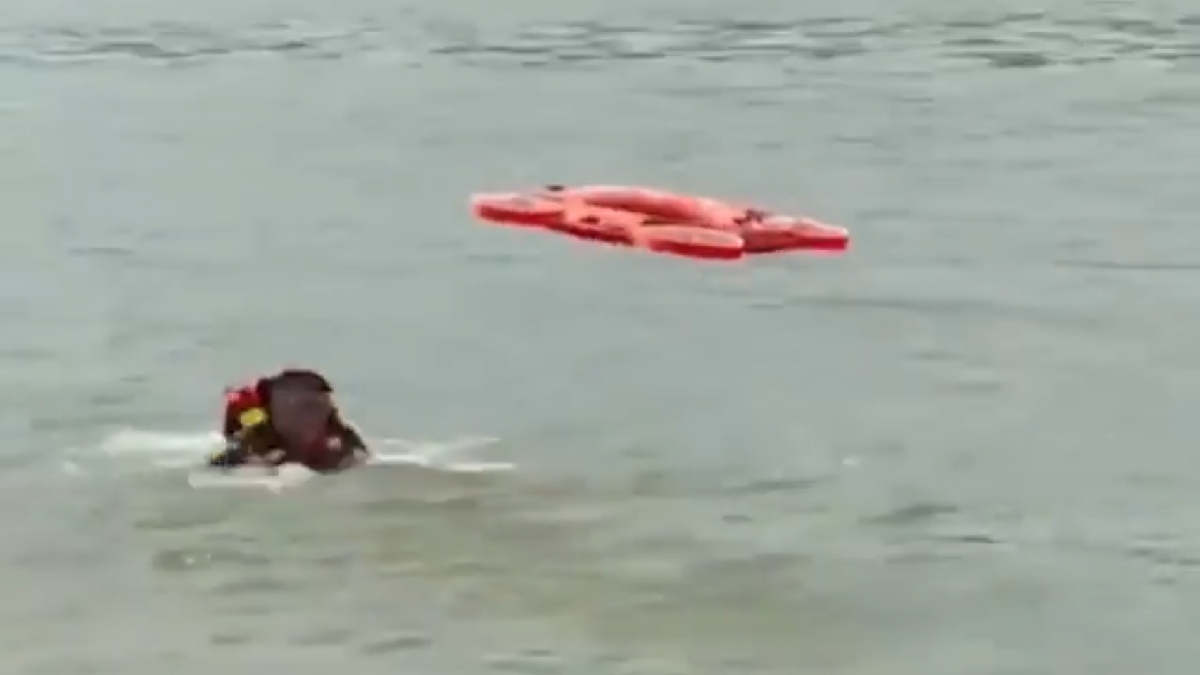
The device combines the functions of a rescue flotation aid and an autonomous aerial vehicle. It can fly at speeds up to 30 miles per hour, and so can reach people in trouble much faster than a rescue boat in situations where every second matters. Once it gets to the destination, it is intended to simply land stably on the water rather than drop a flotation device from the air.
The technology is designed to be effective for lakes, rivers and coastal places, where conditions change and access can be difficult. Rescue teams in water will need to navigate crowded waters, strong currents, vegetation or other obstacles before they can reach the victim. A fast-moving aerial rescue device could alleviate some of that delay.
One of the most remarkable capabilities of the flying lifebuoy is that it can help two adults at once, each weighing up to 80 kilograms. So the device is meant not just for individual emergencies but also for situations involving more than one person. If the buoyancy is very quick, victims are able to take some time to adjust before rescue professionals arrive on the scene.
The autonomous features are another key part of the technology. Rather than needing a person to be physically close to the device in the rescue process, the flying lifebuoy will go to the emergency location and then return to its base on its own. This might be a very beneficial feature in large bodies of water where conventional rescue personnel may be more vulnerable in reaching a struggling swimmer.
The safety benefits for rescue workers are great. Water rescues can be dangerous even for experienced rescue workers, especially when victims panic and try to grab rescuers or when currents and waves create unstable conditions. Sending an autonomous device ahead of human responders could provide flotation support before rescuers enter the water and reduce the danger to the safety of emergency workers.
The speed of the system also drew attention during the demonstration. At up to 30 miles per hour, the flying lifebuoy could reach a swimmer more effectively than a swimmer coming to the scene. It might also be advantageous at times to boats that have to pass through waterways before they can reach the victim.
But the technology is still in the testing phase. Demonstrations are a big step to show how well the device works in the real world, but water conditions can be unpredictable. Strong winds, waves, rain, poor visibility and crowded waterways could all be challenges for an autonomous aerial rescue system. Further testing will be necessary before the technology can be deployed widely.
Last century, batteries not included
— Prof Ray Wills (@ProfRayWills) August 22, 2026
Batteries and electric motors in things that didn't used to have batteries
China's AI-powered autonomous 'flying lifebuoy' added to water rescue toolkit pic.twitter.com/OD1qLmclGj
The safety of the flying lifebuoy, its reliability, navigation capabilities and ability to respond to different emergencies will be examined by the authorities and developers in the coming months. How well it can locate people, approach them safely, remain stable on the water and provide enough flotation will be critical in making it a reality in emergency response systems.
The development fits the larger trend of putting AI, robotics and autonomous systems at the forefront of public safety. Instead of replacing human rescuers, technologies such as this could serve as an additional layer of support, allowing emergency teams to respond more quickly while keeping personnel away from unnecessary danger.
If more tests are successful, AI-powered flying rescue devices could eventually become a familiar sight around busy beaches, lakes, reservoirs and other recreational waterways. Hangzhou’s demonstration is a glimpse of the potential of autonomous technology to transform water-rescue operations by putting a flotation aid over the water and beside a person in distress within moments.